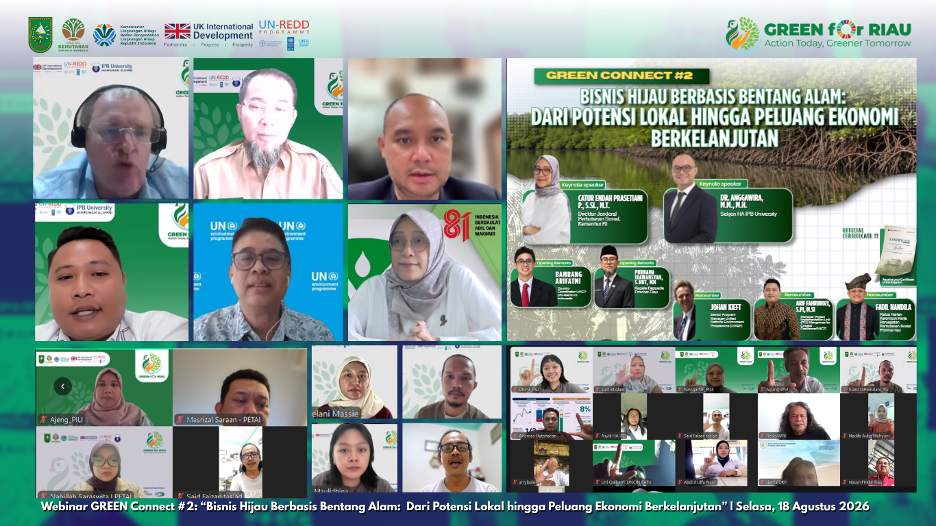
Pekanbaru, 18 August 2026 — GREEN for Riau continued its discussion series through GREEN CONNECT #2, titled “Landscape-Based Green Businesses: From Local Potential to Sustainable Economic Opportunities,” held online via Zoom Meeting.
The webinar brought together government representatives, the UNEP UN-REDD Programme, academics, practitioners, civil society organizations, and site-level actors to discuss green economic opportunities based on Riau’s local potential. The discussion covered customary forest ecotourism, Liberica coffee, community enterprises in mangrove areas, social forestry, environmental services, and green investment.
The event featured six speakers: Said Faizan Tas’ad, Head of the Customary Forest Management Institution of Kenegerian Petapahan; Riandra Hamdani, S.I.Kom., Program and Public Relations, Yayasan Gambut; Muhammad Arif Fahrurozi, S.Pi., M.Si., Manager of the Project Implementation Unit, Mangroves for Coastal Resilience (M4CR); Dr. Ir. Wiratno, M.Sc., IPU., Director General of Natural Resources and Ecosystem Conservation for the 2017–2022 period; Fadil Nandila, S.Pi., Executive Chair of the Riau Provincial Social Forestry Acceleration Working Group; and Johan Kieft, Senior Programme Manager at the United Nations Environment Programme (UNEP).
Connecting Conservation with Economic Opportunities
Bambang Arifatmi, Ph.D., Country Coordinator of the UNEP UN-REDD Programme in Indonesia, stated that Riau has significant natural capital to develop an economy that connects productivity, conservation, and community welfare.
Tropical forests, peatland ecosystems, and commodities such as sago, coconut, Liberica coffee, jelutung, honey, non-timber forest products, and various agroforestry products all have opportunities to be developed through more sustainable value chains.
According to Bambang, forests and peatlands should not be viewed as barriers to development, but as assets that must be protected to support long-term production and economic sustainability.
In her keynote speech, Catur Endah Prasetyani, P.S.Si., M.T., Director General of Social Forestry at the Ministry of Forestry of the Republic of Indonesia, emphasized that ecotourism, mangroves, Liberica coffee, and carbon should be seen as part of one landscape approach.
Community economic development must go hand in hand with the protection of ecological functions. In the context of carbon, she stressed that carbon trading is not the final goal, but one outcome of forest management that can improve community welfare while maintaining ecosystem sustainability.
The second keynote speaker, Dr. Anggawira, M.M., M.H., Secretary General of the IPB University Alumni Association, highlighted the importance of connecting Riau’s natural capital with business models, technology, financing, and markets.
According to him, economic opportunities do not only come from selling raw commodities or carbon credits. Added value can be built through product standardization, brand strengthening, technology, direct access to buyers, performance-based payments, and various forms of environmental financing.
Riau Encourages New Sources of Growth
Purnama Irawansyah, S.Hut., M.M., Head of the Regional Development Planning Agency (Bappeda) of Riau Province, stated in his remarks and official opening that Riau needs to continue expanding its sources of growth and regional revenue.
After many years in which Riau’s economy was largely supported by the oil, gas, and mining sectors, innovative financing opportunities from the environmental sector are now among the alternatives being developed.
Since 2024, the Riau Provincial Government has undertaken various preparations to utilize these opportunities, including through the development of REDD+ and carbon trading based on a jurisdictional approach.
From Customary Forests to Liberica Coffee
From the site level, Said Faizan Tas’ad shared the experience of developing ecotourism in Imbo Putui Customary Forest, Kenegerian Petapahan, Kampar Regency.
Its management is based on conservation, the involvement of Indigenous Peoples, and the protection of local values and traditions. Ecotourism has opened economic opportunities through guide services, equipment rental, traditional cuisine, handicrafts, and non-timber forest products.
These economic benefits also strengthen community incentives to maintain forest sustainability as the main asset for tourism activities.
From the peatland ecosystem, Riandra Hamdani highlighted opportunities for developing Liberica coffee. According to him, increasing the economic value of coffee does not depend only on production, but also on harvest and post-harvest quality, processing, packaging, and market access.
Liberica coffee can also be developed through an agroforestry approach on peatlands managed by communities. In addition to providing an additional source of income, active land management can help increase community attention to peatland conditions and reduce fire risk.
Mangroves and Social Forestry as Sources of Livelihood
Muhammad Arif Fahrurozi explained that mangrove-based businesses do not always have to involve products that directly use parts of mangrove plants.
Business development such as crab fattening, fisheries, livestock, and ecotourism can become alternative livelihood sources for coastal communities, reducing dependence on mangrove cutting.
According to him, business sustainability is also determined by market availability, sound bookkeeping, capacity strengthening, and facilitation for community groups.
Meanwhile, Fadil Nandila, S.Pi. emphasized that social forestry needs to move beyond merely granting access to manage forest areas.
Institutional strengthening, business capacity, financing, and cross-stakeholder support are needed so that social forestry groups can develop the economic potential of the areas they manage while maintaining forest functions.
Conservation that Benefits Communities
Former Director General of Natural Resources and Ecosystem Conservation, Dr. Ir. Wiratno, M.Sc., IPU., shared the experience of developing community-based ecotourism in Tangkahan, North Sumatra.
This experience shows that well-protected areas can provide direct economic benefits to communities through nature-based tourism activities.
He emphasized the importance of positioning communities as subjects in area management, respecting culture and local wisdom, and developing conservation based on science and collaboration.
Four Foundations for Green Investment Development
Closing the speaker session, Johan Kieft highlighted several prerequisites for local potential to develop into sustainable green enterprises and investments.
The discussion summarized four main foundations: good governance, economically viable businesses with markets, strong local institutions, and the ability to demonstrate real environmental and social impacts.
These four elements are needed so that various potentials such as Liberica coffee, ecotourism, mangroves, and forest-based enterprises can grow from local initiatives into stronger business models capable of accessing financing.
Developing a Landscape-Based Green Economy
GREEN CONNECT #2 showed that Riau has many entry points for developing a landscape-based green economy. Customary forests can support ecotourism, peatlands can support adaptive commodities such as Liberica coffee, mangroves can become a livelihood base for coastal communities, while social forestry and environmental services open space for enterprise development and new financing.
Through the GREEN for Riau Initiative, the Riau Provincial Government, together with the UNEP UN-REDD Programme and partners, continues to promote collaboration and knowledge exchange so that forest, peatland, and mangrove protection can go hand in hand with local economic development and improved community welfare.