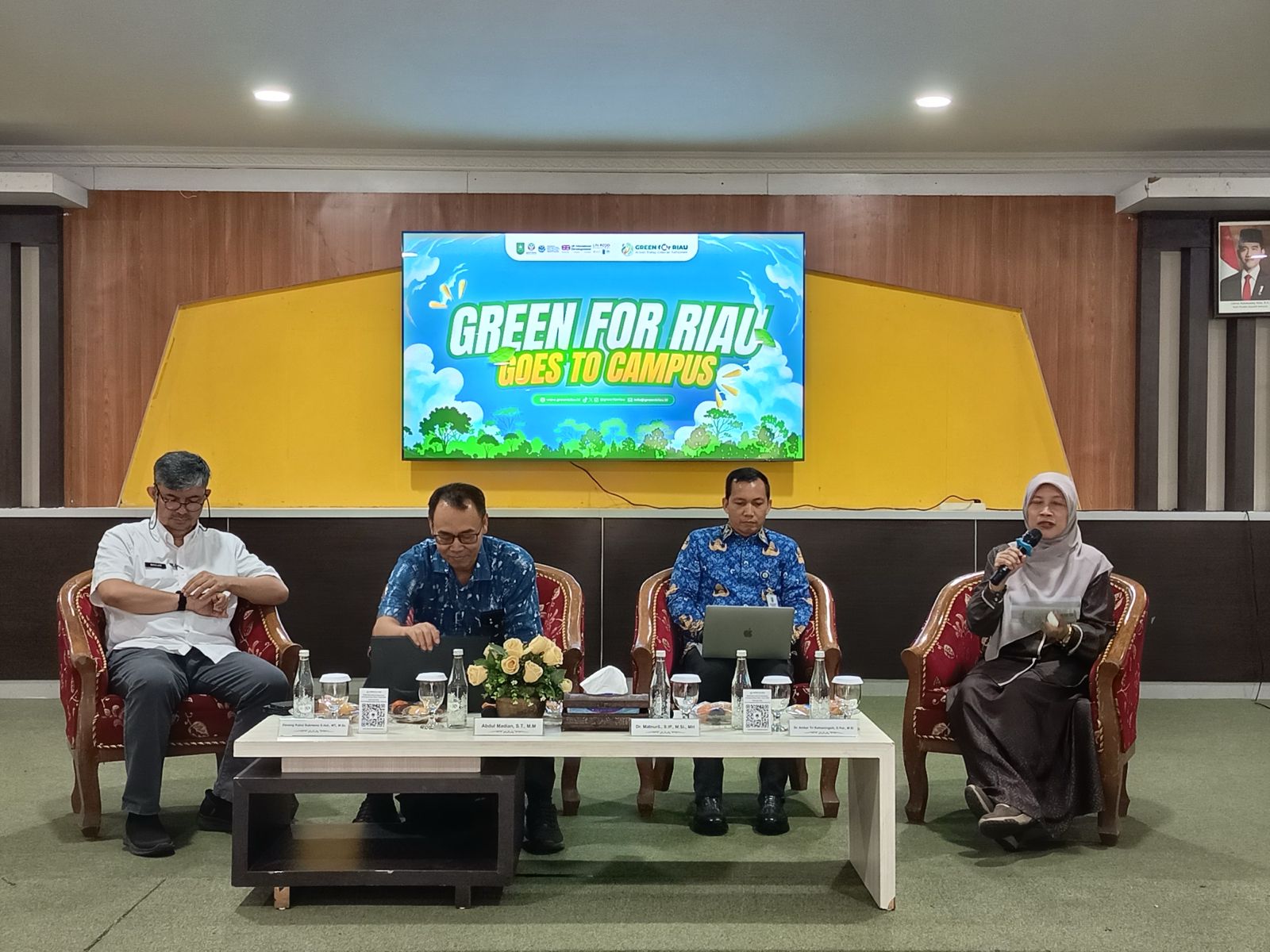
Pekanbaru, June 17, 2026 — The GREEN for Riau Initiative is expanding its collaboration with academics through the GREEN for Riau Goes to Campus program at Lancang Kuning University (Unilak) on Wednesday, June 17, 2026.
Themed "Understanding the REDD+ Approach and Its Implementation in Riau," this activity aims to introduce emission reduction strategies from the forestry and land sectors, while also encouraging university involvement in low-carbon development in Riau Province.
The public lecture was opened by Bambang Arifatmi, Ph.D., Country Coordinator of UNEP UN-REDD Programme Indonesia. In his remarks, he emphasized that the success of REDD+ implementation is determined not only by government policy, but also by the involvement of universities, communities, the private sector, the media, and civil society organizations in building transparent, inclusive, and sustainable forest governance.
The event was moderated by Dr. Ambar Tri Ratnaningsih, S.Hut., M.Sc., a lecturer at the Faculty of Forestry and Science, Lancang Kuning University. The forum featured four speakers who discussed REDD+ implementation from the perspective of regional development, forestry governance, climate policy, and the role of academics.
In the public lecture, Danang K.S., S.Hut., M.T., M.Sc., Provincial Coordinator of UNEP, explained that GREEN for Riau serves as a catalyst for the transformation of Riau Province's development. This initiative encourages a shift from a development model based on natural resource exploitation to a more restorative, sustainable approach that balances the economy, ecology, and community well-being.
Danang also explained that Riau has a strategic role in the climate change agenda due to its peat ecosystems and tropical forests with significant carbon reserves. However, the province also faces serious challenges, such as deforestation, forest degradation, land fires, and development pressures.
To address these challenges, GREEN for Riau promotes three main pillars: emissions reduction, community empowerment, and Through the GREEN for Riau Goes to Campus program at Lancang Kuning University, students are encouraged to understand REDD+ as a critical approach to supporting low-emission development, ecosystem restoration, and sustainable forest governance in Riau Province.. These three pillars are implemented through multi-stakeholder collaboration using a pentahelix approach, involving government, academia, communities, businesses, the media, and development partners.
According to Danang, universities play a crucial role in generating innovations, policy recommendations, and research that support evidence-based decision-making.
Meanwhile, Abdul Madian, S.T., M.M., Head of the Economic and Natural Resources Division of the Riau Provincial Development Planning Agency (Bappeda), highlighted the importance of integrating economic development with the climate change agenda. He explained that low-emission development does not mean inhibiting economic growth, but rather changing development methods to generate economic benefits while protecting the environment.
According to him, one of the biggest challenges facing local governments today is limited funding. Therefore, international funding mechanisms through carbon trading and REDD+ represent a strategic opportunity for Riau, one of which is the Jurisdictional REDD+ (JREDD+) scheme.
Dr. Matnuril, S.IP., M.Sc., M.H., Head of the Forest Planning and Utilization Division of the Riau Provincial Environment and Forestry Agency (DLHK), explained that the successful implementation of REDD+ requires the support of all stakeholders, including universities.
He believes that universities can contribute through ongoing research, public education, and monitoring the implementation of environmental policies. Student involvement should not stop at outreach activities, but can expand to include research, community mentoring, and the development of innovations that support increased carbon sequestration.
Matnuril also emphasized the importance of creating economic benefits without destroying forests. This can be achieved through the development of non-timber forest products, environmental services, ecotourism, and empowerment of communities surrounding forest areas.
Furthermore, Prof. Dr. Suwondo, Mitigation Action Plan Expert or STRADA GREEN for the Riau Initiative, emphasized that REDD+ implementation must be supported by a robust scientific approach. He explained that climate change is not simply an environmental issue, but rather a development challenge that requires synergy across disciplines.
Universities, he argued, have a responsibility to produce innovation, technology, and research that can support evidence-based policymaking.
Prof. Suwondo also emphasized that economic development and environmental protection are not incompatible. They can coexist if the entire development process takes environmental carrying capacity and sustainability principles into account.
He encouraged students to become agents of change through applied research capable of providing solutions to various environmental issues at the local and national levels.
Through the GREEN for Riau Goes to Campus program, it is hoped that more academics will understand the REDD+ approach, contribute to research and innovation, and become part of the transformation of forest governance towards a low-emission, competitive, and sustainable Riau Province.
The involvement of students and universities is crucial in ensuring that the green development agenda is not only understood as policy, but also translated into knowledge, innovation, and concrete action on the ground.
