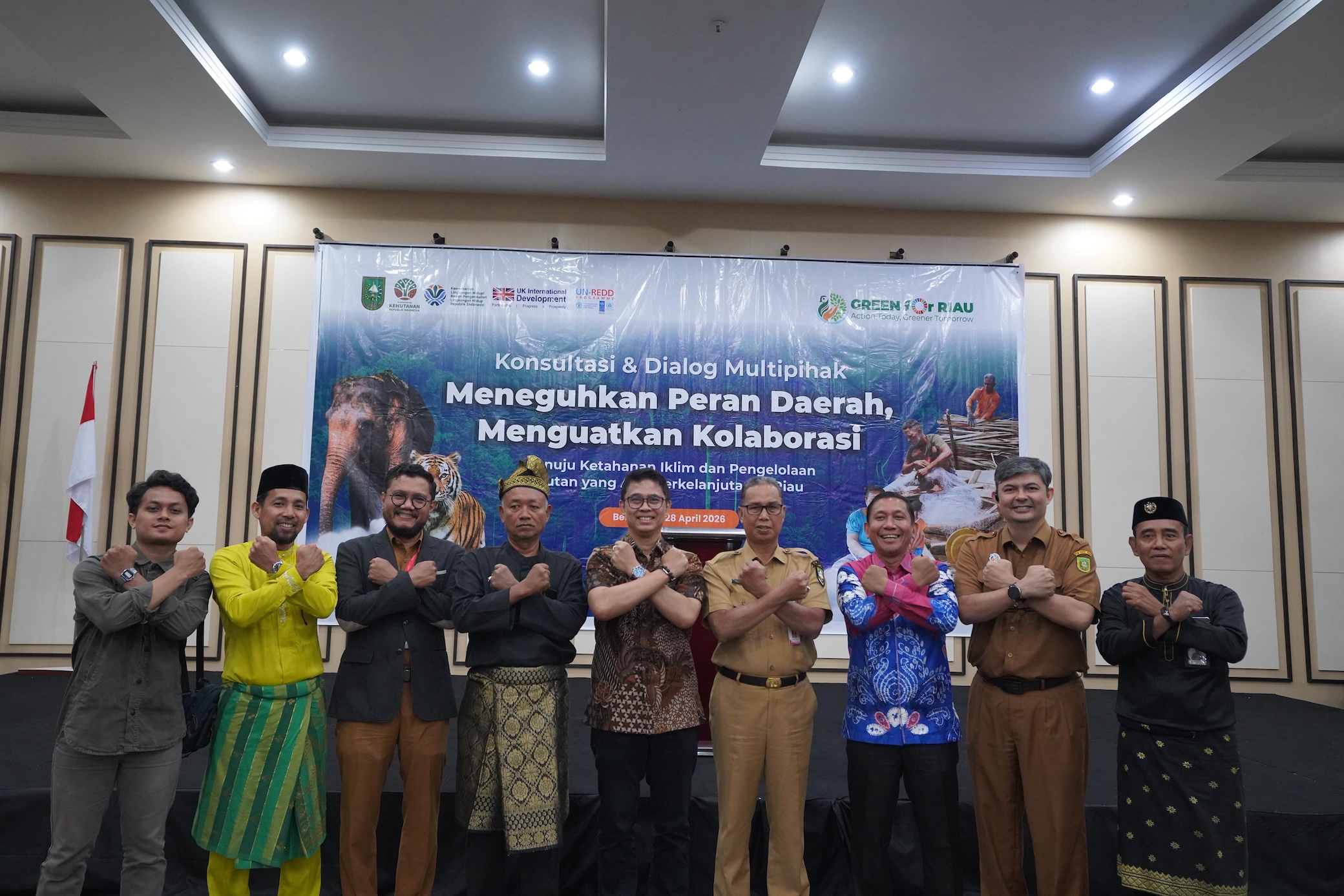
Bengkalis, April 28, 2026 – The GREEN for Riau Initiative once again strengthened multi-stakeholder coordination through a Multi-Stakeholder Dialogue for Bengkalis Regency, Dumai City, and Rokan Hilir Regency, held in Duri, Bengkalis Regency. This event provided a strategic dialogue platform for local governments, indigenous peoples, local communities, social forestry groups, civil society organizations, and development partners to support Riau Province's readiness for inclusive, transparent, and equitable implementation of Jurisdictional REDD+.
This meeting was part of a series of consultations and focused discussions conducted by GREEN for Riau at the district/city level. Through this forum, stakeholders from three coastal and peatland areas in Riau were invited to strengthen a shared understanding of GREEN for Riau's objectives and provide input on several key program components, from gender-based budget tagging and inclusive community participation to deepening and technical validation of the Feedback and Grievance Redress Mechanism (FGRM).
The event began with remarks from the Riau Provincial Government, represented by Mr. Abdul Madian, Head of the Economic and Natural Resources Division of the Riau Provincial Development Planning Agency (Bappeda). He emphasized that GREEN for Riau is a joint effort to reduce emissions from the forestry and land sector without neglecting the well-being of communities living around forest and peatland areas.
He also emphasized that climate change, rising temperatures, the potential for forest and land fires, and changing weather patterns have become real challenges for Riau. Therefore, protecting remaining forest and land cover requires an honest approach to data, attention to field conditions, and involving the community as a vital part of the solution.
Remarks were also delivered by representatives of the Dumai City Government, the Rokan Hilir Regency Government, and the Bengkalis Regency Government. The Dumai City Government, represented by Handayani, S.H., Expert Staff to the Dumai Mayor for Development, Information, Technology, Economics, and Finance, emphasized that sustainable green development is crucial for Dumai as a coastal area, peatland area, mangrove area, and industrial city. She also outlined the Dumai City Government's various efforts in flood control, peatland ecosystem protection, and peatland and mangrove education in educational institutions.
Meanwhile, the Head of the Rokan Hilir Regency Food Security and Agriculture Agency, Cicik Mawardi, emphasized the importance of finding common ground between environmental protection and improving the community's economy. He stated that local communities need to be involved as the vanguard in preserving nature, especially in peatland and coastal areas that face ecological challenges and are economically dependent on certain commodities.
The Bengkalis Regency Government, through H. Toharuddin, S.H., M.Si., Assistant II of the Bengkalis Regency Government, expressed its support for GREEN for Riau. He emphasized that the commitment to environmental protection should not stop at discussion forums, but must be followed up through concrete steps and consistent collaboration between the government, the community, and all stakeholders.

GREEN for Riau as a Space for Multi-Stakeholder Collaboration
In his presentation, Bambang Arifatmi, Country Coordinator of UNEP UN-REDD Programme Indonesia, explained that this program is a follow-up to the launch of GREEN for Riau on May 8, 2025, in Pekanbaru. It aims to support Riau Province in benefiting from greenhouse gas emission reduction efforts, particularly from mitigation activities in the forestry and land sector.
He emphasized that the success of GREEN for Riau depends heavily on leadership from the central, provincial, and district/city governments, as well as collaboration between stakeholders. A pentahelix approach is crucial to ensure that the government, indigenous peoples, local communities, the private sector, academics, research institutions, civil society organizations, and development partners can work together in a unified manner.
He also emphasized that GREEN for Riau must be implemented inclusively, involving indigenous peoples, local communities, women, people with disabilities, and other vulnerable groups. Furthermore, a sense of ownership from the Riau Provincial Government and the Riau community is key to the program's sustainability after technical support from development partners has ceased.
Gender-Based Budget Marking and Strengthening Governance
In the first parallel session, participants from local government elements discussed the gender-based budget marking process. This session was facilitated by Rizky Rachmawati who was directed at strengthening local government capacity in seeing the relationship between planning, budgeting, gender inclusion and climate change mitigation actions. Gender-based budget marking is an important instrument for ensuring that low-emission development programs and activities are not only administrative, but can also be traced in their contribution to social benefits, equal access and community resilience. Regional governments are expected to be able to identify budget support that is relevant to climate action, environmental protection, and empowering affected community groups.
Inclusive Community Participation
The second parallel session focused on inclusive community participation in GREEN for Riau. This session involved representatives of sub-district governments, traditional communities, local communities, social forestry groups, as well as NGOs/NGOs from Bengkalis Regency, Dumai City and Rokan Hilir Regency.
Expert on Indigenous Peoples and Local Communities, Himyul Wahyudi, emphasized that the involvement of indigenous peoples and local communities needs to be carried out from the planning stage to implementation. According to him, the community not only needs to be a recipient, but also part of the decision-making process, especially when the program relates to areas of life, forests, sources of livelihood information, and the social history of the community.
In this session, participants also shared understanding and perspectives of indigenous peoples and local communities. Several representatives said that GREEN for Riau was intended as an effort to protect forests, restore the environment, and ensure that communities around the forests could benefit fairly.
This session was facilitated by Susanto Kurniawan and Ramaidi Azani as social forestry experts. The discussion was directed at exploring the experiences, challenges and aspirations of the community and social forestry groups in protecting forest and peat areas, as well as strengthening their role in green development in the region.

In-depth and Technical Validation of the FGRM Module
In the afternoon session, participants took part in technical in-depth and validation of the FGRM Module facilitated by Anwar Rosyadi. This is important in ensuring that GREEN for Riau has a feedback and complaint handling mechanism that is clear, easily accessible, transparent, and responsive to community needs.
FGRM is needed to ensure that every input, complaint, or potential problem that arises in program implementation can be received, recorded, followed up, and resolved through accountable procedures. This mechanism is also part of strengthening safeguards, so that the implementation of REDD+ in Riau can run with social and environmental precautionary principles.
Through this technical validation, participants can provide input on the flow, instruments and complaints handling approaches to suit the regional context, including the conditions of indigenous peoples, local communities, social forestry groups and local governments at the site level.
Towards an Inclusive and Fair REDD+ Implementation
This forum re-emphasizes the importance of collaboration between the provincial government, district/city governments, communities and development partners in strengthening Riau's readiness towards implementing Jurisdictional REDD+.
Through this activity, GREEN for Riau not only strengthens technical understanding regarding emission reduction, but also opens up space for dialogue for the community and local government to ensure that the low-emission development process runs inclusively, transparently, and provides real benefits for the community.
With the involvement of Bengkalis Regency, Dumai City, and Rokan Hilir Regency, GREEN for Riau is expected to further strengthen the foundations of forest and peatland governance in Riau's coastal areas, as well as encourage green development that protects the environment, strengthens climate resilience, and places communities as the main actors of change.