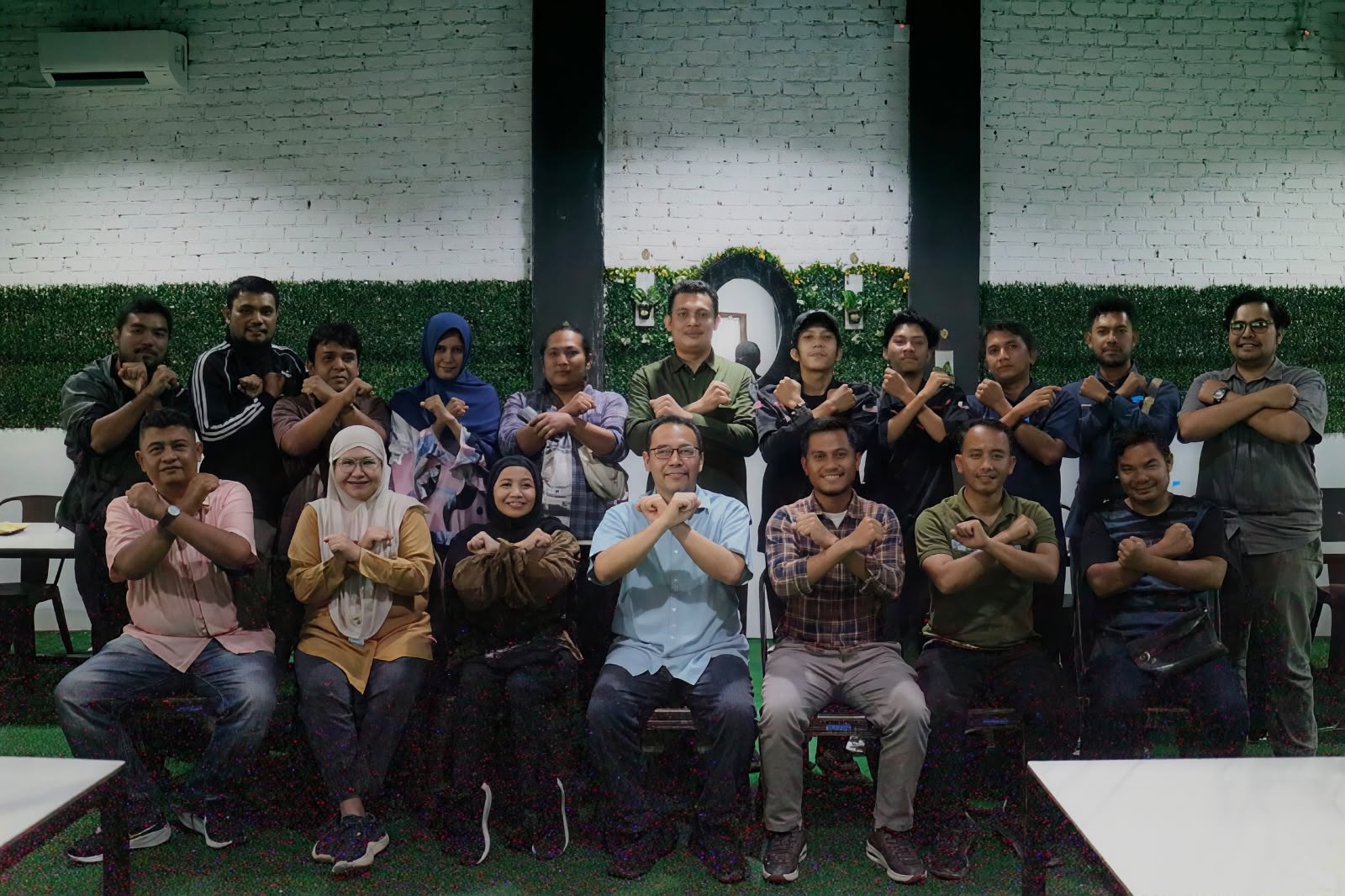
Pekanbaru, July 7, 2026 — The GREEN for Riau Initiative held the "GREEN for Riau Media Roundtable" coffee gathering as a space for dialogue with media personnel in Riau Province.
This event aims to strengthen understanding and dissemination of information regarding sustainable natural resource management, ecosystem restoration, and Riau Province's readiness for jurisdiction-based REDD+ implementation.
The event, which took place on Tuesday, July 7, 2026, at Kopi Radjo Se Nusantara, Pekanbaru, provided a momentum to build closer communication between the program, local government, and the media. The forum also served as a platform for sharing information on the overall direction of the GREEN for Riau Initiative, the challenges of landscape management in Riau, and the strategic role of the media in promoting public information transparency.
The event began with remarks from Bambang Arifatmi, Country Coordinator of UNEP UN-REDD Programme Indonesia. In his remarks, Bambang emphasized that green development cannot be carried out by one party alone. He stated that the media plays a crucial role in shaping public opinion, strengthening accountability, and encouraging public participation in natural resource management and low-carbon development issues.
“Green development must be designed and implemented by various parties. The media plays a crucial role in building public memory, strengthening accountability, and encouraging public participation. Therefore, we need to create a space for open, honest, and constructive dialogue so that the green development vision can be effectively communicated to the public,” Bambang said.
Also speaking was Abdul Madian, Head of the Natural Resources and Economic Division of the Riau Province Regional Development Planning Agency (Bappeda). He explained that GREEN for Riau is a jurisdiction-based REDD+ program that adopts international standards, so its implementation requires a shared understanding, media support, and the involvement of all stakeholders down to the grassroots level.
"The GREEN for Riau Initiative is a new program with international standards. This is certainly not an easy task, so it requires the support of the media and all stakeholders, right down to the grassroots level. This program also has a strategic objective: to open up alternative funding opportunities outside the national and regional budgets (APBN) so that the benefits can be directly felt by the community and stakeholders," said Madian.
GREEN for Riau as a Catalyst for Landscape Transformation
Following the welcoming session, the event continued with a presentation on the GREEN for Riau Initiative by Danang Kabul Sukresno, Provincial Coordinator of GREEN for Riau. In his presentation, Danang explained that GREEN for Riau is a strategic initiative to strengthen Riau Province's readiness to implement jurisdiction-based REDD+ with high integrity.
This initiative rests on three main pillars: emissions reduction, community empowerment, and ecosystem restoration. These three pillars serve as a crucial foundation for transforming Riau's landscape governance from an extractive approach to a more restorative, inclusive, and equitable one.
Riau Province plays a crucial role in achieving Indonesia's climate targets. With an administrative area of approximately 9.02 million hectares, a forest area of approximately 5.41 million hectares, and a Peat Hydrological Unit of approximately 4.97 million hectares, Riau is a key region in efforts to reduce emissions from the land-based sector.
Furthermore, Riau also faces various ecological and socioeconomic challenges, including deforestation, peat degradation, forest and land fires, tenure conflicts, and pressure on wildlife habitats. This situation highlights the importance of stronger, collaborative, adaptive, and data-driven landscape governance.
Through the GREEN for Riau Initiative, the Riau Provincial Government, together with the Government of Indonesia, the UK Foreign, Commonwealth & Development Office (UK-FCDO), and the UN-REDD Programme, technically led by UNEP and supported by the FAO, is strengthening regional readiness for jurisdiction-based REDD+ implementation.
This initiative is a collective action aimed at strengthening forest and land use governance, strengthening forest monitoring systems, establishing transparent benefit-sharing mechanisms, developing social and environmental safeguards, and designing sustainable financing.
STRADA REDD+ as a Roadmap for Regional Mitigation Action
The forum also presented a presentation on the Riau Province REDD+ Regional Strategy by Prof. Dr. Suwondo, M.Sc., Mitigation Action Plan (MAP) Expert for the GREEN for Riau Initiative.
The REDD+ STRADA is a crucial part of the REDD+ architecture because it serves as a roadmap for implementing mitigation actions at the regional level, particularly during the pre-investment phase.
The Riau REDD+ action plan focuses on six main agendas:
- Controlling land expansion and conversion;
- Improving community welfare and livelihood alternatives;
- Resolving tenure conflicts;
- Controlling land conversion;
- Strengthening forest and land governance and planning;
- Improving forest management at the grassroots level.
Through this activity, the media is expected to gain more comprehensive information regarding the development of GREEN for Riau, the jurisdiction-based REDD+ concept, and the role of the REDD+ STRADA in supporting the implementation of mitigation actions in Riau Province.
This forum also serves as a space to build a common understanding of the program's key messages, so that information disseminated to the public can be more accurate, balanced, and educational.

Media as a Strategic Partner in GREEN for Riau
The role of the media in GREEN for Riau is not only seen as part of information dissemination, but also as a crucial strategy for strengthening transparency, participation, and public accountability.
The media plays a crucial role as a public educator, dialogue facilitator, social monitor, and promoter of green economic practices and sustainable natural resource management.
With its broad reach through print, online, radio, television, and digital platforms, the media can help translate complex issues such as REDD+, the Economic Value of Carbon, ecosystem restoration, Article 6 of the Paris Agreement, carbon markets, nature-based solutions, and low-carbon development into information that is more easily understood by the public.
The media is also expected to highlight various good practices at the grassroots level. Stories about communities protecting forests, managing land sustainably, developing green businesses, and building resilience to climate change deserve greater space in public reporting.
At the same time, the media plays a crucial role in voicing the perspectives of indigenous peoples, local communities, women, and vulnerable groups. These perspectives need to be presented so that the implementation of GREEN for Riau is inclusive, equitable, and truly benefits the communities living alongside forests and peat ecosystems.
"The media plays a crucial role as a liaison between programs, the government, communities, and other stakeholders. Through informative, valid, and balanced reporting, the public can understand why sustainable forest and land management is a crucial part of Riau's future," was the key message conveyed at this event.
In addition to serving as a platform for information sharing, the "GREEN for Riau Media Roundtable" also served as a platform for identifying public communication needs, gathering input from media personnel, and exploring opportunities for further collaboration to strengthen the Green Riau narrative.
GREEN for Riau emphasized that program success is measured not only by the development of documents or the implementation of activities, but also by the tangible benefits experienced by the community. This includes indigenous peoples, women's groups, vulnerable groups, youth, and local communities living around forests and peat ecosystems.
With multi-stakeholder collaboration, including media support, GREEN for Riau is expected to become a catalyst for transforming landscape governance in Riau Province. This initiative is also expected to strengthen Riau's contribution to achieving national climate targets, particularly the 2030 FOLU Net Sink, while bridging the climate finance gap and accelerating low-carbon development in the region.