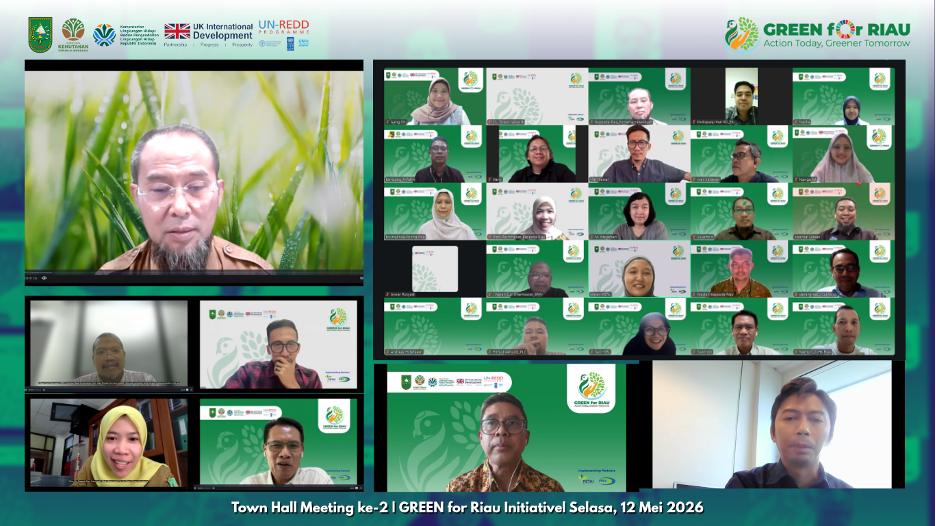
Pekanbaru, May 12, 2026 — The GREEN for Riau Initiative held its second Town Hall Meeting online via the Zoom Meeting platform on Tuesday, May 12, 2026. The Town Hall Meeting is a regular, open consolidation meeting that brings together local governments, experts, implementing partners, and development partners to update progress, identify challenges, and align steps toward Riau's readiness for jurisdiction-based REDD+ implementation.
In his remarks, Bambang Arifatmi from UNEP/UN-REDD stated that GREEN for Riau is not merely a technical project, but rather an initiative owned by the Riau Provincial Government and the Riau community. He emphasized two key values of this initiative: encouraging transformation of landscape, forest, and peatland governance, and serving as a platform for integrating various stakeholders. According to Bambang, GREEN for Riau is expected to strengthen trust between stakeholders, expand cross-actor collaboration, and ensure that inclusion issues, including gender and vulnerable groups, are accommodated in the planning and implementation processes. This program is also said to have significant reach for 12 regencies/cities in Riau, 13 Forest Management Units (KPH), hundreds of villages, indigenous communities, and the peat ecosystem landscape, which is one of the province's key ecological characteristics.
He also highlighted the importance of GREEN for Riau in the context of forest and land fire prevention, biodiversity protection, and strengthening climate finance governance. Bambang expressed his hope that GREEN for Riau could become a national example for an innovative approach that not only pursues carbon credits but also social, economic, ecological, and governance benefits for communities and regions.
One of the main agenda items at this meeting was a discussion of Minister of Forestry Regulation No. 6 of 2026 concerning Procedures for Carbon Trading through Greenhouse Gas Emission Offsets in the Forestry Sector. GREEN for Riau Policy and Legal Expert, Andreas A. Hutahaean, emphasized that this regulation needs to be understood within the framework of harmonizing central and regional policies, especially following the issuance of Presidential Regulation 110 of 2025, which strengthens the national carbon market ecosystem.
According to Andreas, this new policy has important implications for aligning the climate agenda and economic growth, strengthening the recognition of international standards, integrating carbon registries, and enhancing the role of local governments in jurisdiction-based REDD+ implementation. He also highlighted the importance of the nesting mechanism to prevent overlapping carbon claims, double counting, and potential conflicts between government and private projects. Furthermore, other key areas that need to be strengthened include action plans, MRV and data capacity, budget and institutional support, and local community participation. Safeguards and benefit-sharing issues must also be strengthened to ensure that the benefits of carbon trading are received fairly and do not trigger social conflict, particularly in indigenous communities and social forestry areas.
Meanwhile, Suwondo, an expert from STRADA REDD+ Riau, reported that the development of the Riau Province REDD+ Regional Strategy document has now entered the initial draft review stage and will be strengthened through technical consultations related to safeguards, MRV, funding, and nesting. This document is targeted for public consultation and ratification in June 2026.
During the nesting and data collection session, Muis Fajar explained that most of the conceptual work has already been completed, including the development of a nesting rulebook, which is currently undergoing review. Muis also explained that the development of nesting in Riau is currently focused on operationalizing scenarios, including alignment with existing projects such as ecosystem restoration and concession-based projects. Regarding data, Muis stated that data collection from Technical Implementation Units (UPT) and Forest Management Units (KPH) still needs to be strengthened. Most of the data already submitted is dominated by planning documents, while data on field implementation, such as patrol reports and evidence of activity implementation, remains crucial to strengthen the integrity of emission reduction claims.
Stakeholder Engagement and Community Development are also important areas of focus. A more structured stakeholder engagement strategy needs to be developed, not only to convey information but also to ensure that communities, local governments, NGOs, social forestry groups, and indigenous communities are fully involved in the decision-making process.
In the Indigenous Peoples and Local Communities session, discussions highlighted the complexities of indigenous and local community identities in Riau, limited data, low trust in past projects, and the need for information delivery that is more appropriate to local languages and contexts. This issue is considered crucial because the success of jurisdictional REDD+ depends heavily on the recognition, respect, protection, and fulfillment of the rights of indigenous and local communities.
The forum also discussed developments in social forestry (SF), including the institutional challenges of SF groups, the development of RKPS (Regional Work Plans), group readiness to access financing, and opportunities for integrating SF into REDD+ schemes. The discussion highlighted the need for mentoring and support to better prepare them for participation in benefit schemes and land-based mitigation activities.
Regarding forest and land fire prevention, Ati Dwi Nurhayati presented on the progress of information gathering related to human activities causing fires in Riau, prevention strategies, response protocols, early warning and early detection systems, and plans to develop forest and land fire training modules.
In the FGRM session, Anwar Rosyadi presented the progress of the development of the basic guidelines for the complaints mechanism. He explained that feedback from activities in Duri and Bangkinang indicated that some participants still had limited knowledge of national complaint channels such as SP4N-LAPOR. Therefore, the GREEN for Riau complaints mechanism needs to be designed to be easy to understand, accessible, and not confusing for communities at the grassroots level.
The next session discussed strategies for accelerating jurisdictional REDD+ implementation by I Wayan Susi Dharmawan. He emphasized that the main challenge in the near future is demonstrating measurable, credible, and verifiable emission reductions. Therefore, all supporting documents and instruments, from data, safeguards, benefit sharing, FGRM, to institutions, need to be interconnected and not work in isolation.
Riko Wahyudi from RCCC UI then presented the progress of the benefit sharing mechanism development. He stated that two main documents are currently being prepared: the guidelines and the Benefit Sharing Plan. However, the development of these documents still relies heavily on clarity regarding the nesting approach, scenarios, area, credit potential, and safeguards and MRV design. Riko emphasized that benefit sharing needs to be built on a clear foundation, starting with the identification of beneficiaries, the form of benefits, allocation, distribution, and use of funds. In the Riau context, this mechanism needs to ensure fair, transparent, and accountable distribution of benefits to communities that contribute to forest protection and management.
From a human rights perspective, Rosmalinda stated that a Human Rights Due Diligence (HDR) and human rights risk analysis are being prepared for jurisdictional REDD+ intervention areas. This process includes mapping tenure issues, conflicts, vulnerable groups, and potential rights violations. The results will form the basis for developing a human rights action plan and risk mitigation as a preventative measure to ensure REDD+ implementation aligns with national safeguards and international standards.
The meeting also discussed the development of budget tagging by Rizky Elin from the Riau Regional Development Planning Agency (Bappeda). Data collection has expanded from the provincial to the district/city level, although there is still a need for improvements in data collection, location, and alignment with future systems. Budgeting issues are crucial because jurisdictional REDD+ requires long-term funding support, not solely relying on grants or external technical support.
On the public communications side, Iwan Setiawan presented the development of the GREEN for Riau information system and website. The website reportedly now contains a variety of content, including news, articles, podcasts, and Knowledge Management Center documents. He also noted that user engagement and search visibility have begun to show improvement since the website's launch.
Media partner Green Radio Line also presented the development of the GREEN for Riau podcast. By the time of the forum, several episodes had been produced and will continue to be developed as part of the public communications strategy. This podcast is expected to serve not only as documentation of activities but also as a means of public education regarding REDD+, forest governance, indigenous communities, social forestry, and Riau's agenda towards low-carbon development.
Closing the forum, the Head of the Riau Regional Development Planning Agency (Bappeda), Purnama Irawansyah, expressed his appreciation for all parties involved in the process of developing various jurisdictional REDD+ instruments. He emphasized that the identified challenges need to be translated into concrete solutions to support the implementation of green and low-emission development in Riau Province. Bambang added that key documents requiring approval or having political implications need to undergo a third-party review process before being submitted to public consultation. This stage is considered crucial to maintain the credibility of the substance before the documents are used as a basis for further implementation.
Madian from the Riau Regional Development Planning Agency (Bappeda) also noted that much of the work is still in progress. He highlighted the importance of unifying complaint channels, aligning budget tagging data with systems and maps, and establishing mechanisms to facilitate future system use by local governments.
From UN-REDD, Muharrom Efrian expressed his appreciation for the significant achievements achieved in such a short time. However, he cautioned that the process of achieving international standards, including ART-TREES, requires consistency between documents, policies, and field practices. He stated that human rights, safeguards, benefit sharing, and community participation must be operationally proven, not merely conceptualized.
Bambang reiterated the importance of program sustainability after technical support from international partners ends. He stated that program ownership must be firmly vested in the Riau Provincial Government. Therefore, strengthening champions within the local government, establishing permanent institutions, and cross-regional working mechanisms are prerequisites for GREEN for Riau to continue after the technical assistance phase concludes.
The Town Hall Meeting concluded with an affirmation that all components of the Riau REDD+ architecture need to continue to be consolidated toward the consultation, review, and document approval stages in the coming months. The next forum is planned to be held on June 2, 2026, as part of a regular agenda to ensure the GREEN for Riau process is collaborative, measurable, and inclusive.