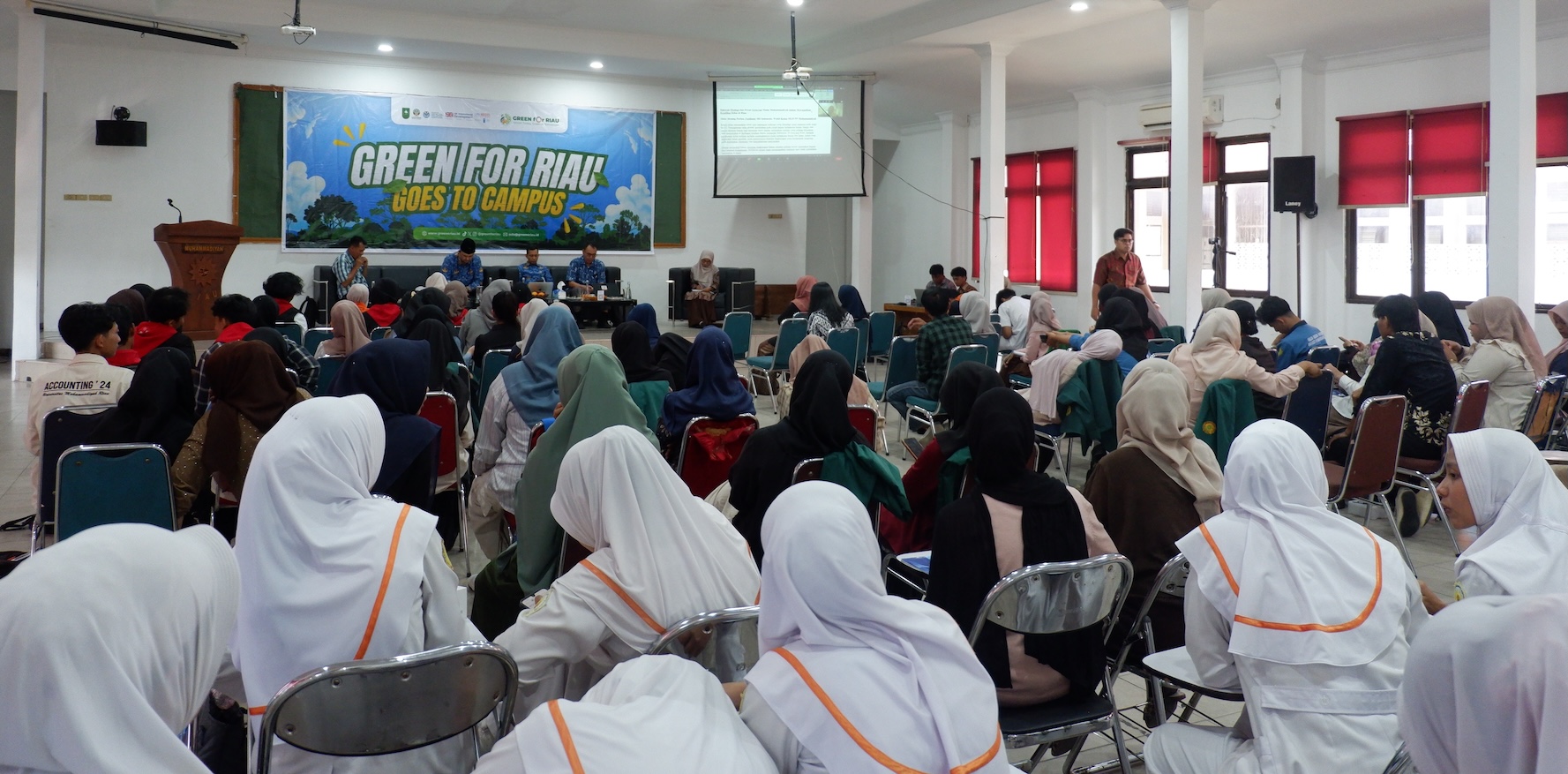
Pekanbaru, Riau – Muhammadiyah University of Riau (UMRI) and the GREEN for Riau Initiative held a public lecture titled "REDD+ Approach and Its Implementation in Riau Province" to increase the younger generation's understanding of climate change, sustainable forest management, and the opportunities for sustainable jurisdictional carbon in supporting low-carbon development in Riau Province. The event was held at the Muhammadiyah Riau Regional Leadership Office Hall on Jalan Kyai Haji Ahmad Dahlan, Pekanbaru. The event was organized by the Peat and Mangrove Study Center under the leadership of Mr. Aidil Haris and attended by UMR's Vice Rector II.
Attended by students, academics, local government officials, and environmental practitioners, the event provided a forum for discussion to strengthen multi-stakeholder collaboration (pentahelix) in addressing the challenges and issues of climate change while promoting sustainable development. As a province with extensive tropical forest and peat ecosystems, Riau plays a strategic role in efforts to reduce national emissions and protect biodiversity.
The event opened with remarks from the UNEP UN-REDD Country Coordinator, represented by Dr. Masrizal Saraan, S.Hut., M.Si. (Director of PETAI). The event was then officially opened by Dr. Aidil Haris, S.Sos., M.Si., Head of the Peat and Mangrove Study Center. Also in attendance was Dr. Widat Irma, SPd., MSi., Deputy Head of the Peat and Mangrove Study Center.
In his remarks, the Vice Rector of UMRI, Dr. Aidil Hasri, emphasized that environmental protection is a shared responsibility that requires the involvement of the government, academia, the private sector, and the community. He stated that universities play a crucial role in building awareness and capacity among the younger generation to be part of the solution to today's environmental problems.

UNEP Provincial Coordinator, Danang Kabul Sukresno, explained that GREEN for Riau was developed as a collaboration hub to support sustainable landscape governance through forest, peat, and mangrove protection, greenhouse gas emission reduction, and community welfare improvement. The REDD+ approach opens opportunities for Riau to link preservation and conservation efforts with access to performance-based climate funding and the carbon economy.
Meanwhile, Abdul Madian from the Riau Regional Development Planning Agency (Bappeda) explained that low-carbon development is part of regional development. He stated that the successful implementation of various environmental programs requires cross-sector collaboration, as well as support from innovative financing sources that can strengthen environmental protection and sustainable development efforts in the region.
In the next session, Dr. Matnuril from the Riau Environment and Forestry Agency (Dinas LHK) explained the importance of forest conservation as one of the main solutions to addressing climate change. He encouraged students to understand that emission reduction depends not only on government policies but also on behavioral changes and concrete community actions in protecting the environment.
GREEN for Riau Expert, Prof. Suwondo explained the development of carbon trading policies in Indonesia, which are increasingly opening up opportunities for regions to benefit from forest and land protection efforts. He stated that Riau's potential is enormous, but it must be supported by transparent governance, credible data, and a robust monitoring system so that the resulting social and economic benefits can contribute to environmental conservation and community well-being.
The presentation was closed by Mrs. Wening Parlan, Director of Eco Bhineka Muhammadiyah, who provided in-depth insights into REDD+ from a religious perspective. She emphasized the need for the academic community to play a role as agents of change in environmental improvement, as taught by Islamic values.
In addition to listening, participants also actively participated in the discussion sessions, exchanging experiences and perspectives between speakers and participants. High enthusiasm was evident from the nature conservation organization (Mapala) and the UMR academic community, who expressed serious interest in the GREEN for Riau Program. They committed to supporting the program's implementation when the time comes. Even more interesting, several students in attendance had previously participated in the Folunet Sink 2030 program and activities of Riau Province. This experience significantly helped other participants understand the substance of the GREEN for Riau Program more quickly and comprehensively.
The warm, interactive, and meaningful event concluded with a souvenir exchange between the speakers and the organizers, and a group photo was captured with all participants.
A joint formulation was reached regarding the GREEN for Riau Initiative as a strategic and innovative program for environmental conservation based on climate change mitigation, particularly in peat management and mangroves in Riau Province.
