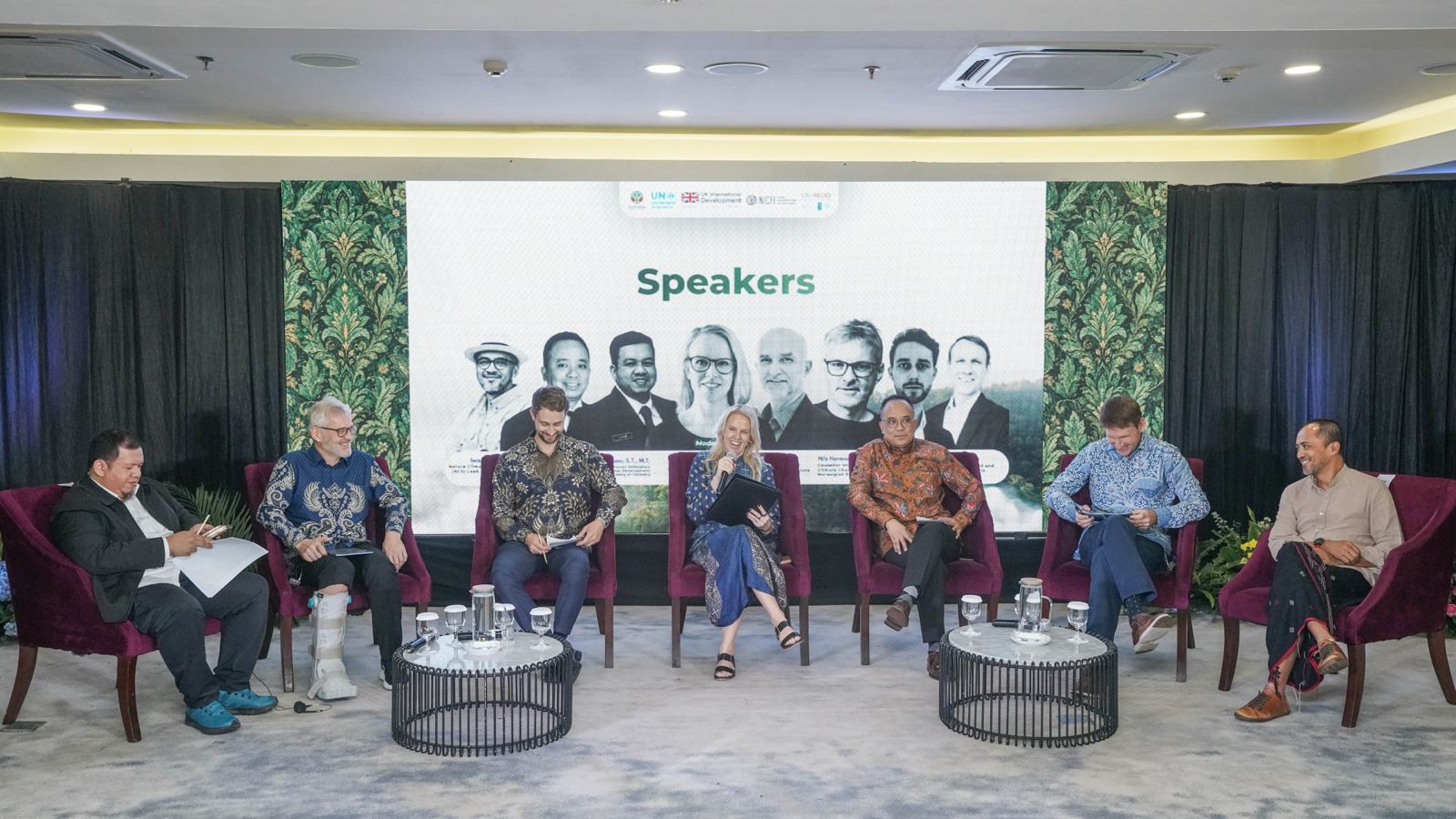
Jakarta, May 26, 2026 — The Ministry of Forestry, through the Directorate of Forest Utilization Business Development, Directorate General of Sustainable Forest Management, in collaboration with the UNEP UN-REDD Programme, held the National Forest Carbon Market Workshop: Enabling JREDD+ Transactions through Legal and Policy Framework at Mangkuluhur ARTOTEL Suites, Jakarta. This forum provided a multi-stakeholder dialogue platform to discuss the direction of strengthening Indonesia's forest carbon market following the issuance of Minister of Forestry Regulation Number 6 of 2026 concerning carbon trading through offset mechanisms in the forestry sector.
The workshop brought together representatives from the central and regional governments, development partners, international institutions, carbon market associations, the private sector, academics, civil society organizations, and carbon market players. The goal was to strengthen stakeholders' understanding of the latest regulatory framework and discuss Indonesia's strategic steps in accelerating and optimizing opportunities for a credible, transparent, and highly integrated jurisdictional-based REDD+ (JREDD+) carbon market.
The UN Resident Coordinator's Office representative, Matthew David Johnson-Idan, stated that Indonesia has made significant progress in strengthening the national carbon market framework. The next challenge is translating this framework into credible trade transactions. He emphasized three key elements: regulatory clarity, integrity in practice, and tangible benefits for communities. He stated that the carbon market can function well if buyers, investors, project developers, local governments, and communities have confidence in the rules, registry system, MRV, safeguards, and accounting mechanisms implemented.
Peter Rajadiston, Minister Counsellor for Development for Indonesia, Timor-Leste, and ASEAN, British Embassy, emphasized that clear, transparent, and predictable regulations are crucial for making Indonesia's forest carbon market attractive to investment. He encouraged the acceleration of nesting operations through practical and consistent ministerial guidance. He stated that success is determined not only by technical systems but also by trust, namely fair benefit sharing, clear and consistently implemented rules, and the involvement of all stakeholders.
The UK government supports various initiatives in Indonesia, such as the GREEN for Riau (UN-REDD) program, UK PACT for carbon pricing, and AIM for Forest for the development of forest monitoring systems. The shared goal is to build a carbon market with integrity, resulting in real emissions reductions, protecting forests and peatlands, and providing direct benefits to local communities.
Laksmi Wijayanti, Director General of Sustainable Forest Management, emphasized that carbon trading is a crucial instrument to support the achievement of Indonesia's climate and forestry targets. She emphasized that the carbon market must operate with high integrity, transparency, and equitable benefit distribution. The JREDD+ approach is considered a bridge between voluntary and mandatory carbon market mechanisms. Bambang Arifatmi, Country Coordinator of the UN-REDD Programme in Indonesia, added that a credible forest carbon market is not only about tons of emissions reduced, but also about governance, accountability, safeguards, and measurable benefits for communities. Regulation is the starting point; the real crucial factor lies in Indonesia's ability to translate regulations into technical procedures, institutional coordination, transparent data systems, and credible transactions.
From a global market perspective, Gabriel Labbate of UNEP highlighted Indonesia's significant opportunities through various mechanisms, including Article 6.2, CORSIA, and the voluntary carbon market. He emphasized that the global market is increasingly selective. Buyers are not only looking for credit volume, but also ensuring that the purchased carbon credits are high quality, low risk, and supported by robust jurisdictional accounting and nesting systems.
The Director of Forest Utilization Business Development, Ilham, S.T., M.T., emphasized that the development of Indonesia's forestry carbon market is not only aimed at opening transaction opportunities but also at ensuring that every carbon credit generated is of high quality and integrity. Indonesia is currently at a crucial phase in shifting from policy readiness to transaction readiness, the phase when policy frameworks begin to be translated into technical procedures, institutional coordination, and credible market mechanisms.
Ilham said that Indonesia has very ambitious mitigation targets, including the restoration of 12 million hectares of critical or degraded land, protection of around 50 million hectares of natural forests as part of emission avoidance efforts, strengthening 8.3 million hectares of social forestry, and recognizing 1.4 million hectares of existing forests. This target is closely linked to the development of forest carbon projects and requires strong financial support and collaboration from various stakeholders.
"Indonesia is open to various schemes, not only voluntary carbon markets, but also nesting, result-based payments, and Article 6," said Ilham. "Forest carbon development must adhere to the principles of additionality, community involvement, benefit sharing, biodiversity protection, safeguards, and FPIC. These principles are essential for Indonesia's carbon credits to meet high integrity standards and be accepted by the international market."
During the panel session, Björn Fondén, a representative from the International Emissions Trading Association (IETA), stated that Indonesia has opportunities from three main sources of demand: international voluntary buyers, Article 6, including CORSIA, and domestic demand through emissions trading. He also emphasized the importance of clarity regarding fee structures, benefit sharing, and the interoperability of national registries with international standards and registries.
Nils Hermann-Ranum from the Norwegian Embassy assessed that Indonesia already has many important foundations in place, including political commitment, a legal framework, and technical capacity. However, he emphasized the need to strengthen transparency, align baselines, nesting frameworks, registries, safeguards, and consistent policies across sectors to ensure the credibility of Indonesia's carbon credits is not eroded by deforestation risks or policy misalignments.
From the perspective of international buyers, Brian Dusza of the Emergent/LEAF Coalition stated that Indonesia has great potential to become one of the world's leading markets for high-integrity carbon credits. However, buyers need regulatory certainty, transparency, a predictable approval process, a robust MRV (Return to Value) system, a credible registry, and safeguards to prevent double counting. He also emphasized the importance of tangible benefits for local and indigenous communities as an indicator of carbon credit quality.
The Chairman of the Indonesian Carbon Trade Association, Dr. Riza Suarga, highlighted Indonesia's advantages in forestry governance, including a sustainable forest management audit system and the certainty of long-term concession terms. He believes this can be crucial for ensuring permanence. He also emphasized the need for regulatory certainty, clarity of levies or taxes, and strengthening the transaction ecosystem for sustainable carbon trading.
From a conservation perspective, Iwan Wibisono of Konservasi Indonesia emphasized the importance of a clear and measurable nesting framework, baseline alignment, safeguards, and benefit sharing as the foundation for high-quality and high-integrity emission reductions. also warned that Indonesia must avoid falling into the "perfection trap," where efforts to build an overly perfect system actually hinder practical implementation on the ground.
This workshop emphasized that Indonesia's forestry carbon market requires more than just transaction readiness. It requires a reliable system capable of ensuring social and environmental integrity, transparent governance, protection of community rights, and equitable benefit sharing. For Indonesia, the development of JREDD+ is a crucial strategy for linking mitigation actions at the grassroots and regional levels with national and global climate targets and international climate finance.
Through this national workshop, the Ministry of Forestry, along with UNEP UN-REDD Programme and partners, emphasized the importance of multi-stakeholder collaboration in building a credible, accountable, and high-integrity forest carbon market. With the support of policies and regulations, strengthening MRV, registries, safeguards, and coordination between the central and regional governments, as well as the global carbon market, Indonesia is expected to take on a more strategic role in the global carbon market, while ensuring that its benefits benefit communities, the environment, and the global climate.
