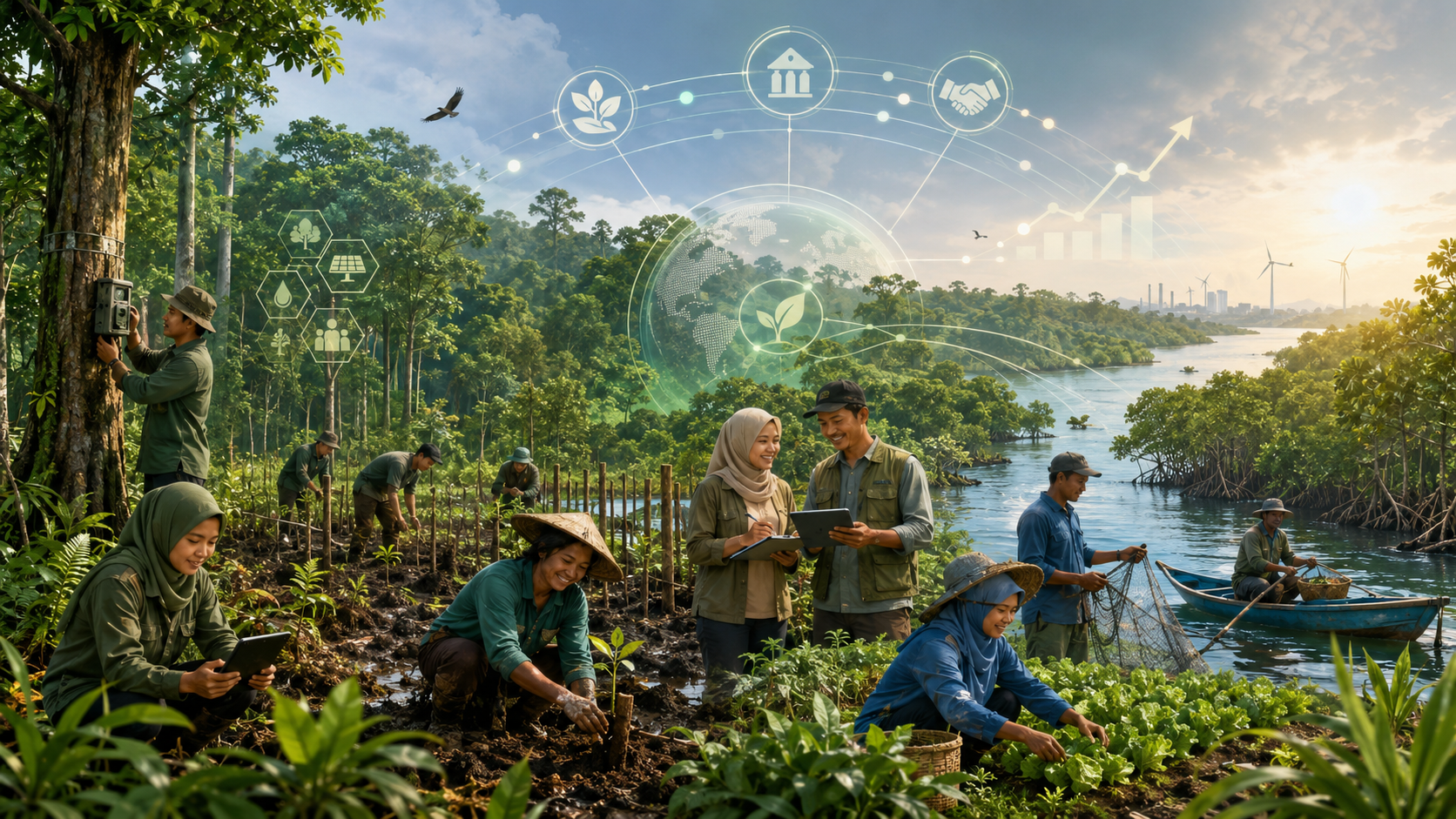
Riau Province is strategically positioned to support the achievement of Indonesia's national climate targets, particularly through its role in managing forests and land, peat and mangrove ecosystems, and other land-use sectors. However, Riau also faces highly complex structural challenges, ranging from ongoing deforestation and forest degradation, recurring forest and land fires, to limited access to adequate climate finance.
These challenges underscore the need for a transformational approach to accelerate the transition to sustainable, integrated, adaptive, and long-term green landscape management.
The GREEN for Riau Initiative is designed as a strategic vehicle to bridge the climate finance gap at the provincial and district levels. This initiative also serves as a catalyst for inclusive regional economic development, while encouraging local leadership in the low-emission development agenda.
GREEN for Riau integrates jurisdiction-based REDD+ approaches, fire prevention, ecosystem restoration, and local economic empowerment into a single, innovative investment framework that is bankable, credible, measurable, and sustainable.
1. Bridging the Climate Finance Gap in Riau
The climate finance requirement to achieve the 2030 FOLU Net Sink target in Riau Province is substantial, estimated at at least IDR 11.3 trillion. This funding is needed to support the implementation of 12 FOLU operational plans, including forest and land fire control, peat restoration, sustainable forest management, social forestry, sustainable forest management, and strengthening data systems and institutions in Riau.
Currently, the capacity of the national budget (APBN), regional budgets (APBD), and conventional public funding schemes remains limited. Meanwhile, the availability of global climate finance continues to increase, both through bilateral and multilateral funds, philanthropy, and private investment. However, these various funding sources have not been fully absorbed and effectively connected to needs at the regional level.
In this context, GREEN for Riau serves as an integrative platform capable of:
- Consolidating climate financing needs across sectors and regions into a single program framework;
- Aligning regional strategic interventions with climate finance standards and results-based financing;
- Increasing investor and development partner confidence through strengthened governance, transparency, inclusiveness, and measurable performance.
With these functions, GREEN for Riau serves as a bridge between regional development priorities and national and global climate finance flows.
2. Impact on Regional Economic Development
GREEN for Riau is designed to provide multiplier effects for regional economic development. This initiative not only provides environmental benefits but also opens up new, more sustainable economic opportunities.
Green investments in sustainable landscape management contribute to the creation of green jobs in various fields, such as sustainable forest management, fire prevention, ecosystem restoration, environmental monitoring, social forestry, and natural resource management.
Furthermore, GREEN for Riau can also increase the productivity of forest and land-based economic sectors by reducing the risk of fires, deforestation, and forest and land degradation. With more manageable environmental risks, economic activities for communities and businesses can be more stable and sustainable.
In the long term, this initiative also strengthens Riau Province's attractiveness as a prime destination for green investment in Indonesia, in line with the trend of low-carbon economic development.
At a macro level, efforts to prevent fires and reduce forest and land degradation can reduce economic losses due to haze disasters, healthcare costs, production disruptions, and logistical bottlenecks. Thus, GREEN for Riau contributes to the stability of the region's long-term economic growth.
3. Backward and Forward Linkages of the Green Economy
GREEN for Riau has strong structural linkages with various other economic sectors.
From a backward linkage perspective, this initiative drives increased demand for forestry and environmental technical and consulting services, high-resolution geospatial and satellite-based monitoring technology, fire early warning systems, MRV systems, financing services, community assistance, and capacity building.
This opens up opportunities for local businesses, MSMEs, financing institutions, research institutions, technology providers, and knowledge- and innovation-based service providers.
Meanwhile, forward linkages are emerging through improving the sustainability of downstream sectors such as agriculture, plantations, forestry, fisheries, and the bioeconomy. Well-managed landscapes can improve business certainty, production quality, access to financing, and market access.
This is increasingly important as the global market increasingly requires high standards of sustainability, traceability, and environmental integrity. Therefore, GREEN for Riau serves as a catalyst for cross-sectoral green economy integration at the regional level.
4. Impact on Social Issues and Inclusiveness
Forest fires and forest and land degradation have significant social impacts, particularly on public health, education, local livelihoods, and vulnerable groups.
GREEN for Riau adopts a landscape-based and community-based mitigation approach, including Indigenous Peoples and Local Communities (IP/LC). This approach is expected to contribute to reducing health risks and educational disruptions due to haze, strengthening sustainable livelihoods at the local level, and mitigating social conflicts related to forest and land management.
This initiative also mainstreams the principles of Gender Equality, Disability, and Social Inclusion (GEDSI) by ensuring the meaningful participation of women, vulnerable groups, persons with disabilities, indigenous peoples, and local communities.
This inclusive approach not only strengthens the program's social legitimacy but also enhances the sustainability of results at the ground level.
5. GREEN for Riau as an Impact Investment Platform
From the perspective of investors and funding partners, GREEN for Riau offers a strong value proposition.
First, more manageable risks through a jurisdictional approach, transparency, clear governance, and a structured and integrated data and information system.
Second, measurable impacts, including reduced greenhouse gas emissions from peat decomposition, reduced fire risk, increased ecosystem resilience, and strengthened social welfare.
Third, blended finance opportunities, which combine public funds, results-based financing, philanthropy, and private investment.
Fourth, scalability, as this model has the potential to be replicated in other regions with similar ecological, social, and economic contexts.
By positioning environmental interventions as a regional development asset, GREEN for Riau enables public and private investors to contribute to climate goals while supporting inclusive local economic growth.
6. Policy Direction
GREEN for Riau is a strategic vehicle to bridge the climate finance gap while driving inclusive economic and social transformation in Riau Province.
By integrating climate, economic, and social welfare agendas, this initiative has the potential to become a model of sustainable development best practice that supports the achievement of the 17 Sustainable Development Goals (SDGs).
Based on local knowledge, regional leadership, community participation, and high standards of integrity, GREEN for Riau can provide tangible benefits to the people of Riau, particularly indigenous peoples and local communities.
Furthermore, this initiative can also make a significant contribution to national and global climate targets. Riau has the opportunity to demonstrate that economic development, forest and peatland protection, emission reduction, and improving public welfare can all proceed in a single, mutually reinforcing transformation.
Author:

Bambang Arifatmi
- Country Coordinator UNEP UN-REDD Indonesia
- Head of Applied Green Economy Innovation, HA IPB
Disclaimer: This article represents the author's personal views and opinions and does not necessarily reflect the official views, policies, or positions of GREEN for Riau and its implementing partners.