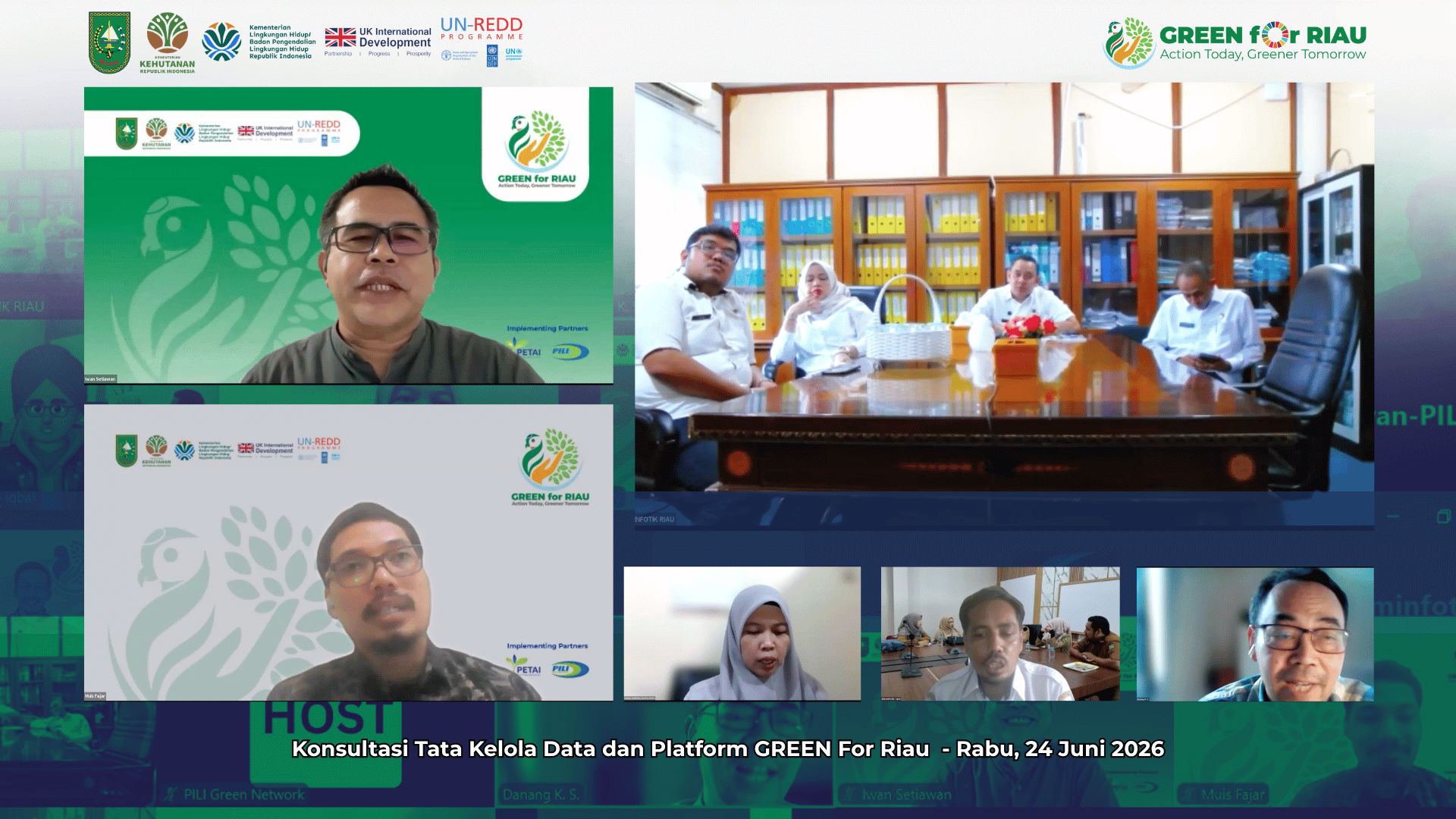
Pekanbaru, June 24, 2026 — The GREEN for Riau Initiative held a consultation forum on data governance and platform operationalization to strengthen the foundation for data management, the development of the GREEN for Riau Platform, and the implementation of Jurisdictional REDD+ (JREDD+) in Riau Province.
This forum provides a space to align roles, responsibilities, and coordination mechanisms among the involved agencies. This alignment is key to efficient, effective, transparent, and sustainable data and platform management.
The consultation forum brought together agencies directly involved in data governance and platform operations at the provincial level, including the Riau Provincial Development Planning Agency (Bappeda), the Riau Provincial Environment and Forestry Agency (DLHK), and the Riau Provincial Communication, Informatics, and Statistics Agency (Diskominfotik).
The discussion focused on developing a data governance framework, platform development needs, operational aspects, and long-term financing schemes. The forum also served as a forum to agree on a cross-agency coordination mechanism to ensure more focused data management for GREEN for Riau.
In his presentation, Iwan Setiawan, an IT System Development Expert, explained that the platform being developed is not simply a website, but rather a jurisdiction-based REDD+ governance instrument to ensure program transparency.
According to him, the GREEN for Riau Platform serves as a shared workspace for cross-agency coordination, data exchange, and program monitoring. He also emphasized that the platform's sustainability requires clarity on system ownership, data management, data sharing mechanisms, and future financing schemes.
"What we're building is more than just a website; it's actually an instrument for REDD+ jurisdictional governance. This platform is a collaborative tool for cross-agency coordination, inter-agency data exchange, and program monitoring," said Iwan.
Next, Muis Fajar, an Expert in Nesting Development, Database Management, and REDD+ Governance, presented the progress of data collection for the 2022–2026 monitoring and crediting period.
He stated that of the approximately 124 data requirement lists distributed to relevant agencies, 87 have been completed. This achievement is considered sufficient to compile a TREES Registration Document (TRD), but insufficient as a basis for compiling a TREES Monitoring Report (TMR) due to the lack of activity documentation.
"This data is sufficient to compile a TRD, but it's not sufficient to be used as a basis for a TMR because much of the data related to activity documentation is still incomplete," Muis explained.
Muis also encouraged the classification of data access that differentiates between public, internal, and confidential or restrictive categories. This classification needs to be complemented by a Standard Operating Procedure (SOP) for information disclosure so that the disclosure and restriction of access to information can be implemented consistently.
In response to the presentation, Abdul Madian, Head of the Economic and Natural Resources Division of the Riau Province Regional Development Planning Agency (Bappeda) and the GREEN for Riau Secretariat, highlighted that some of the unavailable data still originates from internal agencies.
He proposed a short-term solution in the form of renting server services until at least December 2027 to avoid a platform operational downtime. Madian also emphasized the need for a clear SOP for reporting and complaint channels to prevent overlapping responsibilities between agencies.
A representative from the Riau Province Communications and Informatics Office (Diskominfotik) expressed full support for the operationalization of the GREEN for Riau Platform, while also noting the current limitations of server capacity. He stated that system integration is technically possible, but requires clear data classification and adequate budgetary and human resource support.
This note is crucial to ensure that additional operational burdens on local government servers can be implemented without disrupting existing services.
M. Iqbal Ramli from the Riau Province Communications and Informatics Office added that some data could actually be accommodated through the Riau Province One Data framework, as stipulated in the Governor's Regulation. Meanwhile, Lielie Embas from the Riau Province Communications and Informatics Office explained that statistical data is already available in the data house, while spatial data is managed through a geoportal. Both have the potential to be integrated with the GREEN for Riau Platform.
She added that all data to be integrated must first go through a verification and validation mechanism to maintain its quality and accuracy.
As the primary data producer and validator in the forestry sector, Sandra from the Riau Province Environment and Forestry Agency (DLHK) acknowledged that there is still a significant amount of data that needs to be completed. She conveyed the DLHK's commitment to follow up on data needs with the Forest Management Units (KPH) and the Social Forestry Agency.
Sandra also requested that a more specific list of data needs be submitted to the DLHK so that the follow-up process can be more focused and efficient.
Irfan Kemal, Safeguards Expert, emphasized that transparency must be a key principle in data and platform management. However, he underscored the importance of sorting out data deemed sensitive or confidential.
Currently, the safeguards team is developing an information disclosure protocol as a guideline for disclosing or restricting access to information.
"One of the principles that must be prioritized is transparency, but there must still be a filtering process for data deemed sensitive or confidential," said Kemal.
Through this consultation forum, GREEN for Riau aims to obtain input to strengthen the sustainability of data management and platform operations. Some of the identified needs include the development of standard operating procedures (SOPs) and a data governance framework for GREEN for Riau, the development of platform features, and strengthening operational aspects, maintenance, and long-term financing.
These needs will serve as a shared reference for all agencies involved in data management, information system development, and the implementation of jurisdiction-based REDD+ in Riau Province.
Going forward, strengthening data governance and the operationalization of the GREEN for Riau Platform is expected to be the backbone of the GREEN for Riau Initiative. With a more structured, integrated, and accountable data system, Riau Province is expected to be increasingly prepared to realize jurisdiction-based REDD+ that is credible, inclusive, and measurable, and provides tangible benefits to communities and the environment.