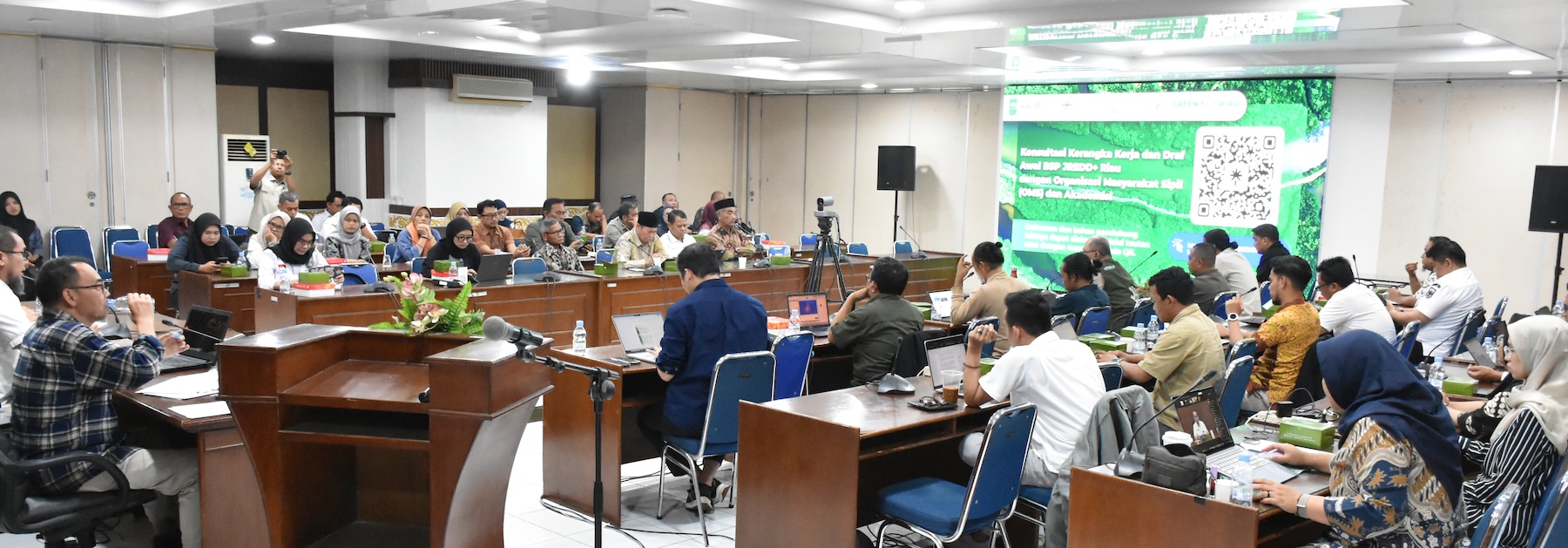
Pekanbaru, 23 September 2026 — The Riau Provincial Government, together with GREEN for Riau, held a consultation on the framework and initial draft of the Riau JREDD+ Benefit Sharing Plan (BSP) with civil society organizations (CSOs) and academia. The forum gathered input on who should be eligible to receive benefits, how contributions should be assessed, and how funds should ultimately be distributed in a fair and accountable manner.
The consultation formed part of a series of discussions with different stakeholder groups. In his opening remarks, Head of Bappeda Riau Province, Purnama Irawansyah, S.Hut., M.M., emphasized that the size of the area and the number of parties involved require an inclusive process. He linked the development of the BSP to the principle of “no one left behind”: those who protect forests, are affected by the programme, or support its implementation need to have space in the discussion.
Danang Kabul Sukresno, Provincial Lead of GREEN for Riau, stated that the experience of CSOs and academia is needed to enrich the BSP design. Their inputs are expected to cover social and environmental conditions on the ground, in addition to technical aspects of land governance.

In presenting the initial draft, the BSP expert explained that the proposed benefit-sharing mechanism remains open for refinement. The principles discussed included effectiveness, efficiency, fairness, transparency, and accountability. The draft also distinguishes direct contributions to emission reductions from supporting roles, such as community facilitation and capacity building.
A number of participants highlighted the need for clearer recognition of Indigenous Peoples, local communities, villages, and social forestry groups. Participants requested that their contributions to forest protection, including those that began long before carbon programmes, be reflected in the criteria and allocation of benefits. There were also proposals to clarify the position of villages and prevent overlapping calculations of contributions in social forestry partnership areas and permit-holder areas.
 CSO representatives questioned the provisional allocation for civil society organizations and universities, and proposed that the differences in their roles be taken into consideration. Track records in community facilitation, the capacity of local organizations, and the need for initial support for groups that lack resources also emerged as key points in the discussion. One participant proposed that carbon funds could serve as a “trigger fund” to attract additional financing support.
Participants from religious organizations offered to play a role in public education and the dissemination of forest protection messages through their networks. Other inputs emphasized the practical application of gender equality, disability, and social inclusion principles in both decision-making processes and the use of funds.
The forum also discussed institutional options for fund distribution, including the possibility of strengthening institutions in Riau. Participants requested that the selected mechanism create space for local organizations to grow while also meeting fund management and accountability requirements.
In response to the various views expressed, the drafting team explained that the allocation percentages in the initial draft are not yet final decisions. Proposed changes need to be discussed with all stakeholder groups. Inputs from this consultation will be used to refine the BSP, including the detailed beneficiary criteria and implementation procedures.
