
Pekanbaru, Riau, 4 March 2026 — Forest monitoring holds the key in efforts to reduce emissions from deforestation and forest degradation (REDD+) in countries like Indonesia, home to the world’s third largest tropical forest. At the heart of it is a Measurement, Reporting and Verification (MRV) mechanism to accurately calculate the amount of forest carbon emission and its changes over time.
At this front, Indonesia’s Riau province holds a critical contribution with its almost five million hectares of carbon-rich peatland. Riau is poised to become one of the first provinces to access REDD+ international financing, rewarded based on measurable emission reductions to fund local climate action. Reliable MRV systems, then, have become a necessity for the province.
Food and Agriculture Organization of the United Nations (FAO) is supporting the provincial government of Riau in strengthening its MRV systems and capacity under the UN-REDD programme’s GREEN for Riau initiative. This support includes a comprehensive series of capacity-building workshops, covering from the governance to the technicalities of the MRV mechanism, jointly held by Riau province and FAO between August and December 2025.
A phased approach to building MRV readiness
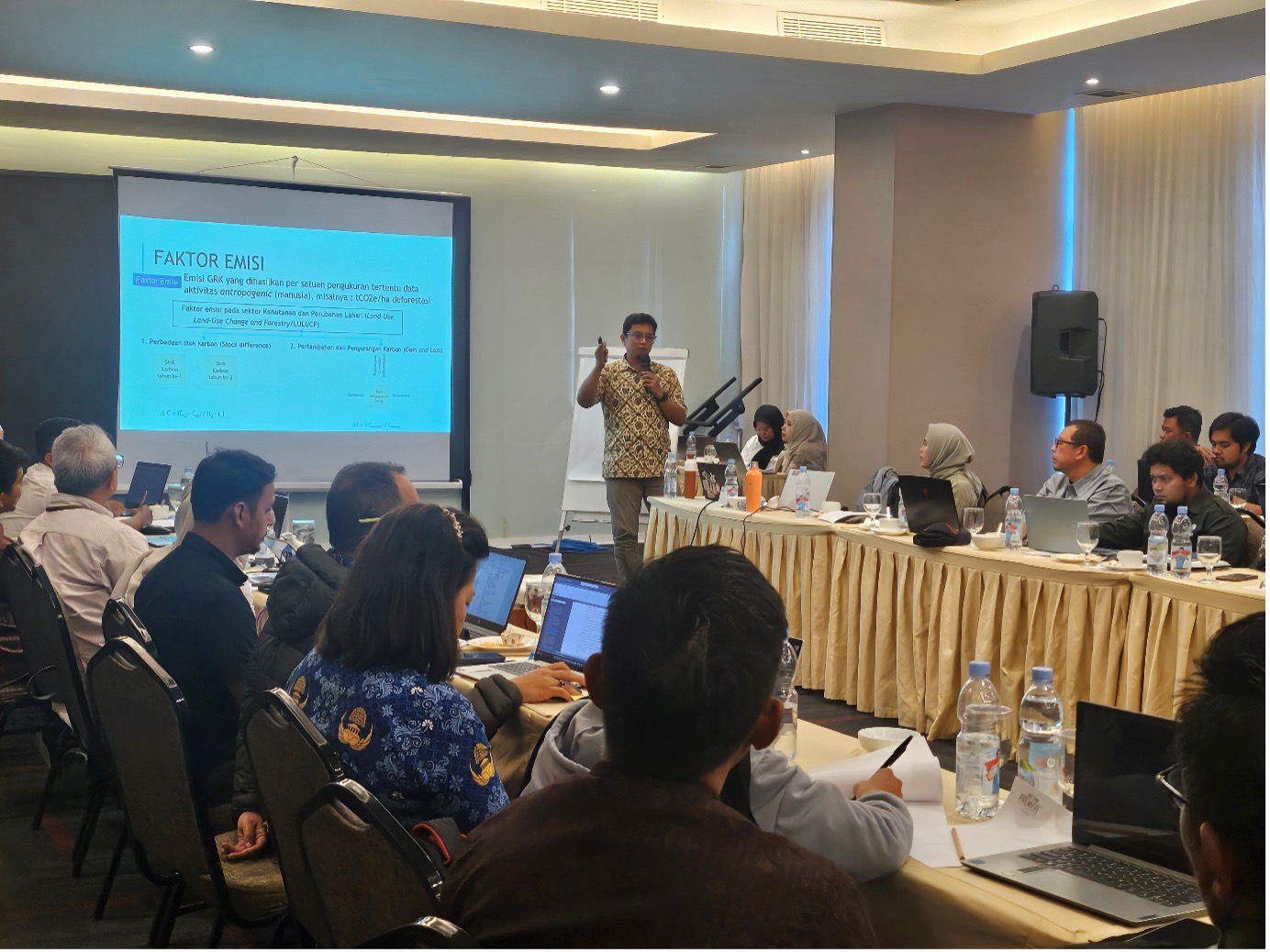
Workshop participants gained both conceptual understanding and practical skills to strengthen Riau’s Measurement, Reporting and Verification (MRV) systems, such as on institutional readiness, activity data analysis, and emission factor development. (FAO/Eny Lestari)
The capacity-building series was designed as a step-by-step learning process by addressing key components in developing MRV systems: governance and institutional frameworks, activity data analysis, and emission factors.
Institutional readiness and policy alignment lay the foundation for developing and implementing an MRV mechanism. The first workshop gathered stakeholders from the government, academia, private sector, and non-government organizations to explore MRV governance structures at both national and sub-national levels on 21 and 22 August 2025.
Discussions during the workshop emphasized the need for two key actions. First, Riau should integrate MRV systems and the REDD baseline Forest Reference Emission Levels (FREL) into regional development planning, including aligning them with Riau’s long-term development strategies. Second, it should establish a coordinated provincial MRV team, potentially formalized under a Governor Decree, to ensure stronger cross-sectoral coordination and data harmonization.
Building on the institutional foundation, the second workshop shifted the focus to enhancing technical capacity in activity data analysis. Participants took part in hands-on Geographic Information System (GIS) exercises to detect land cover changes, calculate affected areas, and analyze emissions from peat decomposition and peat fires in line with the Intergovernmental Panel on Climate Change (IPCC) guidelines. The training also highlighted the importance of transparency, accuracy, completeness, consistency, and comparability (TACCC) principles, as well as alignment between sub-national and national datasets.
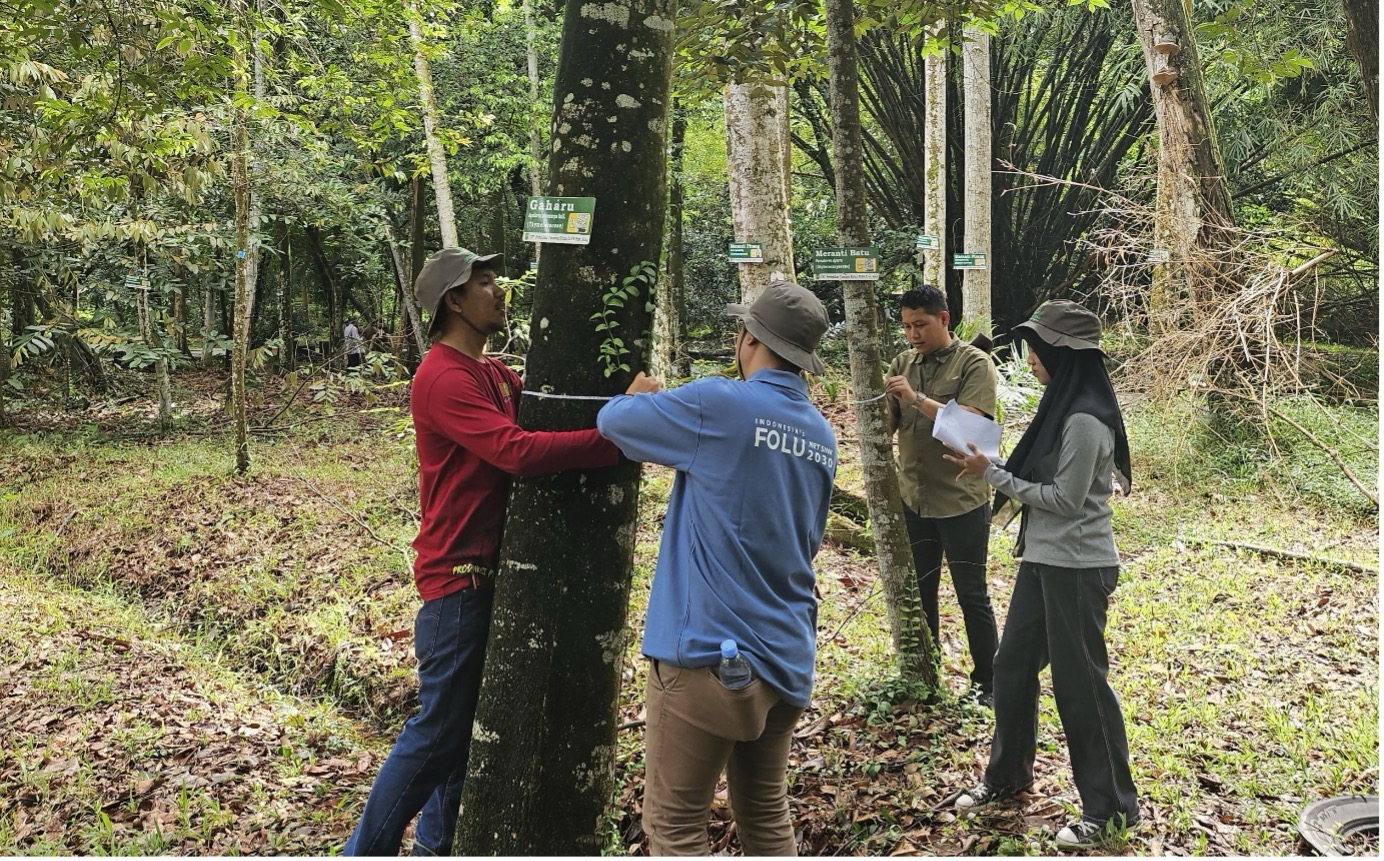
Workshop participants learned to establish vegetation plots and collect real data for carbon stock analyses during a field exercise in Pekanbaru city forest on 18 December 2025. (FAO/Eny Lestari)
The final workshop then deepened technical expertise in emission factor development. Emission factors are important in calculating a carbon footprint as they represent the quantity of emissions released from a certain activity or process. During the workshop, held on 16-18 December 2025, participants were trained to derive emission factors from field data, calculate carbon stock, and assess uncertainties in data activities. Field exercises conducted in Pekanbaru city forest enabled participants to establish vegetation plots and collect real data for carbon stock analyses. The workshop also introduced advanced methods such as the Monte Carlo simulation to improve confidence in MRV results and addressed common challenges in satellite-based land cover analysis.
Strengthening technical and institutional capacity
During the workshops, key provincial institutions such as the Regional Development Planning Agency (Bappeda), the Environment and Forestry Service (DLHK), and other relevant agencies were formally endorsed as the GREEN for Riau MRV Team. Participants from these institutions were able to gain both conceptual understanding and practical skills throughout the training. The series emphasized that building a credible MRV system requires not only strong technical knowledge but also institutional coordination, consistent methodologies, and transparent documentation.
The workshops also facilitated knowledge exchanges with national experts from the Ministry of Forestry, Ministry of Environment, IPB University and Riau University, as well as lessons learned from similar projects on results-based payment implemented in other Indonesian provinces, such as East Kalimantan and Jambi. These insights are critical as Riau ramps up efforts to meet subnational climate targets and explore opportunities for results-based payments and participation in international carbon markets.
Strategic importance for Riau
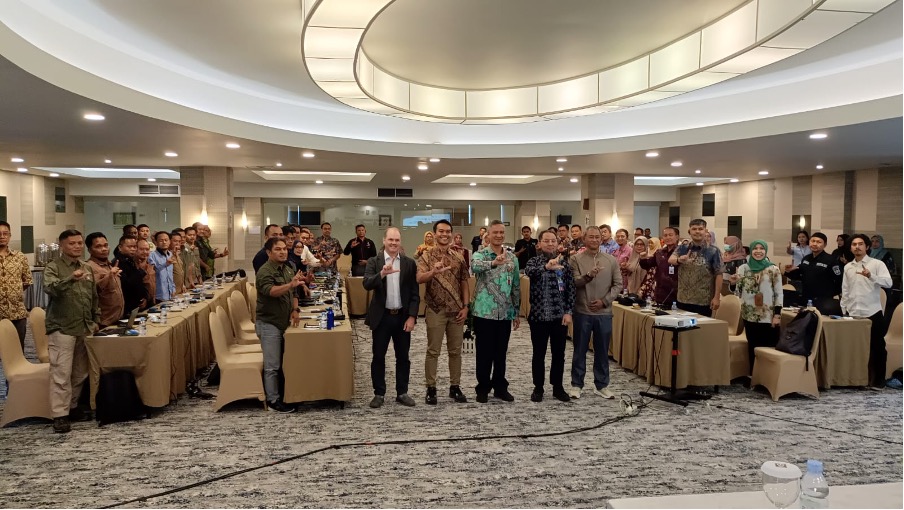
The workshop gathered stakeholders from the government, academia, private sector, and non-government organizations as well as experts to explore MRV governance structures at both national and sub-national levels. (FAO/Rahmayati)
Riau Province holds a critical position in Indonesia’s climate mitigation efforts, with significant forest and peatland areas that contribute both to emissions and potential reductions. Strengthening MRV systems at the sub-national level ensures that emission reductions from the Forestry and Other Land Use (FOLU) sector are measurable, reportable, and verifiable in accordance with international standards, including frameworks such as the ART’s REDD+ Environmental Excellence Standard (TREES).
Through this series of workshops, Riau is laying the groundwork for a high-integrity REDD+ implementation that aligns with national policies while meeting global expectations for transparency and credibility.
Moving forward
The MRV capacity-building series marks an important milestone, but also the beginning of a longer-term process to prepare Riau for REDD+ implementation. Key follow-up actions include strengthening MRV institutions, advancing the development of provincial FREL, enhancing data integration across sectors, and continuing advanced technical training. This sustained commitment reflects the shared vision of the Riau provincial government and its partners to support low-emission development, sustainable forest and peatland management, and meaningful contributions to global climate change mitigation.
About UN-REDD and GREEN for Riau
The United Nations Collaborative Programme on Reducing Emissions from Deforestation and Forest Degradation in Developing Countries (UN-REDD Programme) aims to reduce forest emissions and enhance forest carbon and builds on the technical expertise of FAO, coupled with the expertise of the United Nations Development Programme (UNDP) and UN Environment Programme (UNEP).
The Growing Resilience through Emissions Reductions, Community Empowerment, and Ecosystem Restoration for a Nurturing Future for Riau (GREEN for Riau) initiative is supported by the UN-REDD Programme, implemented by UNEP and FAO, and funded by the UK-FCDO. The initiative includes FAO-led support for developing a sub-national Forest Reference Emission Level (FREL) and the corresponding forest emission monitoring system, while also supporting broader capacity-building and governance strengthening activities.
FAO/Eny Lestari