Berikut terjemahan Bahasa Inggris yang sudah dirapikan dan siap dipublikasikan:
Pelalawan, Riau, 29–30 July 2026 — The journey to the Kampar Peninsula is not a short one. From Pangkalan Kerinci, the delegation had to travel by road for several hours before continuing by boat along a blackwater river, a distinctive feature of peatland landscapes. Yet, upon entering the area, the long journey felt worthwhile.
Within this well-preserved peat swamp forest lie important lessons on how nature can be restored, carbon can be protected, and communities can grow alongside conservation efforts.
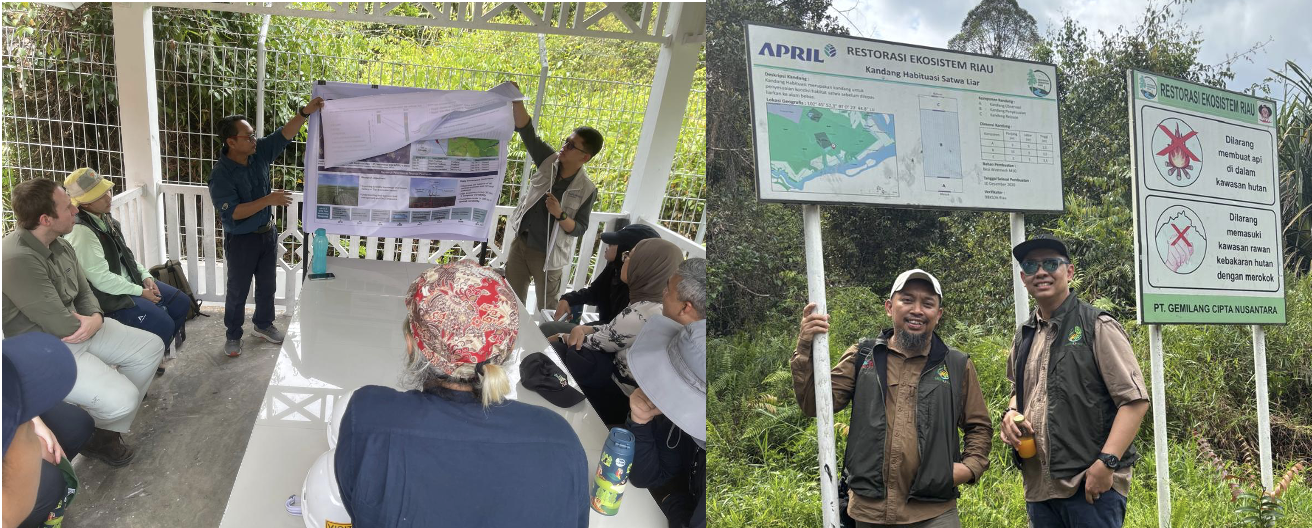
On 29–30 July 2026, a delegation from the Riau Provincial Government had the opportunity to observe firsthand various restoration practices carried out by Restorasi Ekosistem Riau (RER) in the Kampar Peninsula.
The Riau Provincial Government delegation was led by the Assistant II of the Riau Provincial Secretariat and Acting Head of the Riau Provincial Environment and Forestry Agency, M. Job Kurniawan, AP., M.Si., and the Head of Bappeda Riau Province, Purnama Irawansyah, S.Hut., M.M., accompanied by Abdul Madian, S.T., M.M. and Dr. Matnuril, S.IP., M.Si.
From the United Kingdom – Foreign, Commonwealth and Development Office (UK-FCDO), the delegation included Judith A’Bear, Head of Climate Policy and Finance; Saul Hathaway; Widya Anantya, Programme Manager for Forest and Land Use; and Erfa Canisthya, Climate Change Policy Officer. UNEP was represented by Bambang Arifatmi, Ph.D., Country Coordinator. FAO was represented by Mohamad Ridlo and Dyah Ratri, while PETAI was represented by Dr. Masrizal Saraan.
The visit was more than a field agenda. For many participants, it was an opportunity to understand how the challenges of climate change are translated into concrete action at the site level.
Upon arrival in Pangkalan Kerinci, the delegation was welcomed by APRIL Group and RER representatives, including APRIL Group Director of External Affairs, Mulia Siregar, accompanied by Nyoman Iswarayoga, Head of External Affairs and RER Communications; John Pereira, Deputy Head of Operations at RER; Wawan Gunawan, Planning and Government Manager; and Khairul Basyar, Environment and NGO Relations Manager.
During the opening discussion, John Pereira presented various ecosystem protection and restoration efforts being carried out across an area of more than 150,000 hectares spanning the Kampar Peninsula and Padang Island.
In this landscape, ecosystem restoration does not only mean keeping forests standing. Restoration work also includes fire prevention, biodiversity protection, scientific research, peatland hydrological restoration, and partnerships with surrounding communities.
A Tower that Reads the Breath of the Forest
One of the locations that drew particular attention from participants was the Greenhouse Gas Flux Tower.
The research tower standing in the middle of the forest may appear simple. Yet, from this tower, researchers can understand how peat forests interact with the atmosphere.
Through a technology known as Eddy Covariance, instruments installed on the tower record the movement of carbon dioxide entering and leaving the ecosystem. The data collected regularly help answer a crucial question: is the forest absorbing carbon or releasing it into the atmosphere?
For policymakers, this information is highly valuable. Climate change is no longer an issue discussed only in meeting rooms or international forums. In the Kampar Peninsula, climate change can be observed through data collected from the heart of the peat forest.
At the foot of the tower, a lively discussion took place. Researchers explained how seasonal changes, vegetation conditions, and groundwater levels can influence carbon emissions from peatlands.
This landscape demonstrates that protecting forests is not only about safeguarding trees, but also about understanding the ecological processes taking place within them.
Restoration Begins with Water
While many people associate restoration with tree planting, the Kampar Peninsula offers a different perspective.
Here, the first step in restoration begins with protecting water.
The delegation visited several canal blocks built to regulate water flow in peatlands. These structures function to retain water within the peat dome while preventing drainage that can increase fire risk.
Some of the canals that exist today are remnants of past activities. When water flows out too quickly, peat becomes dry and highly flammable. Under such conditions, carbon stored for thousands of years slowly escapes into the atmosphere.
For this reason, restoring peatlands is not enough by planting new vegetation. The hydrological system must first be restored so that the ecosystem can function naturally again.
The simple yet fundamental lesson from the Kampar Peninsula is that protecting water means protecting peat.

When Fishers Become Conservation Partners
In the Serkap River, restoration takes a different form.
Here, communities are not treated as objects of a program, but as part of the effort to protect the area.
Through groups such as Serkap Jaya Lestari, fishers are encouraged to apply more environmentally friendly fishing practices. The use of poison and electric fishing gear is avoided, while fish catch records are maintained regularly to monitor the condition of fish resources.
Equally important, fishers serve as sources of information about the condition of the river and its surrounding areas. They understand seasonal changes, fish migration patterns, and various signs of environmental disturbance that may not be captured by formal monitoring systems.
This experience shows that conservation success often depends on the involvement of communities living side by side with the landscape.
When communities receive benefits and have space to participate, environmental protection becomes stronger and more sustainable.
Helping Forests Regrow Naturally
At the RER nursery, not far from the canal blocking site, thousands of native peatland tree seedlings grow in neatly arranged polybags.
Some of these seedlings come from natural saplings collected from the forest and nurtured before being replanted in degraded areas.
However, not all areas are restored through planting.
In locations that still have natural seed sources and adequate ecological conditions, restoration is carried out by allowing nature to work. The role of the area manager is to ensure that the landscape is protected from fire, encroachment, and other disturbances so that natural regeneration can take place.
This approach shows that restoration is not about replacing nature, but helping nature recover.

Building a Jurisdictional Approach for Riau
In addition to observing restoration practices in the field, the visit also provided an opportunity to discuss how lessons from the Kampar Peninsula can support the broader climate agenda in Riau Province. One focus of the discussion was the development of a jurisdictional REDD+ approach through the GREEN for Riau Initiative.
The jurisdictional REDD+ approach aims to strengthen pentahelix coordination in supporting efforts to reduce emissions from deforestation and forest degradation at the provincial level. In this context, various ongoing initiatives, including ecosystem restoration projects and carbon programs developed by the private sector, are viewed as important contributions to achieving Riau Province’s climate targets.
Participants also discussed the concept of nesting, which refers to how activities and benefits from site-level projects can be integrated into a broader jurisdictional framework.
This approach is expected to provide clarity for existing projects while encouraging new investments in the future, while also ensuring that private sector contributions remain recognized and aligned with Riau Province’s low-carbon development goals.
Discussions during the visit also reaffirmed the importance of collaboration among government, communities, the private sector, and development partners in supporting emission reduction efforts and low-carbon development in Riau.

Lessons from the Kampar Peninsula
Toward the end of the visit, one message became increasingly clear.
The success of restoration is not determined only by how many trees are planted or how large an area is fenced. Restoration success is determined by the ability to keep the entire system functioning: water remains stored within the peat dome, carbon remains protected, wildlife has safe habitat, and communities benefit from a healthy ecosystem.
The Kampar Peninsula shows that restoration is a long-term effort requiring science, patience, investment, and collaboration.
Amid growing climate change challenges, the experience from this peatland landscape offers hope that ecosystem recovery is not only possible, but can also generate tangible benefits for both the environment and people.
In places like this, efforts to protect carbon ultimately lead to a greater purpose: nurturing life.
