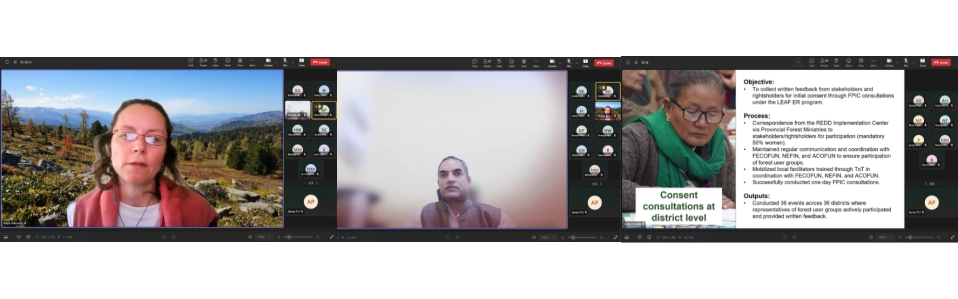
In an effort to strengthen the implementation of Free, Prior, and Informed Consent (FPIC) in forest-based emissions reduction programs, the GREEN for Riau Initiative Team participated in a Learning Exchange session with a Nepalese team that has implemented the FPIC process under the LEAF jurisdictional REDD+ (Lowering Emissions by Accelerating Forest Finance) scheme.
The event brought together representatives from Nepal, UNEP, FAO, UNEP-WCMC, the Riau Provincial Environment and Forestry Agency (DLHK), GREEN for Riau experts, and implementing partners from Indonesia to share experiences, challenges, and lessons learned in implementing FPIC in the context of jurisdictional-scale forest carbon programs.
In the session, Mohan Poudel from FAO Nepal explained that UN-REDD provides technical support for the implementation of LEAF jurisdictional REDD+ in Nepal, including strengthening safeguards, developing technical documents, implementing FPIC, and developing a Benefit Sharing Plan (BSP).
Nepal's LEAF jurisdiction covers three provinces, covering approximately 3.22 million hectares of forest, and a crediting period of 2022–2026. Nepal has signed the Emission Reductions Payment Agreement (ERPA) with an estimated volume of approximately 4 million tons of carbon credits.
Meanwhile, Sudha Khadka, Country Director of RECOFTC Nepal, explained that Nepal developed a national Free, Prior, and Informed Consent Guideline as a basis for consultation and consent with indigenous peoples and local communities. This guideline was developed through a consultative process with indigenous peoples and local communities and then endorsed by the government as the official reference for all forestry carbon programs in Nepal.
In its implementation, Free, Prior, and Informed Consent (FPIC) is seen as an iterative and ongoing process to ensure communities receive adequate information about the LEAF program, safeguards, the Grievance Redress Mechanism, and benefit-sharing schemes.
Nepal also shared its experience on the importance of stakeholder mapping at a very large jurisdictional scale, encompassing more than 12,000 community forest user groups. To reach a wide area, Nepal developed a network-based approach, including umbrella organizations of indigenous peoples and local communities. This approach was strengthened through the implementation of Training of Trainers (ToT) involving local governments, indigenous peoples' organizations, and local facilitators to ensure an inclusive and effective consultation process at the district and community levels.
In the discussion, Nepal emphasized several key lessons learned from the implementation of FPIC, including the importance of ensuring representation of women and vulnerable groups, the use of local languages, and a participatory communication approach that is more easily understood by communities than formal technical presentations. The use of local facilitators who understand the local cultural context was also considered crucial in building community trust in the consultation process.
The discussion with the GREEN for Riau Initiative team also addressed the challenges of implementing FPIC in a broad jurisdictional context, including how to determine indigenous peoples' representation, the consent-granting mechanism, and how the process will be evaluated by the Validation and Verification Body (VVB) under the ART/TREES scheme. It was also emphasized that the VVB evaluation focused not only on the number of participants or the location of the consultations, but also on the justification and legitimacy of the process developed with rights holders and stakeholders.
Participants from Indonesia expressed their appreciation for Nepal's openness in sharing its experience in implementing FPIC for its forest carbon program. The lessons learned from Nepal were considered highly relevant for Indonesia, particularly in developing the FPIC approach in REDD+ and ART/TREES schemes at the jurisdictional level.
This Learning Exchange activity is expected to be the beginning of strengthening collaboration and learning exchange between countries to ensure a more inclusive, participatory, and credible implementation of safeguards and FPIC in forest-based emission reduction programs.