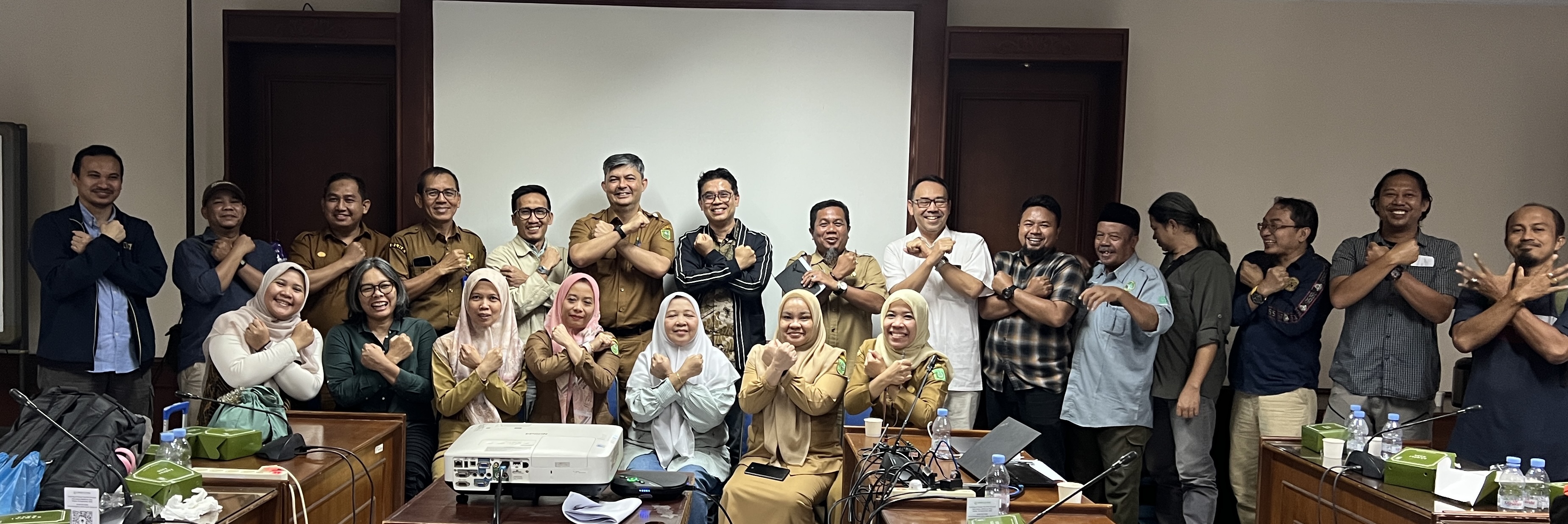
Pekanbaru, 22 September 2026 — The GREEN for Riau Initiative organized a Training of Trainers (ToT) for the Provincial Free, Prior and Informed Consent (PADIATAPA/FPIC) Team at the GREEN for Riau Secretariat, Riau Provincial Bappeda Office. The training strengthened the understanding and facilitation skills of the provincial team before they support further training at the district/city level and the implementation of PADIATAPA at the site level.
Danang Kabul Soekresno, Provincial Lead of the GREEN for Riau Initiative, stated that the provincial team would become the “frontline” of the next PADIATAPA process. He emphasized the importance of two-way communication: communities need to receive clear information while also having space to ask questions, provide input, and raise concerns. According to Danang, the process must be carried out based on the principles of transparency, accountability, and accuracy.
Head of Bappeda Riau Province, Purnama Irawansyah, S.Hut., M.M., who officially opened the training, reminded participants that the broad scope of GREEN for Riau requires meaningful engagement of stakeholders at the site level. He expressed hope that the PADIATAPA Team could “bring the programme down to earth” for communities. To achieve this, participants need to agree on methods, procedures, and the substance of explanations so that they have “one template” and “one voice” when facilitating the process in the field.
PADIATAPA provides communities and stakeholders with the opportunity to receive complete information before making decisions freely. During the training, GREEN for Riau Safeguards Expert, Irfan Kemal, emphasized that PADIATAPA is a continuous process. New questions or concerns may arise as the programme develops and must continue to have space for discussion.
 Participants studied three modules covering an introduction to PADIATAPA, its implementation procedures, and key information on GREEN for Riau. The materials were reinforced through discussions on participation options, documentation, feedback and grievance redress mechanisms, and benefit-sharing plans.
During facilitation simulations, participants practiced explaining the programme in language that is easy to understand and responding to questions regarding land rights, options for participation, and the possibility of withdrawing consent. The simulation evaluation highlighted the importance of recording unanswered questions and ensuring that women and groups facing access barriers are still able to express their views.
The discussion also emphasized the need for caution when explaining programme benefits. The benefit-sharing plan is still under discussion, so facilitators must not present figures or allocations that have not yet been determined as promises to communities.
Through this ToT, the Provincial PADIATAPA Team is expected to deliver information consistently and facilitate open dialogue when supporting district/city teams. Technical discussions on approaches in each area will continue while taking into account the conditions of local communities.
