Berikut terjemahan Bahasa Inggris yang sudah dirapikan dan siap dipublikasikan:
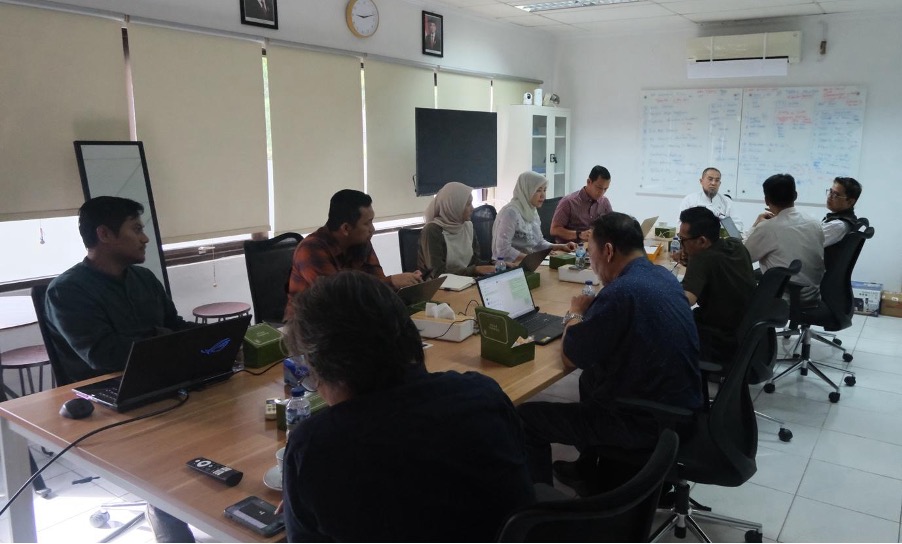
Pekanbaru, 19 June 2026 — The Riau Provincial Government, together with the GREEN for Riau Initiative, held two consultation sessions to strengthen the development of the Regional Strategy and Action Plan for Reducing Emissions from Deforestation and Forest Degradation, or STRADA REDD+ Riau Province. Both meetings took place at the GREEN for Riau Secretariat, located at the Bappeda Riau Province office.
The first session was held with the Regional Development Planning Agency (Bappeda) of Riau Province and the Environment and Forestry Agency (DLHK) of Riau Province to discuss the revised document and preparations for public consultation and national-level consultation.
The second session was held with GREEN for Riau experts to further examine and integrate various technical aspects into the strategy and action plan.
Aligning STRADA REDD+ with Regional Policy Directions
The meeting with the Riau Provincial Government was attended by the Head of Bappeda Riau Province, Purnama Irwansyah, S.Hut., M.M.; Head of the Economy and Natural Resources Division of Bappeda Riau Province, Abdul Madian; Head of the Forest Planning and Utilization Division of DLHK Riau Province, Dr. Matnuril, S.IP., M.Si., M.H.; and Head of the Watershed Management, Peat Restoration, and Social Forestry Division of DLHK Riau Province, Budi Hidayat, S.P., M.M.
The discussion focused on aligning STRADA REDD+ with regional policy directions and development planning documents, forest and land governance needs, and REDD+ implementation plans in Riau Province.
Several aspects received particular attention, including refinement of the strategic narrative, strengthening of the action plan, availability of supporting data, funding needs, and substantive readiness for the next consultation processes.
The Riau Provincial Government emphasized that STRADA REDD+ must not only be technically robust, but also serve as a shared reference for regional agencies in planning and implementing low-emission development.
Therefore, the document needs to be developed in an integrated and realistic manner, while reflecting the institutional, social, economic, and ecological context of Riau Province.
Inputs from Bappeda and DLHK are an important part of ensuring that the strategy has a clear connection to regional development priorities and can be translated into implementable programs, activities, targets, indicators, and financing needs.

Integrating Cross-Expertise Inputs
In the following session, the discussion continued with GREEN for Riau experts supporting the development of STRADA REDD+ across various fields. The discussion was led by Prof. Dr. Suwondo, Mitigation Action Plan Consultant, who focused on shaping the strategic direction and mitigation action plan.
Experts involved in the discussion included Harry Oktavian, S.Pi., Stakeholder Engagement and Community Development Consultant; Himyul Wahyudi, S.E., Indigenous Peoples and Local Communities Consultant; Susanto Kurniawan, S.Pi., M.Si., Social Forestry Policy and Partnership Expert; Rahmaidi Azani, S.Pi., Social Forestry Technical and Knowledge Strengthening Expert; Rizky Rachmawati, Budget Tagging Consultant; and Irfan Kemal Putra, Environmental and Social Safeguards Framework Consultant.
This meeting served as a coordination space to ensure that assessments, data, and technical inputs from each expert can be integrated into a comprehensive STRADA REDD+ framework.
The discussion covered stakeholder engagement, Indigenous Peoples and local communities, social forestry strengthening, community facilitation strategies, application of safeguards principles, as well as budget tagging and financing needs to support implementation of the action plan.
The experts emphasized that STRADA REDD+ should be developed as an implementation guide that can be used by government and stakeholders, rather than merely as a document outlining broad policy directions.
The action plan needs to consider field conditions, institutional capacity, social and ecological challenges, and the availability of funding sources.
Strengthening social forestry and community engagement was also highlighted as a key focus. The strategy must be able to respond to the needs of community groups at the site level, strengthen local institutions, and ensure that the benefits of REDD+ implementation are delivered in an inclusive and equitable manner.

Strengthening REDD+ Implementation Readiness in Riau
The two consultation sessions strengthened the STRADA REDD+ development process by combining regional government policy direction with technical inputs from across areas of expertise.
The results of the discussions will be used to refine the substance of the document before it enters a broader consultation process.
Through a participatory, data-based, and coordinated process, the Riau Provincial Government and the GREEN for Riau Initiative continue to strengthen regional readiness to build better forest and land governance, promote low-emission development, and advance REDD+ implementation that is inclusive, credible, and sustainable.
