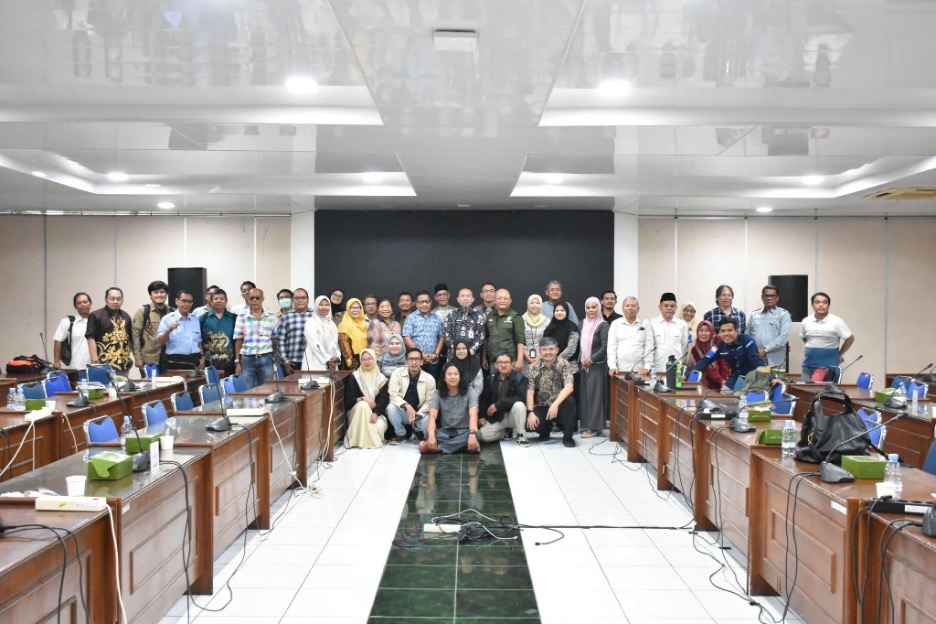
Figure 1. Participants of the GREEN for Riau dialogue pose for a group photo at the Riau Provincial Development Planning Agency.
PEKANBARU - 3 September 2026. The Dialogue and Collaboration Strengthening Forum held at the Riau Provincial Bappeda Office served as a space for exchanging information, views, and experiences on various important aspects of JREDD+ readiness, including accounting areas, governance and financing transparency, social and environmental safeguards, Free, Prior and Informed Consent (FPIC/PADIATAPA), social forestry, Indigenous Peoples, and gender equality and social inclusion. These aspects align with the purpose of the meeting: to strengthen understanding, gather inputs, and encourage stakeholder engagement in the development of GREEN for Riau.
The ongoing process is still in the readiness phase. Therefore, several data sets, documents, mechanisms, and governance arrangements are still being refined and remain open to inputs from various parties. The forum also conveyed that civil society organizations (CSOs) will continue to be involved in discussions and consultations in the next stages.

*Figure 2. GREEN for Riau Provincial Coordinator, Danang K. S. S.Hut., MT, M.Sc., shares his views during the NGO meeting at the Riau Provincial Bappeda Office, 3 September 2026.*
Head of the Riau Provincial Bappeda, Purnama Irawansyah, S.Hut., M.M., explained that emission reduction efforts in Riau are not a newly initiated process. The work began in 2012 and later developed through various low-emission development commitments in Riau Province. Currently, the process is being strengthened through the preparation of institutional foundations, data, regulations, and governance before entering a broader implementation phase.
In the discussion on carbon finance, Purnama emphasized that carbon should be positioned as an additional benefit, while the main focus must remain on real action at the site level. Community empowerment, local economic development, environmental improvement, and ecosystem restoration are objectives that must move forward together.

*Figure 3. Head of the Riau Provincial Bappeda, Purnama Irawansyah, S.Hut., M.M., shares his views during the NGO meeting at the Riau Provincial Bappeda Office, 3 September 2026.*
Social Forestry: Economic Benefits Should Not Have to Wait for Carbon
Executive Chair of the Riau Social Forestry Acceleration Working Group, Fadil Nandila, S.Pi., highlighted the importance of consolidating social forestry data so that the government and stakeholders can use the same reference.
He also emphasized that social forestry groups do not need to wait for carbon payments to start gaining economic benefits. Various opportunities such as ecotourism, livestock, fisheries, and other productive enterprises can be developed now, according to the conditions and potential of each area.
Strengthening Social Forestry Business Groups (KUPS), including through business legality and access to financing sources, is also considered important so that social forestry can increasingly deliver economic benefits to communities while supporting sustainable forest management.
Site-level experiences enriched the discussion. CSO representatives shared experiences related to overlapping social forestry potential with PBPH permits, boundary issues, and the need to ensure that spatial data and administratively recorded potential are verified against actual field conditions.

*Figure 4. Executive Chair of the Social Forestry Acceleration Working Group, Fadil Nandila, S.Pi., shares his views during the GREEN for Riau dialogue forum at the Riau Provincial Bappeda Office, 3 September 2026.*
Forest Protection Is Closely Linked to Spatial Planning and Community Rights

Figure 5. Okto Yugo Setiyo shares his views during the GREEN for Riau dialogue forum at the Riau Provincial Bappeda Office, 3 September 2026.
Jikalahari Coordinator, Okto Yugo Setiyo, highlighted the links between spatial planning, permits, natural forest protection, peatlands, and areas of important ecological value.
According to him, data verification and harmonization are needed so that decisions under GREEN for Riau are based on accurate spatial information. Recognition of Indigenous Peoples and the designation of customary forests are also important parts of the discussion, because forest protection cannot be separated from the communities who live in and manage these areas.
The forum also brought together various landscape management approaches. Participants’ inputs emphasized the importance of looking at actual conditions on the ground, including areas that have undergone land-use change and areas currently undergoing recovery, as part of developing more contextual strategies at the site level.
Transparency and Governance Integrity Became Key Themes in the Discussion

Figure 6. Participants attend the GREEN for Riau dialogue forum at the Riau Provincial Bappeda Office, 3 September 2026.
Tarmidzi from FITRA Riau conveyed the importance of accountability from the outset, including ensuring that carbon finance schemes are built fairly and with integrity, and that forest-managing communities are not positioned merely as objects, but receive adequate understanding and benefits from the process.
Johny Setiawan Mundung from Yayasan Inisiatif Bumi Swarnadwipa also called for clarity regarding accounting areas, funding sources and mechanisms, as well as strengthened integrity and oversight mechanisms.
In response to these inputs, the Riau Provincial Government and the GREEN for Riau team stated that the approximately 2.6 million hectares of accounting area will be further deepened and verified, including the actual conditions of the area, Indigenous Peoples, villages, social forestry areas, and land cover within it. The coverage of communities, villages, and beneficiaries will also be discussed further through the development of the Benefit Sharing Mechanism (BSM).
According to the GREEN for Riau team, risks of misuse in financing need to be addressed through safeguards, the capacity and credibility of the institutions involved, clear activity criteria, and oversight mechanisms. The accounting area also remains open to inputs and corrections from parties with experience and data at the site level.
Expanding the Role of CSOs at the Site Level
The dialogue also discussed opportunities for local CSOs to take on a larger role in the implementation process. The Riau Provincial Government sees space to strengthen the capacity of local civil society organizations so that they can support facilitation activities on the ground, especially given the vast area and the need to reach communities in various locations.

Figure 7. Hasan Supriyanto shares his views during the GREEN for Riau dialogue forum at the Riau Provincial Bappeda Office, 3 September 2026.
During the forum, Hasan Supriyanto from FKKM Riau Region also emphasized the importance of continuing civil society engagement in future discussions, as several mechanisms are still being developed and are not yet final. This input was accepted as part of the agenda that needs to be continued in the next stages. As a follow-up, GREEN for Riau will also consider mechanisms to strengthen local CSOs in supporting site-level activities.
Women Need Access, Control, Benefits, and Space in Decision-Making

*Figure 8. Director of Riau Women Working Group, Amniati, S.Pi., shares her views during the GREEN for Riau dialogue forum at the Riau Provincial Bappeda Office, 3 September 2026.*
Perspectives on gender and social inclusion were an important part of the forum. Director of the Riau Women Working Group (RWWG), Amniati, S.Pi., stated that experience from village-level facilitation shows that women still face various limitations in access to resources, control, decision-making, and benefit reception.
She also highlighted that social forestry institutions are still largely dominated by men, while women often remain in supporting or administrative roles despite having important knowledge about food, local resources, and community life. Therefore, capacity building, expanded access, stronger women’s voices in decision-making, and safer participation spaces need to become part of implementation.
Inputs on gender and social inclusion will be carried forward in the process of preparing GREEN for Riau implementation documents. One agreed follow-up is the submission of concrete recommendations from the forum to GEDSI experts as material for refining the documents.

Figure 9. Participants of the GREEN for Riau dialogue forum capture a group moment after the activity at the Riau Provincial Bappeda Office, 3 September 2026.
From Dialogue to Follow-Up
The 3 September forum was not the end of the consultation process.
The meeting will be followed by a series of subsequent discussions, including a high-level dialogue and public consultation on 7 September 2026 to further discuss the approximately 2.6 million hectares of accounting area, while opening space for inputs from CSOs with experience and data at the site level. Further discussions are also scheduled for 8 September, while the refinement of the benefit-sharing mechanism and the coverage of beneficiary areas will continue into the next stages.
This series of dialogues shows that JREDD+ readiness in Riau is not only about emission accounting methodologies. Data quality, governance, integrity and transparency in financing, strengthening community economies, protection of forests and peatlands, recognition of community rights, and the engagement of women and vulnerable groups are equally important parts of building a strong foundation for jurisdictional REDD+.
For GREEN for Riau, the readiness phase is an opportunity to continue refining this foundation together with stakeholders before broader implementation begins. The ultimate goal is to ensure that emission reduction efforts and environmental finance are connected to tangible benefits at the site level: more empowered communities, growing local economies, and increasingly protected forests and ecosystems in Riau.