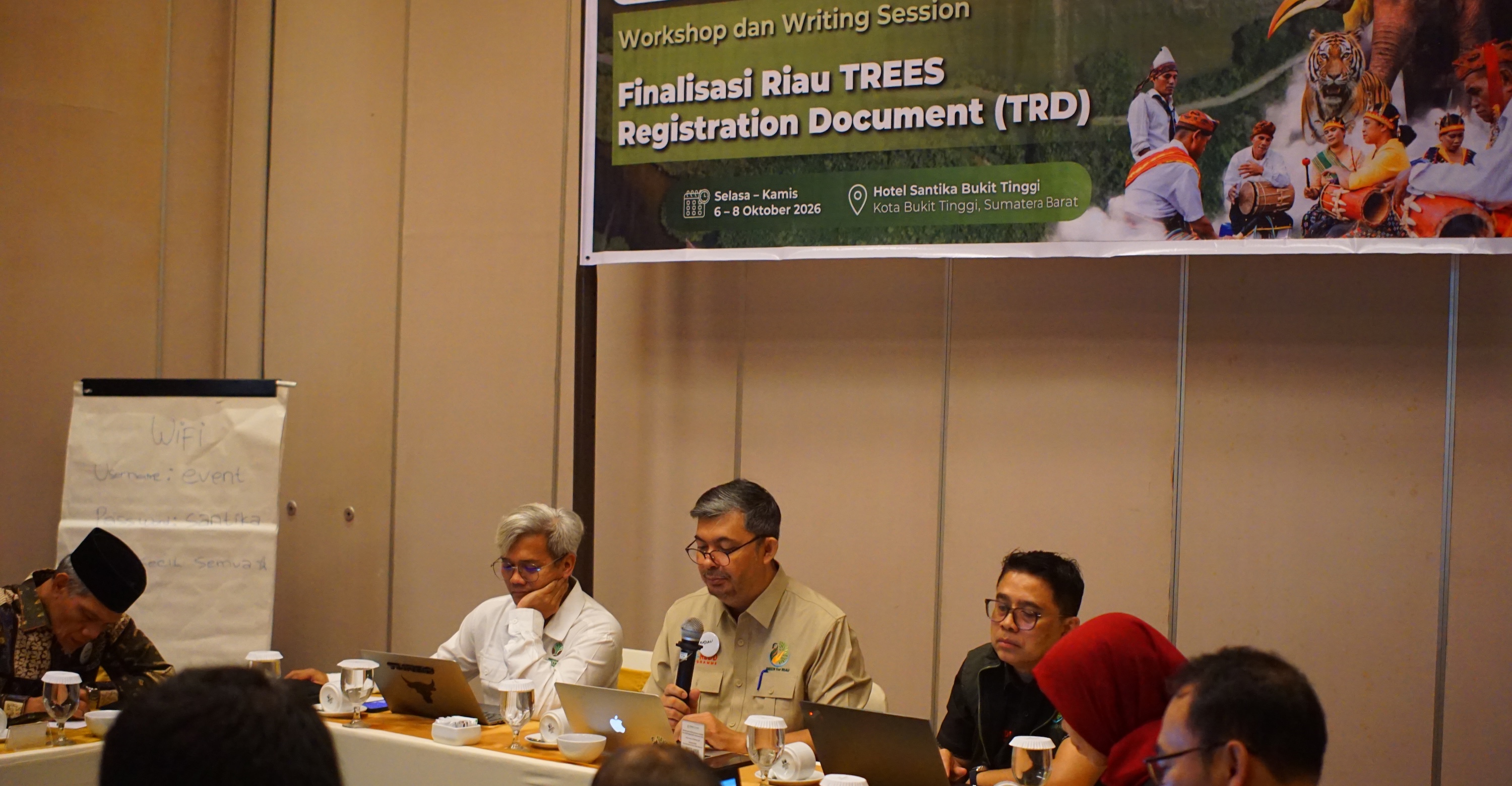
Bukittinggi, 6–8 October 2026 — The Riau Provincial Government continues to strengthen its commitment to supporting emission reductions from deforestation and forest degradation through the GREEN for Riau Initiative. As one of the pilot provinces for ART-TREES implementation in Indonesia, Riau organized a Workshop and Writing Session for the Finalization of the Riau TREES Registration Document (TRD) in Bukittinggi, West Sumatra. The activity marked a strategic step in preparing for the implementation of Jurisdictional REDD+ in accordance with the Architecture for REDD+ Transactions – The REDD+ Environmental Excellence Standard (ART-TREES), while taking into account technical aspects, governance, and environmental and social safeguards.
The three-day workshop focused on the finalization of the TRD, strengthening understanding of ART-TREES 3.0 requirements, and identifying data needs and supporting evidence for meeting safeguard indicators. The activity involved central and regional governments, Technical Implementation Units (UPT), national and international development partners, associations, the Riau Malay Customary Institution (LAMR), the Measurement, Reporting, and Verification (MRV) and Safeguards Working Groups, as well as experts and implementing partners. The involvement of these various stakeholders forms an important part of building Riau’s readiness through a collaborative, transparent, and inclusive process.
In his remarks, Bambang Arifatmi, Country Coordinator of the UNEP UN-REDD Programme in Indonesia, emphasized the importance of GREEN for Riau as a strategic step in the development of jurisdictional REDD+ in Indonesia.
“GREEN for Riau is an important momentum to promote the application of international standards, jurisdictional nesting mechanisms, and stronger multi-stakeholder collaboration. Through this cooperation, we hope the TRD can meet the requirements and obtain approval from the ART Secretariat.”
In line with this, Abdul Madian, S.T., M.M., Head of the Economy and Natural Resources Division of Bappeda Riau Province, emphasized the importance of finalizing the TRD as a foundation for strengthening the credibility of GREEN for Riau implementation.
“Finalizing the TRD is an important step in strengthening the credibility of GREEN for Riau in meeting ART-TREES standards. We hope that collaboration among all stakeholders can ensure environmental protection, good governance, and fair benefits for the people of Riau.”
The series of activities continued with a presentation on national policy directions related to ART-TREES and jurisdictional REDD+, delivered by Bambang Pancatriono, S.Kom., M.Si., from the Directorate of Forest Utilization Business Development (BUPH), Ministry of Forestry. In his presentation, he emphasized the importance of alignment between national and regional policies to ensure the integrity and effectiveness of jurisdictional REDD+ implementation.
“Jurisdictional programmes need to be aligned with policies and systems at both the national and provincial levels. ART-TREES plays a role in supporting the integrity of emission reduction results, while national policies provide the foundation for strengthening governance and ensuring consistent programme implementation.”

From the technical perspective, Maria Antonova from the United Nations Environment Programme World Conservation Monitoring Centre (UNEP-WCMC) strengthened participants’ understanding of the ART-TREES 3.0 requirements, including their relationship with the Cancun Safeguards and Indonesia’s safeguards system. The discussion also covered indicator compliance and the data and supporting evidence required for the preparation of the TRD, providing a basis for participants to conduct a more in-depth review of the document.
Building on this understanding, participants then joined a writing session divided into five thematic working groups. Discussions focused on the alignment of REDD+ with national forestry programme objectives and relevant international conventions and agreements; respect, protection, and fulfilment of tenure rights over land and territory; identification of Indigenous Peoples and local communities; and fulfilment of the rights of all stakeholders to participate fully and effectively in the design and implementation of REDD+ activities.

Each group reviewed the available information, identified gaps in data and supporting evidence, and formulated recommendations to support the finalization of the TRD.
During this review process, Teguh Imansyah Martadijaya from the Directorate of Climate Change Mitigation, Ministry of Environment, also provided input, emphasizing the importance of complete and traceable supporting evidence in ensuring compliance with safeguards requirements in REDD+ programme implementation.
“Compliance with safeguards requirements needs to be supported by valid and traceable data and evidence, not merely descriptions of activities that have been carried out. Therefore, collaboration among institutions and stakeholders is important to complete the required information and ensure that the Riau TRD is prepared comprehensively.”
 The review results from each group were then consolidated and presented in a joint discussion to gather input, align substance across themes, and formulate follow-up steps. This process became an important part of strengthening the quality of the TRD, particularly in ensuring the completeness of information and supporting evidence in accordance with ART-TREES requirements.
Closing the series of activities on Thursday, 8 October 2026, Prof. Dr. Haruni Krisnawati, S.Hut., M.Si., Expert Staff to the Minister for Climate Change, Ministry of Forestry, provided strategic guidance on accelerating the registration process and completing the documents in line with the GREEN for Riau timeline.
“Accelerating the registration of TREES Concept 3.0 and the completion of TRD 3.0 needs to become a shared priority so that the entire process can proceed in accordance with the GREEN for Riau timeline.”
The guidance also emphasized the importance of coordination, clear division of roles, and the commitment of all stakeholders in meeting the document completion targets.
As a follow-up, the Riau Provincial Government together with stakeholders will continue the finalization of the TREES Concept and TRD through the completion of technical data, strengthening of safeguards supporting evidence, and multi-stakeholder coordination and consultation in preparation for submission to the ART Secretariat.
Through the GREEN for Riau Initiative, this step is expected to strengthen readiness for the implementation of credible, transparent, and inclusive jurisdictional REDD+, while promoting sustainable forest governance, environmental protection and community rights, and contributing to the achievement of Indonesia’s emission reduction targets.
