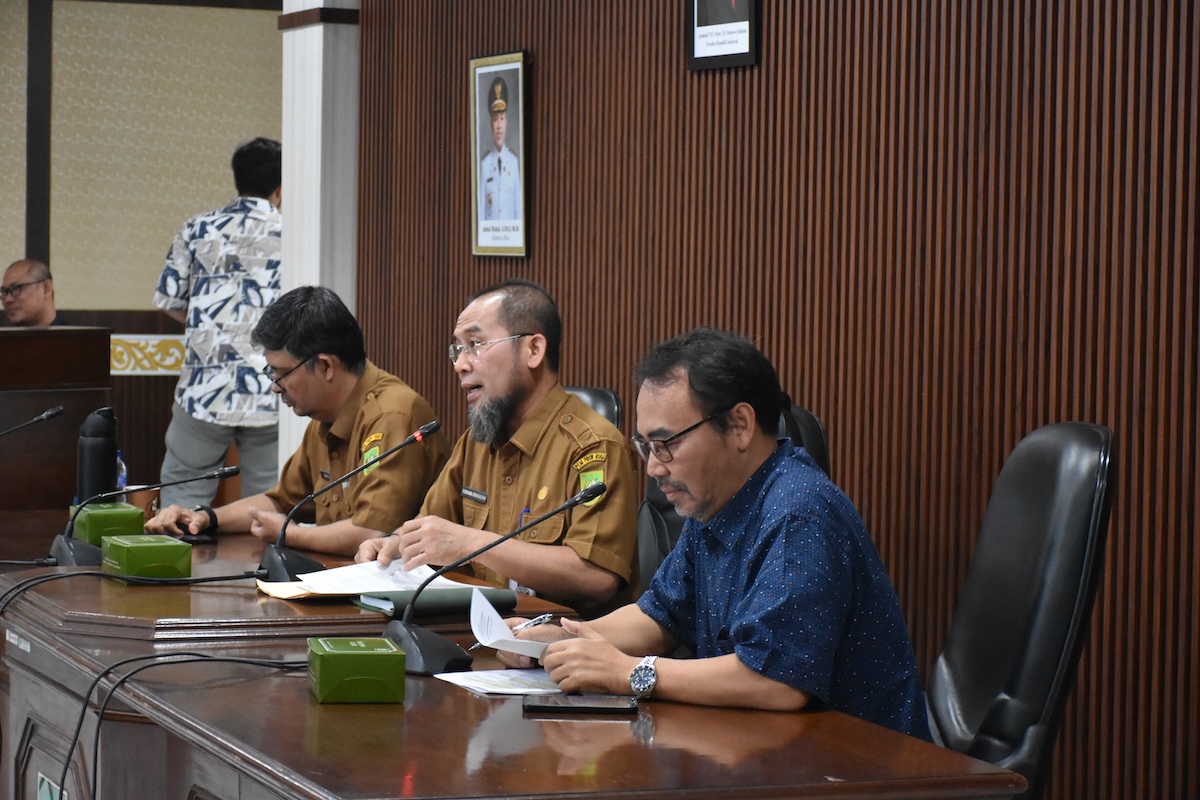
Pekanbaru, May 12, 2026 — The Riau Provincial Government, through the Regional Development Planning Agency (Bappeda), held a Coordination Meeting on the Identification of Gender-Based Climate Change Adaptation and Mitigation Actions for stakeholders in Riau Province in the Parlaungan Meeting Room, 3rd Floor, Bappeda Office, Pekanbaru. This activity is a crucial part of strengthening the implementation of the GREEN for Riau initiative through the Regional Climate Budget Tagging (RCBT) approach, involving government, NGOs, media, academics, the private sector, and development partners.
The meeting was attended by more than 50 participants from various organizations and institutions, including the Riau Provincial Bappeda, the Riau Provincial Environment and Forestry Agency (DLHK), the Social Forestry Center, environmental NGOs, media, and development partners in Riau Province.
The Head of the Riau Province Regional Development Planning Agency (Bappeda), Purnama Irawansyah, in his remarks emphasized that the GREEN for Riau Initiative (GREEN-Riau) represents a shared commitment to improving environmental conditions while ensuring that communities remain a key part of green development.
"The GREEN for Riau Initiative represents a shared commitment to improving environmental conditions in Riau Province without neglecting the communities living in and around the program area," said Purnama Irawansyah.
He explained that the jurisdictional approach used in GREEN-Riau requires that all programs, plans, and budgets from various parties be inventoried and their contribution to reducing greenhouse gas emissions in Riau Province calculated.
"This entire process aims to demonstrate to the international community that Riau Province is voluntarily and consciously committed to reducing greenhouse gas emissions," he emphasized.
Purnama also highlighted the importance of climate budget tagging as an instrument for building more integrated and transparent development governance.
"Previously, each institution operated independently, but now all activities are calculated collectively to determine their contribution to the greenhouse gas emission reduction target in Riau Province."
In its remarks, the Riau Provincial Government is targeting the development of a REDD+ architecture and Benefit Sharing Mechanism (BSM) as part of its readiness for international carbon financing schemes and the ART-TREES approach.
Meanwhile, Budget Tagging Expert, Rizky Rachmawati, explained that RCBT is not simply an administrative process, but a concrete demonstration of commitment to financing climate action at the regional level.
"Climate budget tagging is not just an administrative process, but part of a joint financing commitment that demonstrates the region's commitment to the global climate agenda."
He added that all parties were asked to identify climate change mitigation and adaptation actions they had undertaken since 2016 and future activity plans as part of Riau Province's green financing system.
"The main objective of climate budget tagging is to provide evidence that Riau Province has been taking concrete action to reduce greenhouse gas emissions for a long time."
The discussion forum also emphasized the importance of data transparency, the integration of the Gender Equality, Disability, and Social Inclusion (GEDSI) initiative, and strengthening collaboration between stakeholders in supporting low-carbon development in Riau Province.
The discussion forum also featured various views and constructive input from NGOs and development partners regarding the importance of data transparency, the flexibility of tagging mechanisms, and the recognition of stakeholder contributions. NGO representatives highlighted the importance of clarity regarding the benefits of the data transparency requested in the tagging process.
"We hope that the data collected will be used to attract new investment and strengthen Riau's position in securing international funding, rather than become a reason to reduce support," stated one NGO representative at the discussion forum.
Critical input was also provided regarding the assessment methodology in climate budget tagging, ensuring it is not solely based on budget values.
"Budget tagging is not enough to simply look at the budget amount; it also needs to consider program objectives, activity outputs, location, and gender and social inclusion aspects," said Tarmidzi (representative of FITRA Riau) during the discussion session.
Meanwhile, Haryono, a representative of the RIMBA project, emphasized the importance of building trust and flexibility in the data collection process.
"Participation in GREEN-Riau should remain voluntary and built on shared awareness, not administrative obligations."
He also assessed that data transparency can actually strengthen the attractiveness of green investment in Riau Province.
"International donors are currently attracted to regions that demonstrate strong local investment and commitment."
The discussion also highlighted the importance of an integrated data system so that environmental program interventions can be more equitable and not focused on specific areas.
Abdul Madian, Head of the Economic and Natural Resources Division of the Riau Province Regional Development Planning Agency (Bappeda), as moderator of the forum, emphasized that participation in GREEN-Riau is voluntary, but crucial to ensure that all stakeholders' contributions are recognized in future carbon financing schemes.
"GREEN for Riau is built on the basis of concrete contributions to emissions reduction and green development, not based on the status of a disadvantaged or impoverished region."
He also emphasized that the jurisdictional approach presents a significant opportunity for Riau Province to demonstrate regional leadership in the global climate change agenda.
"The main focus is on the actions of various parties on the ground, including the government, NGOs, international projects, and the community."
Through this activity, the Riau Provincial Government hopes that all parties can work together to build a credible, transparent climate action data and financing system that can strengthen Riau's position in international carbon financing schemes and achieve Indonesia's Nationally Determined Contribution (NDC) and Sustainable Development Goals (SDGs) targets.
