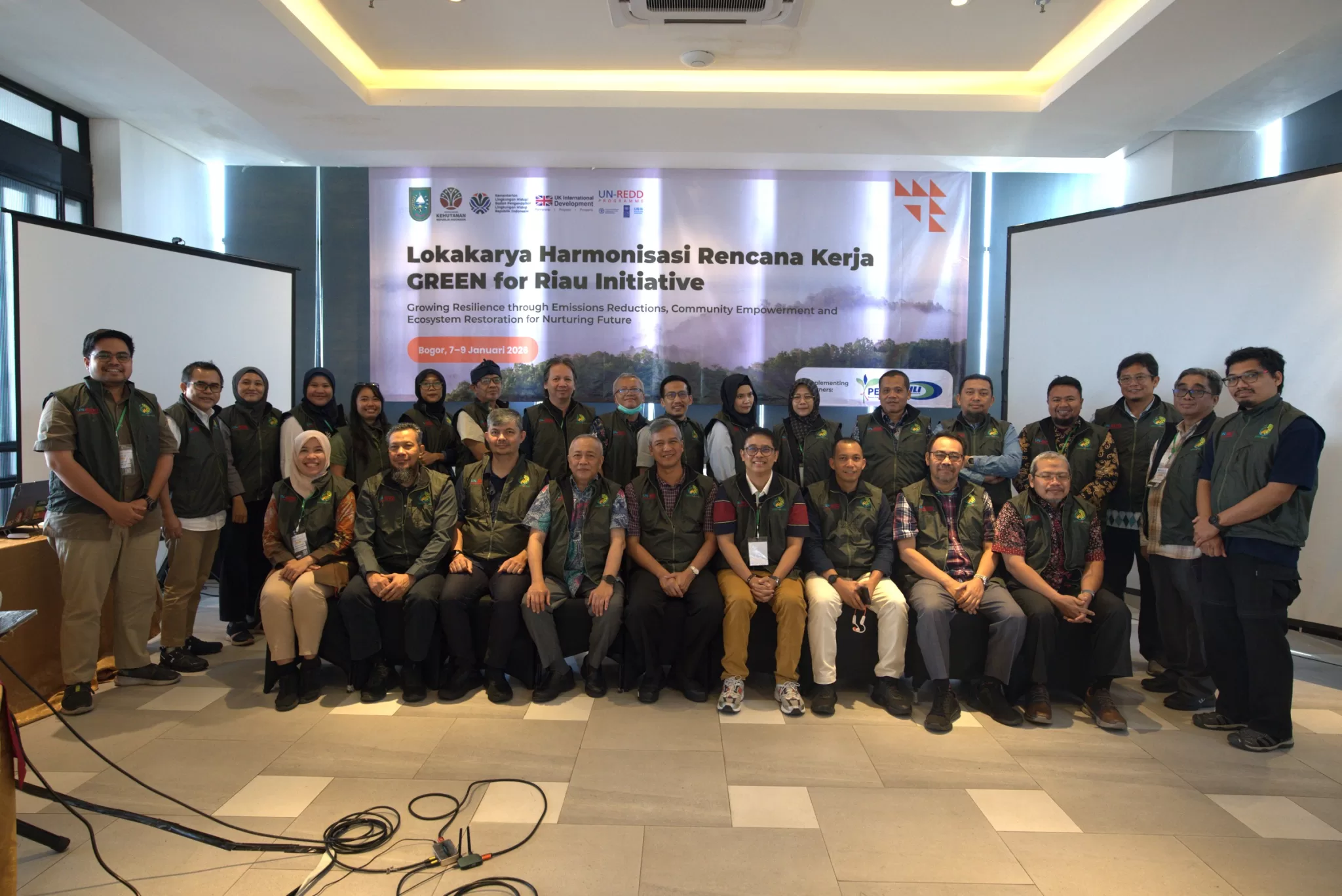
Bogor, January 9, 2025 – The GREEN for Riau Initiative (GREEN Riau) Work Plan Harmonization Workshop entered its third day, with an agenda increasingly focused on strengthening governance and aligning joint implementation strategies. At this stage, discussions were no longer conceptual, but rather focused on operational work mechanisms, cross-stakeholder coordination, and the technical foundations that will form the basis for future program implementation.
The final morning session of the day's agenda included aligning work plans across consultants, explaining the GREEN for Riau Initiative governance structure, initial technical sharing on accounting areas and emissions calculations, and strategic direction from the Riau Provincial Government.
Before the discussion session began, the forum emphasized the importance of aligning roles, targets, and coordination mechanisms across stakeholders. As the third day approached, the workshop reached a more focused stage in aligning integrated, inclusive and sustainable implementation strategies.
Bambang Arifatmi, Country Coordinator of the UNEP UN-REDD Programme in Indonesia, presented the program's governance structure. He explained the division of working group clusters within the GREEN for Riau Initiative, including Budget Planning; Measurement, Reporting, and Verification (MRV); Governance/Stakeholder Engagement, Safeguards; and Benefit Sharing Working Group Clusters. This structure is designed to ensure clear roles, effective coordination mechanisms, and the sustainability of human resources and knowledge transfer so that the program can run independently going forward.
The main directive from the Riau Provincial Government was delivered by M. Job Kurniawan, AP., M.Sc., Head of the Riau Provincial Environment and Forestry Office, who emphasized the local government's strong commitment to supporting the GREEN for Riau Initiative. In his directive, he emphasized the importance of cross-stakeholder data synchronization to avoid burdening the community, as well as the need for intensive coordination between the government, NGOs, consultants, and international partners. The Riau Provincial Government also encourages the involvement of indigenous and local communities from the planning stage, including through the Benefit Sharing Mechanism (BSM) scheme, and maintains a balance between ecological functions and economic benefits, in line with efforts to recognize and protect customary forests.
The morning session also included initial technical sharing sessions on accounting areas and emissions calculations by the FAO. The group outlined the status of emissions calculations in Riau Province and the main challenges facing peatlands, particularly those outside forest areas. Initial discussions focused on options for establishing accounting areas. All options are indicative and will be further reviewed through technical simulations that consider methodology, data, risks, and emission reduction performance.
In the afternoon session, the workshop focused on presentations of group work results and identification of cross-cutting issues. The discussion emphasized the importance of a centralized data management system with a secretariat as a single data gateway, supported by a shared repository, standardized data sharing procedures, format standardization, particularly for spatial data, and the development of a Web GIS to support emissions verification and MRV requirements. Alignment of work plans based on target audiences (provincial, district/city, and national) was also agreed upon to improve efficiency and collaboration across consultants.
The operational coordination mechanism and follow-up plan were discussed. The implementation process was agreed upon, starting with the preparation of the Terms of Reference (TOR) by consultants, coordination with implementing partners, and the licensing process and official invitations through local governments. All activities must be accompanied by reporting and document uploads to a centralized data repository, which serves as the backbone of the GREEN for Riau Initiative's information management.
In closing, the forum agreed that the results of the three-day workshop would be compiled by the secretariat and returned to all consultants as a preliminary version of the integrated work plan. Immediate follow-up focuses include finalizing the data requirements list, strengthening initial coordination, and preparing for implementation activities for the current month.
“The GREEN for Riau Initiative operates like a collaborative orchestra, where every role blends harmoniously. When the Pentahelix unites, the GREEN for Riau Initiative becomes a green symphony that flows toward sustainable forests, a restored climate, and a sustainable future for Riau and the world.”