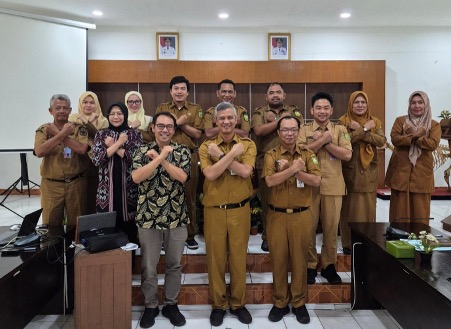
Pekanbaru, 28 April 2026 — The Riau Provincial Government, through the Riau Provincial Environment and Forestry Agency (DLHK) under the GREEN for Riau framework, held a Focus Group Discussion (FGD) on Information Gathering as the Basis for Developing a Forest and Land Fire Prevention Strategy in Riau Province. The activity took place at the Riau Provincial DLHK office.
The FGD served as a cross-sector discussion forum to gather information, experience, and input from stakeholders on the causes, high-risk areas, early warning systems, and prevention strategies related to forest and land fires, locally known as karhutla, in Riau Province.
The activity was attended by representatives from various elements of local government, national government, and academia, including DLHK Riau Province, Bappeda Riau Province, BPBD Riau Province, the Riau Provincial Public Works, Spatial Planning, Housing, Settlement Areas and Land Agency, the Riau Provincial Plantation Agency, the Food Crops and Horticulture Plant Protection Technical Unit, BMKG Riau, and researchers from the University of Riau.
The presence of these various institutions strengthened the cross-sector information-gathering process, particularly on field conditions, early warning systems, regional governance, infrastructure, development planning, and technical aspects of forest and land fire prevention in Riau Province.
Through this FGD, participants discussed several key aspects, ranging from peatland ecological conditions, human activities that may trigger fires, field monitoring challenges, funding needs, and the use of technology to support early detection systems and decision-making.
Fire Prevention Must Be Evidence-Based and Grounded in Field Conditions
GREEN for Riau Provincial Coordinator, Danang Kabul Sukresno, stated that the activity was an important part of developing a more contextual and evidence-based forest and land fire prevention strategy.
According to him, fire prevention strategies should not only look at fire data, but also consider the roles of different stakeholders, local conditions, and potential risks that may affect the success of fire control efforts.
“This FGD serves as a space to gather inputs from technical agencies and relevant stakeholders. We need to understand field conditions, including how fire risks can be managed so they do not exceed the available response capacity,” said Danang.
In his remarks, M. Job Kurniawan, Acting Head of the Riau Provincial Environment and Forestry Agency, emphasized that forest and land fires remain a recurring challenge that requires joint action.
The complex condition of peatland ecosystems, the vast forest areas in Riau, and pressure from human activities are factors that must be managed through a more comprehensive approach.
“Moving forward, our focus is to strengthen prevention. Forest and land fires cannot be handled by one party alone. Collaboration, technological support, capacity strengthening, and a clear division of responsibilities among government, communities, and permit holders are needed,” he said.
He also emphasized that groundwater level management, field preparedness, and institutional strengthening at the site level are important elements in reducing fire risks, especially in peatland areas that are highly vulnerable when they become dry.
Mapping Forest and Land Fire Risks More Accurately
GREEN for Riau Forest Fire Prevention Expert, Dr. Ati Dwi Nurhayati, explained in her presentation that Riau Province is one of the regions with a high level of vulnerability to forest and land fires.
This vulnerability is influenced by the vast extent of peatland ecosystems, human accessibility, land cover, fire occurrence frequency, hotspot distribution, and drought conditions.
“Prevention strategies need to be developed based on vulnerability and risk levels. High-risk areas certainly require a different approach compared to low- or medium-risk areas. Therefore, data and field experience from stakeholders are very important,” explained Dr. Ati.
During the discussion, participants highlighted that the causes of forest and land fires cannot be separated from social and economic factors. Land clearing by burning is still perceived by some communities as cheap, easy, and fast.
For this reason, prevention strategies need to consider more economically realistic alternatives to land clearing without burning, while strengthening outreach, mentoring, and monitoring at the field level.
Data Integration for Early Warning Systems
Participants from disaster management institutions emphasized that early warning systems need to become more operational and easier for field officers to use. Hotspot data, the Fire Danger Rating System (FDRS), information on consecutive dry days from BMKG, community reports, and field patrol results need to be integrated to provide clearer priority areas.
“Data is very important, but it must be translated into field-level decisions. If all areas are categorized as high risk, officers will have difficulty determining priorities. Therefore, the decision support system needs to be more practical, contextual, and aligned with operational needs,” said one participant during the discussion.
The FGD also discussed the importance of developing a Decision Support System capable of integrating various data sources, including hotspots, weather data, peatland conditions, community reports, and field information.
Such a system is expected to help the government and stakeholders determine priority areas for prevention, patrols, and early response.
Strengthening Community Roles at the Site Level
In addition to technology, participants also highlighted the importance of strengthening the role of communities, including Masyarakat Peduli Api (MPA) or Fire Care Communities, in early reporting systems.
Community involvement is considered essential because many fire-prone areas are located far from government centers and are difficult for officers to access. With a more active reporting system, fires are expected to be detected and addressed before they spread.
Through this FGD, several key inputs were gathered, including the need for cross-agency data integration, strengthening early warning systems, increasing capacity and funding for field monitoring, providing alternatives to land clearing without burning, and strengthening coordination among provincial government, district and municipal governments, KPH, BPBD, BMKG, village authorities, communities, and permit holders.
This activity was supported by the UN-REDD Programme and the United Nations Environment Programme (UNEP), and implemented together with Yayasan PETAI and Yayasan PILI as implementing partners under the GREEN for Riau Initiative.
Through this activity, GREEN for Riau supports the Riau Provincial Government in strengthening emission reduction governance in the forestry and land-use sector, including through a data-based, collaborative, and sustainable forest and land fire prevention strategy.