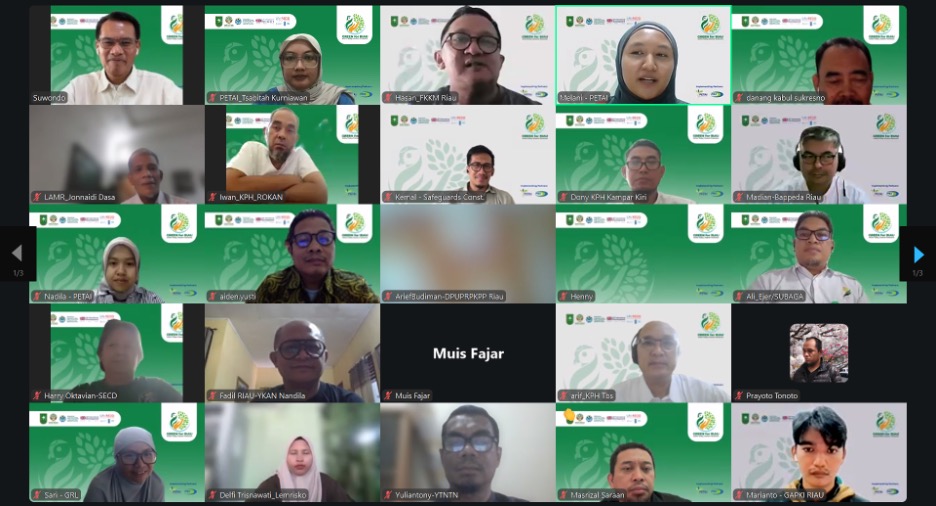
March 11, 2026 – In an effort to accelerate forest conservation-based climate change mitigation, Riau Province reaffirmed its commitment through the Riau Province STRADA REDD+ Baseline Data Identification and Verification Coordination Meeting. This activity is a crucial step in ensuring the availability of accurate data as the foundation for the implementation of Jurisdictional REDD+ (JREDD+) GREEN for Riau.
This initiative, supported by the Ministry of Forestry (Kemenhut), UNEP, and the UK-FCDO, focuses on three main pillars: greenhouse gas (GHG) emission reduction, community empowerment, and ecosystem restoration.
In his opening remarks, Abdul Madian, Head of the Economic and Natural Resources Division of the Riau Province Regional Development Planning Agency (Bappeda), emphasized that the data identification and verification process is at the heart of the GREEN for Riau program. He stated that without a strong and verified database, designed climate change mitigation efforts risk being ineffective.
"Climate change mitigation efforts must be based on accurate, valid, and accountable data. Therefore, the data identification and verification process must be carried out carefully, critically, and collaboratively," he said. He also emphasized that Riau Province plays a strategic role in supporting the national GHG emission reduction target. Therefore, the synchronization of data and indicators discussed at this meeting is expected to strengthen the formulation of more targeted strategies and action plans.
Prof. Dr. Suwondo, M.Sc., professor of ecology and environment at the University of Riau and Mitigation Action Plan Expert for GREEN-Riau, in his presentation stated that this data update is crucial for building a solid REDD+ architecture in Riau, updating the strategy that has been in place since 2012.
"This updated STRADA REDD+ baseline data is our scientific and strategic foundation. By establishing the indicative JREDD+ area, Riau is preparing to implement forest-based climate solutions that will have a real impact on both the planet and the well-being of its people," said Prof. Suwondo.
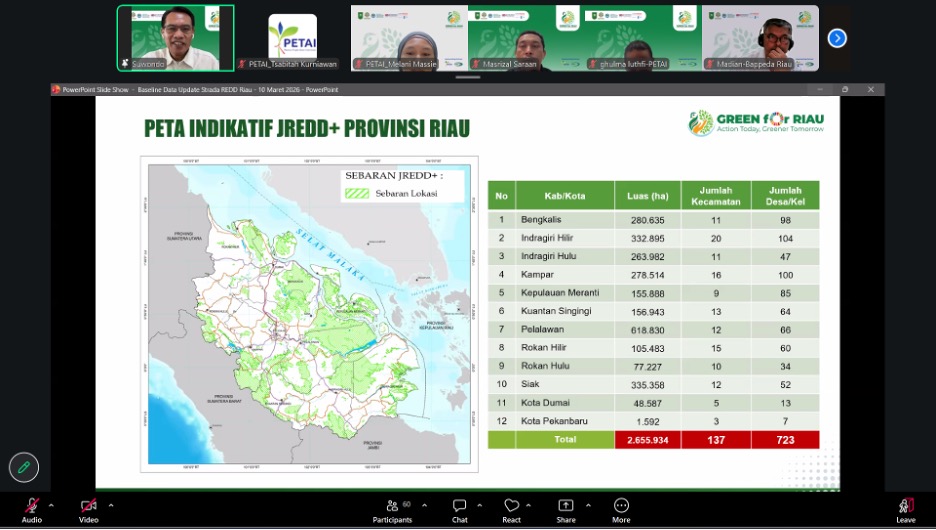
Comprehensive Mapping and Ambitious Emission Reduction Targets
This data updating process includes layered identification, starting from land cover (1990-2024), Peat Hydrological Units (PHU), to potential Social Forestry (PS) and conservation areas. Of the approximately 4.98 million hectares of PHU in Riau, more than 1.78 million hectares fall within the JREDD+ indicative areas. Furthermore, the program also accommodates 97,815 hectares of PS areas to ensure local communities are key actors in forest governance.
Through the Emission Pathway Analysis, Riau has developed a projection scenario up to 2060. Under the Ambitious scenario, Riau Province targets a 34% emission reduction by 2060 (reaching 34.4 million tons of CO2/year), dominated by emissions reductions from the land and energy sectors.
Aligned with Riau's 2025-2029 Regional Medium-Term Development Plan
To address the high cost and limited access to primary data at the grassroots level, the GREEN for Riau Secretariat will encourage the involvement of civil society organizations (CSOs/NGOs) in the process of collecting and validating field data. The preparation and updating of the Riau Province REDD+ STRADA document is targeted for completion by the end of May to early June.
This document will then be aligned with the Riau Province Medium-Term Development Plan (RPJMD) for 2025–2029, so that REDD+ implementation does not proceed separately from the regional development agenda, but is directly integrated into the provincial development planning framework.
Within this framework, REDD+ actions are directed at supporting several regional development priorities, including:
- Improving community economic development, through the development of non-timber forest products (NTFPs) and sustainable agroforestry systems.
- Resolving land conflicts, through strengthening spatial governance and legal certainty over land tenure.
- Strengthening social forestry, by expanding community access to sustainable natural resource management.
- Strengthening environmental oversight, to suppress illegal practices through a transparent and accountable governance system.
Through the GREEN for Riau initiative, the Riau Provincial Government is also promoting the development of a REDD+ benefit-sharing mechanism, which allows for the utilization of incentives from global carbon transactions. The benefits obtained are expected to return to the region in the form of support for village economic development, strengthening community institutions, and protecting and restoring ecosystems in Riau Province.