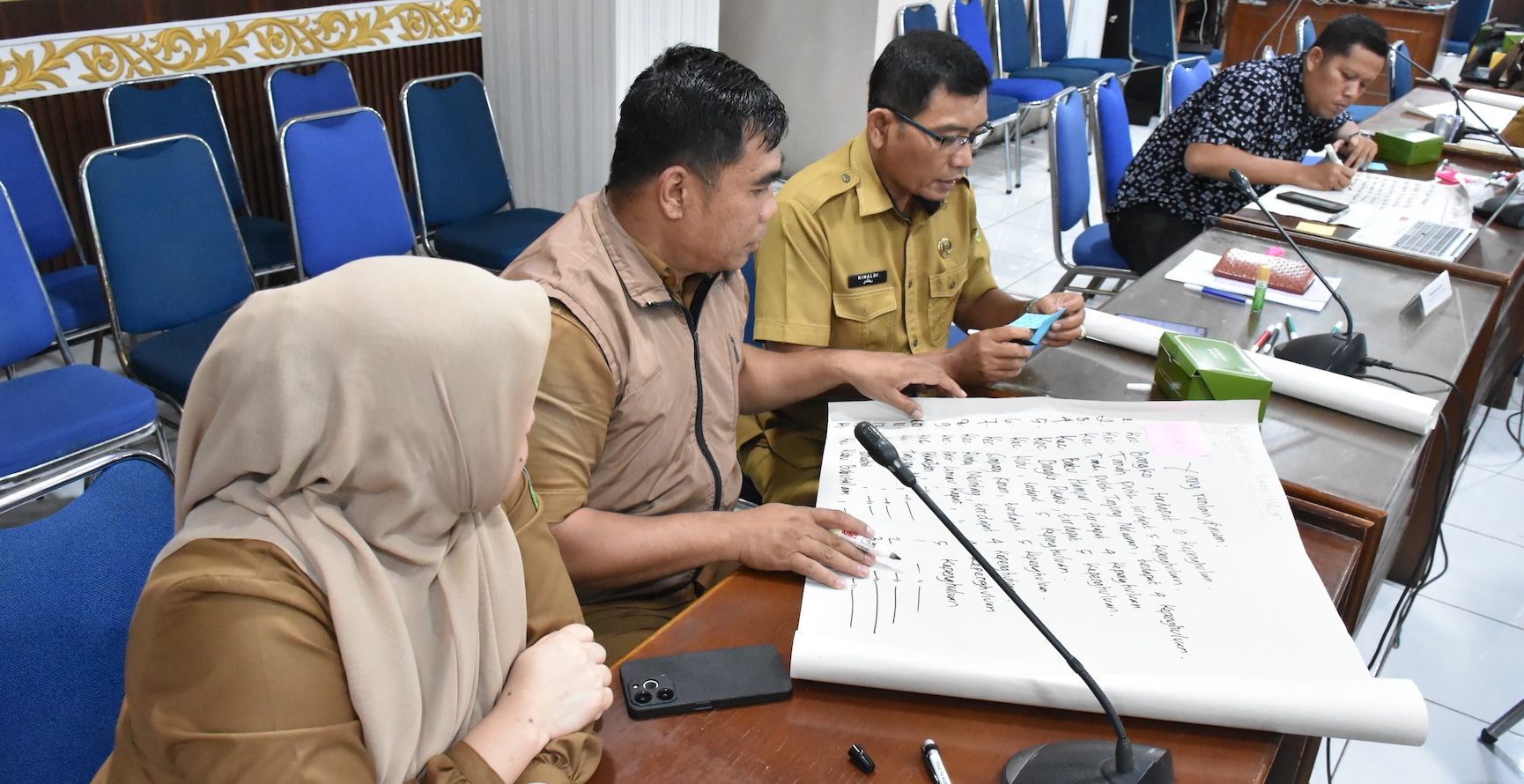
Engaging environmental, agricultural, and plantation-sector agencies from all 12 districts and cities in Riau Province in developing land-use-based regional green programmes.
Pekanbaru, 27 October 2026 — The Riau Provincial Government, through the GREEN for Riau Initiative, held a training session on the roles and functions of district and city government agencies (OPD) in supporting jurisdictional REDD+ (JREDD+) implementation. The event took place in a hybrid format on Tuesday (27 October) at the Parlaungan Meeting Room, third floor of the Riau Provincial Bappeda Office.
The training involved district and city agencies responsible for the environment, agriculture, and plantations. It aimed to improve understanding of JREDD+, clarify agency roles and responsibilities, and encourage the development of green programmes that can be integrated into regional development planning documents.
Purnama Irawansyah, Head of Riau Provincial Bappeda, emphasized that GREEN for Riau forms part of efforts to improve landscape governance. Riau’s extensive peatland ecosystems require joint action to prevent fires, maintain forest cover, and increase carbon sequestration.
“Financing improvements to ecosystems and the environment requires support from various funding sources. Local government readiness, including stronger institutions and the alignment of development programmes with emission reduction efforts, is therefore important,” Purnama said.
Danang Kabul Sukresno, Provincial Lead of GREEN for Riau, explained that a jurisdictional approach requires synergy among provincial, district, city, subdistrict, and village governments. Local initiatives such as Siak Hijau, Pelalawan Sejuk, and Bengkalis Lestari can provide a foundation for strengthening this collaboration.
Danang stressed that programme development must connect environmental protection with community empowerment and ecosystem restoration. He also asked participants to share information and discussion outcomes with their respective institutions to support continuity in implementation.
During the technical session, Miranty Magetsari, GREEN for Riau’s Institutional Strengthening Expert, facilitated discussions on JREDD+ literacy, institutional arrangements, the division of responsibilities, and green programme development. Participants also explored the importance of environmental and social safeguards, community participation, and traceable activity documentation.
Miranty reminded participants that forest protection must be accompanied by economic solutions for communities. Empowerment programmes should be designed to reduce pressure on ecosystems while supporting livelihood needs.
“We must provide solutions, because we cannot simply ask communities not to cut down trees,” she explained.
 The discussions also highlighted the need to align improvements in agricultural and plantation productivity with the protection of forests and natural ecosystems. Potential agency contributions include agroforestry, rehabilitation of degraded land, protection of riverbanks and High Conservation Value areas, fire prevention, and the development of alternative livelihoods.
During the workshop, participants identified at-risk areas and intervention sites, then developed draft programmes based on local challenges. Site selection considered sources of threats, target groups, and connections to GREEN for Riau’s performance accounting area and surrounding areas.
These drafts will serve as initial inputs for internal discussions and coordination across government agencies. Collaboration with Forest Management Units (KPH), Indigenous community groups, civil society organizations, companies, universities, and community groups was also encouraged to improve the effectiveness of task allocation and programme implementation.

In the closing session, Riau Provincial Government representative Rizky Rachmawati emphasized that reducing emissions from deforestation and forest degradation is a shared responsibility.
“This is not the responsibility of just one government agency,” Rizky said. “It involves not only government, but also the private sector, universities, Indigenous Peoples, NGOs, and the media.”
She expressed the hope that participants would help disseminate information within their respective institutions while encouraging the integration of green programmes into regional development planning.
Through this training, the Riau Provincial Government encouraged district and city agencies to follow up on their draft programmes, complete supporting data and evidence of activities, and strengthen coordination. These steps form part of Riau’s readiness to implement JREDD+ in support of forest conservation and improved community well-being.