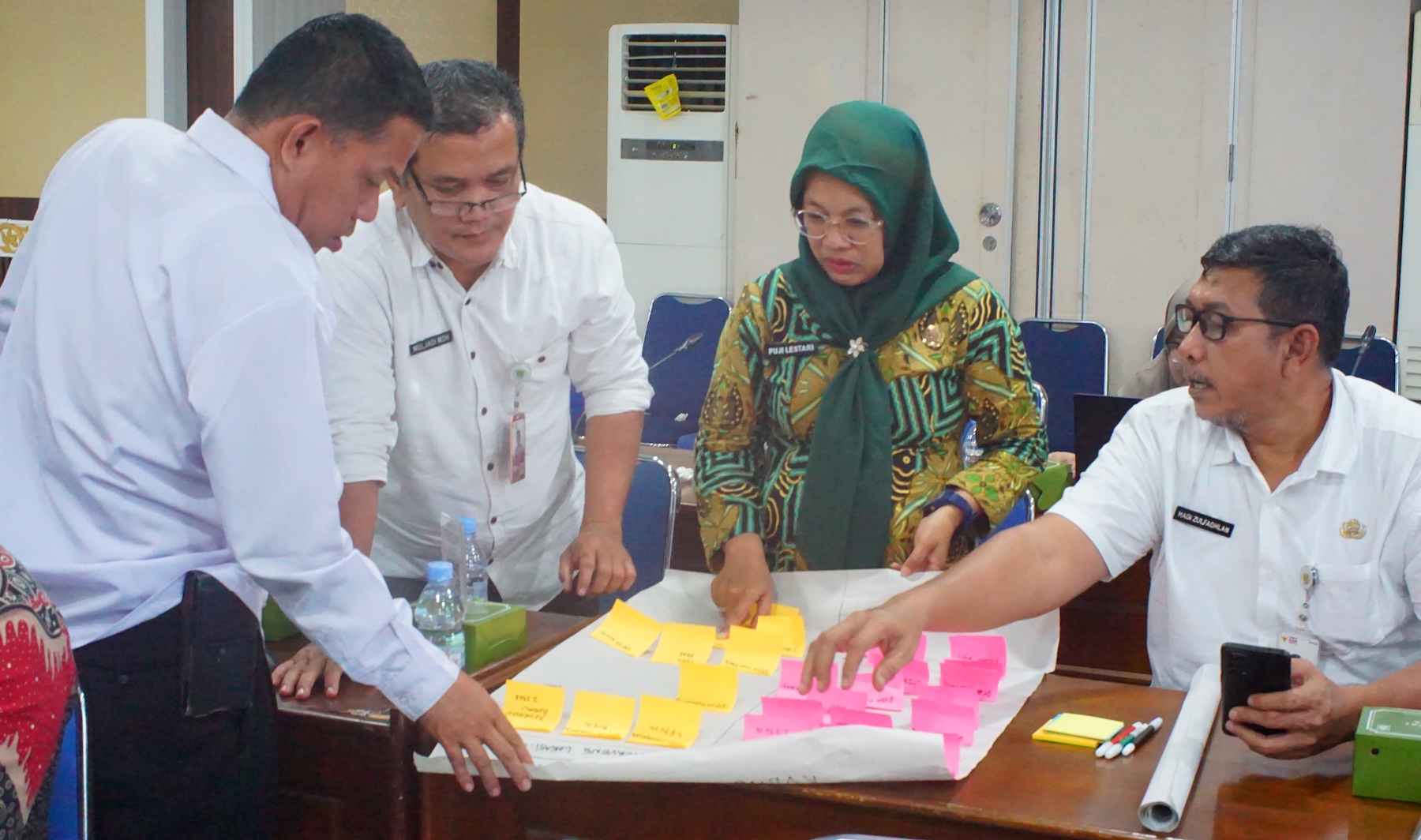
Engaging planning, social affairs, community and village empowerment, women’s empowerment and child protection, communications, and organizational affairs agencies from all 12 districts and cities in Riau Province to support the GREEN for Riau Initiative.
Riau, 28 October 2026 — The Riau Provincial Government strengthened the involvement of district and city government agencies (OPD) in the GREEN for Riau Initiative through training on the roles and functions of agencies in non-land-use sectors. Held in person and online, the event explored cross-sector contributions to reducing emissions from deforestation and forest degradation, strengthening governance, and empowering communities.
Participants included representatives from Bappeda, Community and Village Empowerment Agencies, Women’s Empowerment and Social Affairs Agencies, Communications and Informatics Agencies, and district and city organizational affairs divisions. The discussions complemented the preceding training for land-use-sector agencies.
Purnama Irawansyah, Head of Riau Provincial Bappeda, emphasized the importance of commitment from provincial, district, and city governments in developing jurisdictional REDD+. This approach places emission reduction achievements within a single provincial-level measurement framework, making contributions from all areas essential to its success.
“We need a shared commitment between the provincial government and district and city governments,” Purnama said.
He explained that GREEN for Riau creates opportunities for environmental financing through recognition of performance in protecting forests and reducing emissions. Local governments therefore need to maintain natural forests, prevent forest and land fires, and document their efforts as evidence of performance.
Danang Kabul Sukresno, Provincial Lead of GREEN for Riau, explained that the involvement of non-land-use agencies is needed to extend the programme’s reach to communities. Their roles include development coordination, public communication, village empowerment, and stronger participation by women and vulnerable groups.
“This is collective action, meaning collaboration among everyone at the provincial, district, subdistrict, and village levels,” Danang said.
GREEN for Riau’s readiness phase receives support from the UK Government through UK FCDO, with technical assistance from UNEP and FAO. This support is used to prepare technical and governance arrangements for jurisdictional REDD+, including emission accounting, social and environmental safeguards, and benefit-sharing mechanisms.
During the institutional strengthening session, Miranti Magetsari, GREEN for Riau’s Institutional Strengthening Expert, explained that agency contributions must be translated into clearly defined roles, coordination channels, and work programmes aligned with their respective mandates. Districts and cities can use existing forums or teams, adapting them to GREEN for Riau’s implementation needs.
“GREEN for Riau cannot succeed without your active participation at the district and city levels,” she said.
 Participants also discussed the development of green programmes for 2027–2030. Proposals were directed towards activities that deliver tangible community benefits while supporting forest and peatland protection, including agroforestry, stronger women’s enterprise groups, fire prevention, and alternative livelihoods that reduce pressure on forests.
Each proposal needs clearly defined locations and target groups, measurable results, a division of responsibilities among partners, and traceable documentation. Coordination across agencies is needed to avoid overlapping activities and funding.
Community rights were also addressed through discussions on the Feedback and Grievance Redress Mechanism (FGRM). Sri Mariyati, GREEN for Riau’s FGRM Expert, emphasized that grievance mechanisms must ensure inclusive access, confidentiality of identities, and complainant safety.
“Full assurance of safety and protection of the confidentiality of complainants’ identities,” Sri Mariyati stressed when explaining the FGRM’s operational principles.
The grievance channels discussed included online services through Suara Rimba and in-person services at the local level. Participants highlighted the need to clarify the relationships among grievance channels, public information services, and the institutions authorized to follow up on reports. Offline services remain necessary to reach residents who face barriers to accessing or using technology.
Programme implementation must also apply Free, Prior and Informed Consent (FPIC), known in Indonesia as PADIATAPA, and Gender Equality, Disability and Social Inclusion (GEDSI) principles. Communities need adequate information and the opportunity to decide freely whether to participate.
As a follow-up, participants were asked to share the outcomes with leaders and colleagues in their respective institutions, assign appropriate personnel, strengthen cross-sector coordination, and complete their green programme proposals. Organizing data and evidence of activities is also important to support validation and verification.
The benefit-sharing mechanism remains under development and consultation. Institutional strengthening and local environmental action are therefore expected to continue alongside the preparation of programme arrangements, without waiting for revenues from carbon trading.
