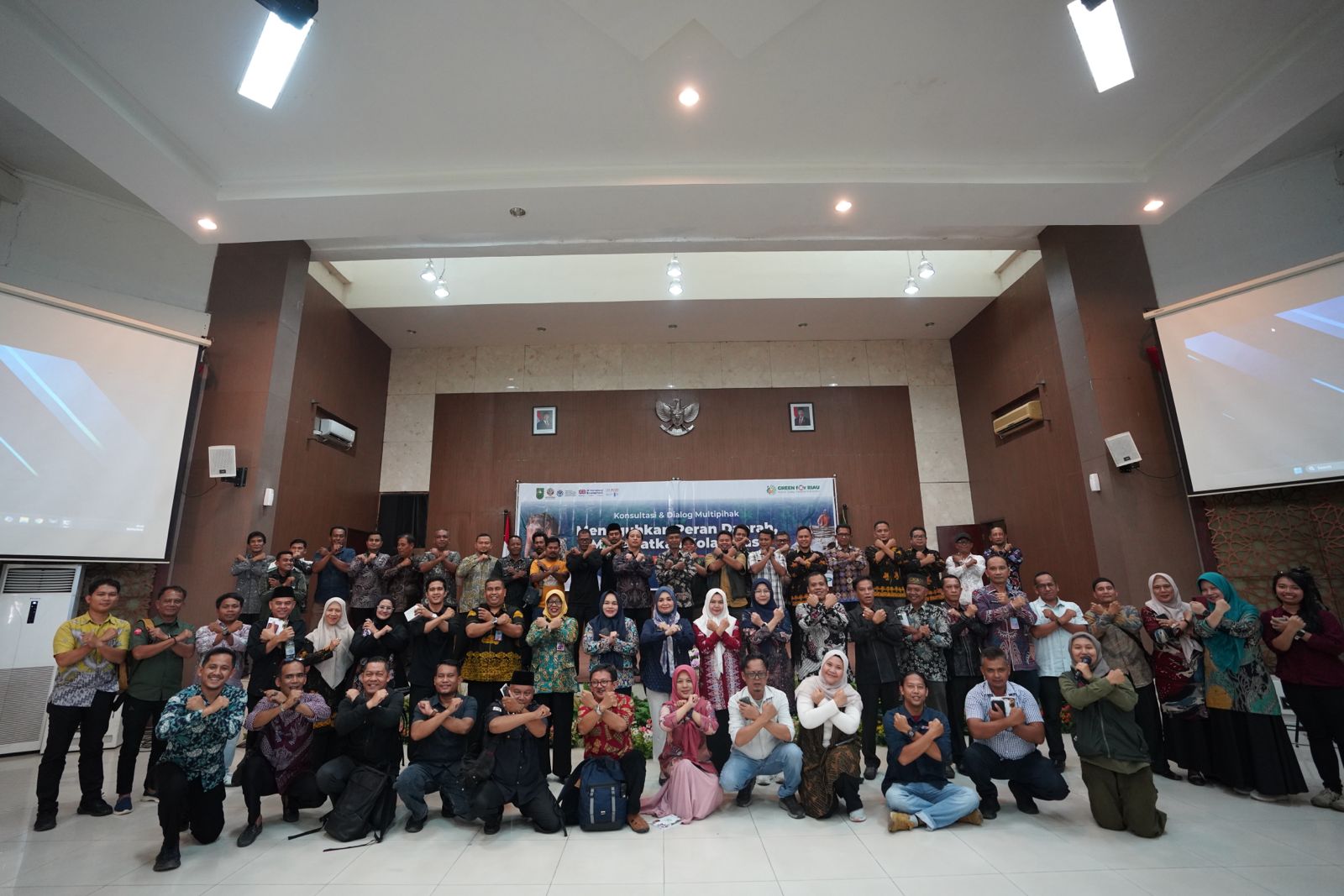
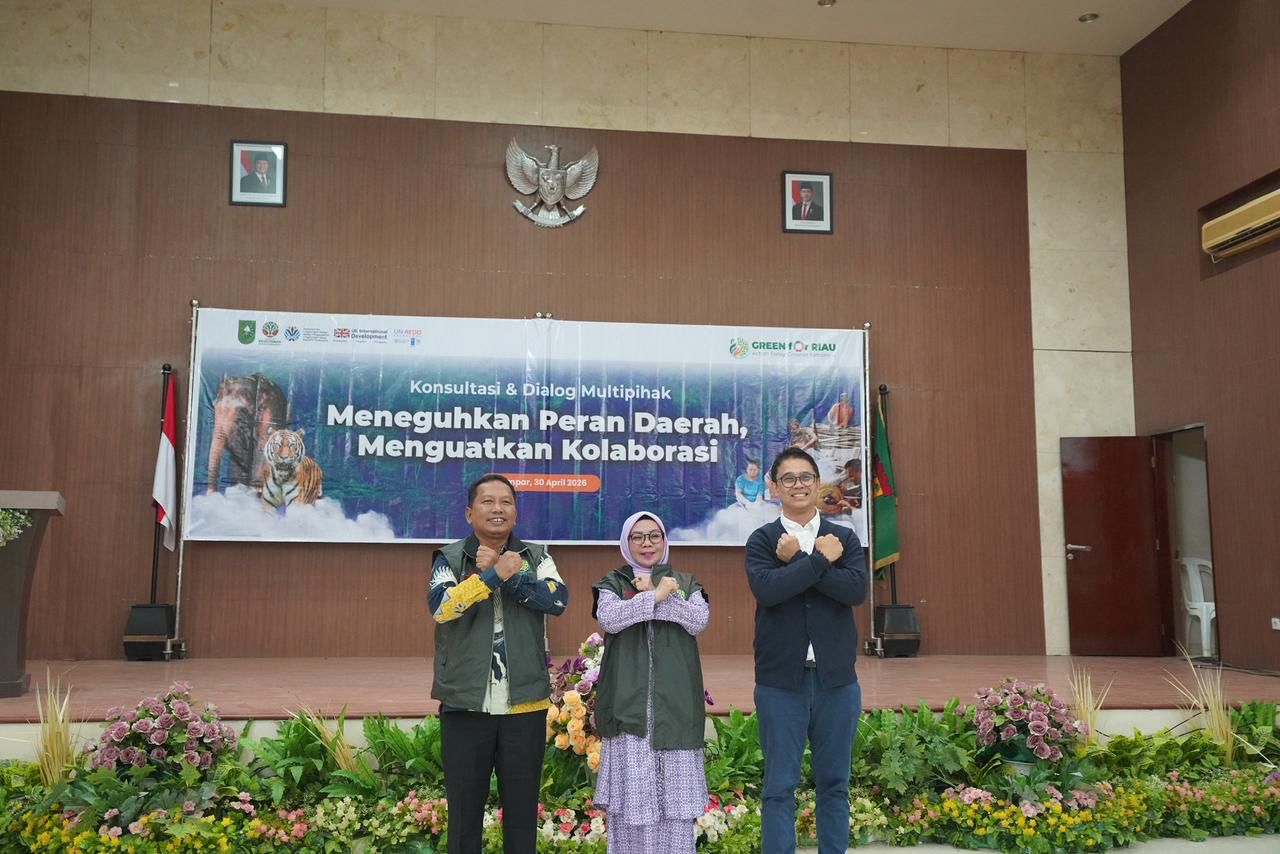
Kampar, 30 April 2026 – The GREEN for Riau Initiative continues its series of Multistakeholder Dialogues in order to strengthen the role of regions in Bangkinang, Kampar Regency. This activity brought together stakeholders from Kampar Regency and Rokan Hulu Regency as part of strengthening regional readiness to support the implementation of Jurisdictional REDD+ in Riau Province.
The meeting in Bangkinang was the closing district meeting of the GREEN for Riau dissemination series at the district/city level. Previously, similar activities had been carried out in Siak for the Pelalawan, Siak and Meranti Islands clusters; in Indragiri Hulu for the Indragiri Hulu, Indragiri Hilir and Kuantan Singingi clusters; as well as in Duri for the Bengkalis, Dumai and Rokan Hilir clusters.
Through this activity, GREEN for Riau strengthens dialogue between regional governments, indigenous peoples, local communities, social forestry groups, civil society organizations, academics, the business world and development partners. This forum is an important space to harmonize understanding, gather input, and build joint commitments in inclusive, transparent and sustainable forest and land management.
The activity began with remarks by Bambang Arifatmi, Country Coordinator of the UNEP UN-REDD Program Indonesia, who emphasized that GREEN for Riau is not only a technical program for reducing emissions, but also a space to strengthen governance, community participation and multi-stakeholder trust. "Transformation can only be realized with leadership that guides direction, maintains consistent implementation, and builds public trust," he said.
He also emphasized the importance of ensuring that the community is not placed solely as a beneficiary, but rather as part of the program planning and implementation process. "We must ensure that traditional communities, local communities, women, people with disabilities and the younger generation are not just beneficiaries, but are co-creators in program design and implementation," he added.
Regional Support for Forest Protection and Green Development
The Rokan Hulu Regency Government, represented by the Head of the Rokan Hulu Regency Baperida, Simel Mary, also expressed support for the implementation of GREEN for Riau as a strategic step in strengthening sustainable forest protection and management. In the remarks delivered by representatives of the Rokan Hulu Regency Government, it was emphasized that forests are not only seen as natural resources, but also as life support, ecosystem balance, and an important legacy for future generations.
"Forests are not just natural resources, but also life support, ecosystem balance support, and a valuable heritage that we must protect together for future generations," said the speech.
The Rokan Hulu Regency Government also emphasizes that successful forest management cannot be done alone. Multi-stakeholder collaboration is needed involving the government, indigenous communities, social forestry groups, the business world, as well as inclusive and sustainable policy support. "It requires multi-stakeholder collaboration, involvement of indigenous communities, social forestry groups, the business world, as well as inclusive and sustainable policy support," he continued.
Meanwhile, the Deputy Regent of Kampar, Dr. Hj. Misharti, S.Ag., M.Sc., in his speech said that Kampar Regency has a strong commitment to preserving the environment, especially through forest protection and management. This commitment is realized through various efforts, including strengthening social forestry, facilitating community groups, supporting the recognition and protection of indigenous communities, controlling forest and land fires, and integrating environmental issues in regional planning documents.
"Kampar Regency has high hopes for the GREEN for Riau initiative. We hope that this initiative can become a multi-stakeholder collaboration platform that strengthens the role of local government, society, the business world and international development partners," he said. He also emphasized the importance of inclusive mechanisms to ensure the participation of indigenous peoples and local communities, as well as systems that are able to integrate forest protection with improving community welfare.
"We believe that the success of forest protection is not only determined by regulations, but also by collaboration, joint commitment and program sustainability in the field," he stressed.
Indigenous Communities, Social Forestry and NGOs are Fully Involved
The GREEN for Riau District Meeting in Bangkinang does not only involve regional governments, but also sub-district governments, village governments, indigenous communities, social forestry groups, NGOs, academics, women's groups, and community leaders from Kampar and Rokan Hulu Regencies.
The involvement of these various elements is an important part in ensuring that the implementation of GREEN for Riau runs inclusively and meaningfully. In the context of jurisdiction-based REDD+, input from indigenous peoples, local communities and social forestry groups is key so that the program is not only oriented towards reducing emissions, but also pays attention to rights, local knowledge, sources of livelihood and real conditions at the site level.
This forum is also a space to explore the experiences, challenges and aspirations of the community in protecting forests and land, including good practices that have been carried out by the community in managing social forestry, preventing forest and land fires, and strengthening the community-based green economy.
 Strengthening Governance, FGRM, and Forest and Forestry Prevention
In the discussion session, participants were invited to explore a number of important aspects in GREEN for Riau, including strengthening governance, inclusive community participation, the role of indigenous communities and social forestry groups, as well as feedback and complaint handling mechanisms or the Feedback and Grievance Redress Mechanism (FGRM). Through the FGRM discussion, participants provided input so that the complaint mechanism and complaint handling could be understood more simply and easily accessed by the community at the site level. This is important to ensure that every input, complaint or potential problem that arises during program implementation can be received, recorded and followed up on in a transparent manner.
The discussion also highlighted the importance of community-based forest and land fire prevention, including strengthening peat management, monitoring peat water levels, and using data to support prevention efforts. Local knowledge and community practices are also a concern as part of a prevention strategy that is more contextual and appropriate to regional conditions.
Closing the Series of District Meetings, Strengthening Joint Commitment
The meeting in Bangkinang emphasized the importance of regional leadership, multi-stakeholder collaboration and meaningful community involvement in supporting low-emission development in Riau Province. It is hoped that this activity will produce constructive input, strategic recommendations, as well as a shared commitment to preserving forests and the environment, especially in Kampar and Rokan Hulu Regencies. Through open and participatory dialogue, GREEN for Riau encourages efforts to protect forests, strengthen climate resilience and improve community welfare to run in a balanced manner.
With the end of the series of regional multi-stakeholder dialogues in Bangkinang, GREEN for Riau further strengthens the foundation of regional collaboration towards an inclusive, transparent and fair implementation of Jurisdictional REDD+ throughout the Riau Province region.