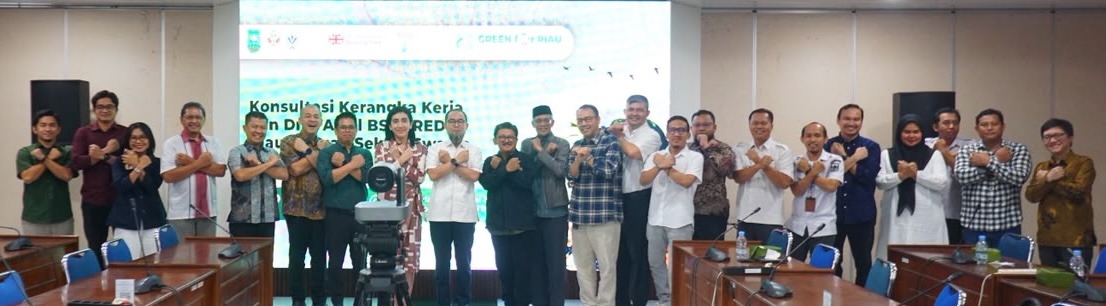
Pekanbaru, 23 September 2026 — The Riau Provincial Government held a consultation on the framework and initial draft of the Riau JREDD+ Benefit Sharing Plan (BSP) with holders of Forest Utilization Business Licenses (PBPH), the Indonesian Forest Concessionaires Association (APHI), and other stakeholders. The meeting gathered input from the private sector on who should be entitled to receive benefits from emission reduction efforts, how contributions should be assessed, and how benefits can be distributed fairly.
Opening the meeting, Head of Bappeda Riau Province, Purnama Irawansyah, S.Hut., M.M., emphasized the principle of “no one left behind.” He stated that parties contributing to maintaining forest cover and supporting emission reductions need to be taken into account in benefit-sharing policies. Therefore, feedback and criticism from the private sector are needed to refine the draft BSP.

Bambang Arifatmi, Country Coordinator of the UNEP UN-REDD Programme in Indonesia, described the BSP as a “bridge between performance and fairness.” In his remarks, he emphasized that the credibility of REDD+ depends on robust measurement of emission reductions, environmental and social safeguards, and clarity regarding who receives the benefits. Buyers and investors, he noted, also need to see evidence that benefits genuinely reach those who contribute, including communities.
Danang Kabul Sukresno, Provincial Lead of GREEN for Riau, presented the development of Riau’s JREDD+ and the importance of aligning existing carbon projects with the provincial-level REDD+ programme. This alignment, known as nesting, is one of the key issues for PBPH holders that have already implemented forest management and emission reduction activities.
Riko Wahyudi, GREEN for Riau Benefit Sharing Plan Expert, explained that the BSP draft is still under consultation. The proposed benefit-sharing mechanism needs to be developed through stakeholder agreement so that its criteria and mechanisms can be accepted and implemented. The forum with the private sector forms part of the process to test the initial proposal against conditions on the ground.

During the discussion, representatives of PBPH and APHI requested clarification on the definition of forest cover, how company performance would be assessed, and what evidence of mitigation actions would be required. Participants also discussed options for benefits in the form of cash or activities, the possibility of overlapping claims between PBPH holders and villages, and the relationship between existing carbon projects and Riau’s jurisdictional scheme.
In response to these inputs, the drafting team stated that several elements of the draft, including additional requirements for PBPH holders and forms of benefit distribution, still require further discussion. Participants’ inputs will be documented as material for refining the BSP and for subsequent discussions with relevant parties.
Through this consultation, the Riau Provincial Government seeks to ensure that the BSP design recognizes the contributions of various parties while also providing space for the protection of the rights of Indigenous Peoples, local communities, and vulnerable groups. The development of the benefit-sharing mechanism will continue through dialogue and further review of issues that have not yet reached agreement.
