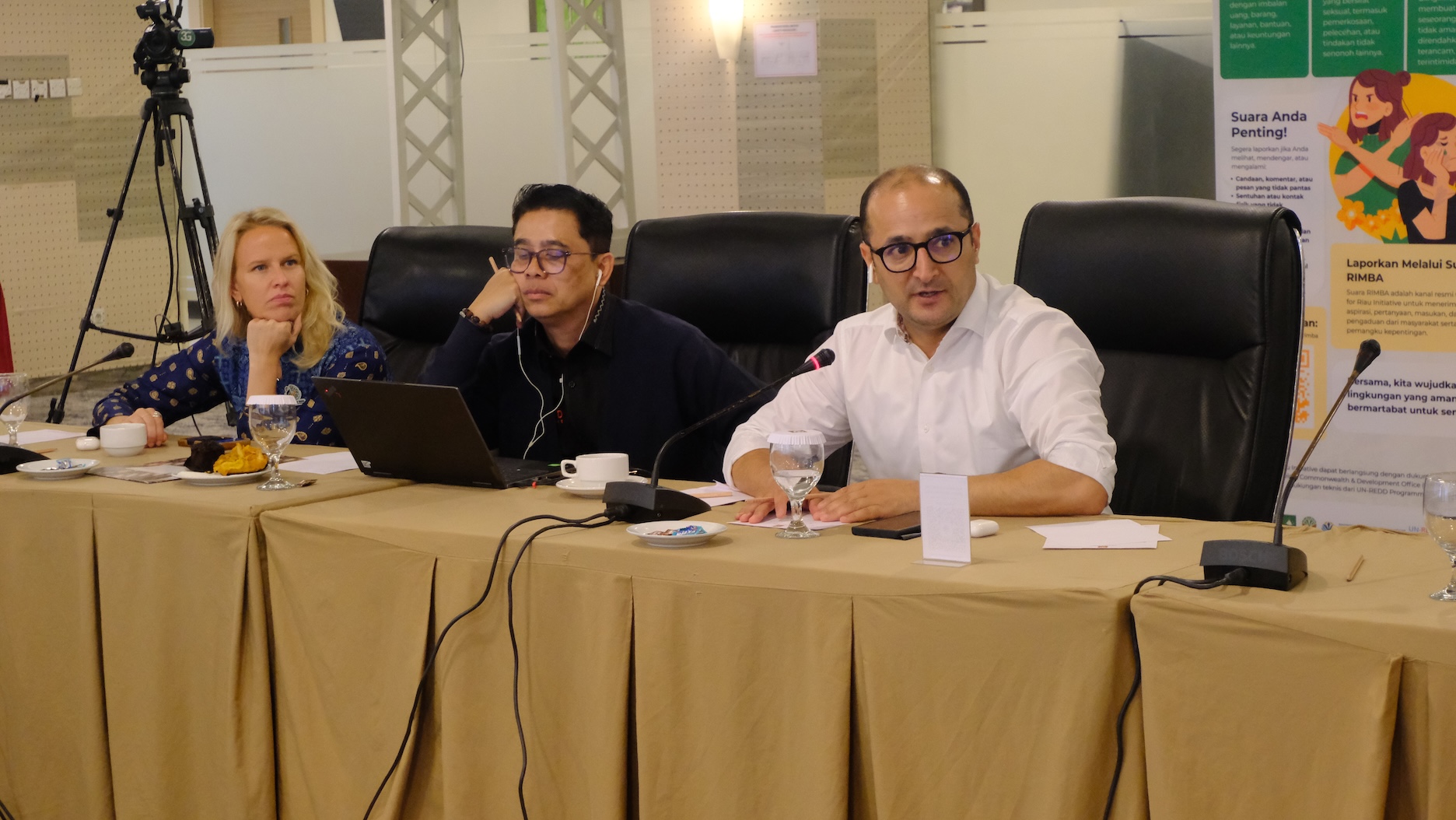
JREDD+ Nesting Roundtable discusses the integration of projects, communities, and government into one transparent jurisdictional accounting system to prevent double counting
Pekanbaru, 8 September 2026 — The Riau Provincial Government, together with the Ministry of Forestry and the UN-REDD Programme, held the Roundtable Workshop Draft Operational Guidance Note Riau’s Jurisdictional REDD+ Nesting and Accounting Framework in Pekanbaru. The meeting marked an important part of the process to develop the nesting and accounting framework for jurisdictional REDD+ in Riau Province.
The activity was held in a hybrid format at Hotel Pangeran, Pekanbaru, involving stakeholders from central and regional governments, carbon project developers, development partners, carbon standard bodies, the private sector, and other relevant parties. The forum aimed to gather inputs on the draft Operational Guidance Note for the Riau JREDD+ Nesting and Accounting Framework, while also identifying policy decisions and institutional arrangements that still need to be refined before the document is finalized.
Riau Province holds a strategic position in supporting Indonesia’s climate targets. With around 4.9 million hectares of peatlands, Riau stores significant carbon stocks, while at the same time facing pressures from deforestation, forest and peatland degradation, fires, and land-use change. Riau is currently also a pilot location for a subnational jurisdictional REDD+ programme aligned with the ART-TREES standard and is being prepared to access results-based finance to support Indonesia’s Net FOLU Sink 2030 target.
The need for a nesting framework has become increasingly important, as mitigation outcomes in Riau are generated by various parties and across areas that may overlap, ranging from jurisdictional programmes and existing carbon projects to permit holders, social forestry groups, and communities. Without an integrated accounting system, this condition could create risks of double counting, double issuance, and overlapping claims over emission reduction results.
In her remarks, Prof. Dr. Haruni Krisnawati, S.Hut., M.Si., Expert Staff to the Minister for Climate Change, Ministry of Forestry, emphasized that the development of the nesting framework must remain aligned with national policies and targets, ensure environmental integrity and carbon trading integrity, provide clarity on the rights and responsibilities of each party, and continue to accommodate ongoing mitigation initiatives. The framework must also ensure that benefits can be received fairly by communities, including Indigenous Peoples, social forestry groups, women, vulnerable groups, and other community groups that contribute to forest protection.
The framework being developed is also expected to be adaptive to evolving regulations and methodologies. Riau’s experience has the potential to become an important lesson for the development of jurisdictional REDD+ approaches in other provinces, as well as for the development of operational nesting arrangements at the national level. Several issues that still require further assessment include government authority, methodology, accounting and registration, risk allocation, and their relationship with national mitigation targets.
Annette Wallgren, UN-REDD Asia-Pacific Regional Coordinator, UNEP Asia Pacific, emphasized that nesting is not only a matter of technical carbon accounting. This framework serves as an instrument to connect actions at the project and site levels with reporting at the provincial and national levels, so that the contributions of various parties can be recognized within one consistent system and the risk of double counting can be prevented. Clear rules are also needed to build certainty and trust among communities, project developers, government, and potential carbon credit buyers.
The Riau Provincial Government highlighted the complexity of conditions on the ground. The area discussed in the jurisdictional context covers around 2.6 million hectares, with various forms of permits, management rights, interests, and ongoing mitigation activities. Therefore, the nesting framework needs to be carefully designed so that it can accommodate both existing activities and new initiatives without compromising the integrity of the jurisdictional system.
In the technical presentation, Kamran Hussain, Programme Management Officer (UNEP/UN-REDD), Jakarta & Technical Advisor on Forest Carbon Markets - Asia Pacific, explained that the draft guidance aims to place projects, communities, and the Riau Provincial Government within one accounting system that ensures every tonne of emission reduction or removal is counted correctly, transparently, and only once. All proposals presented during the roundtable remain draft proposals and are open to refinement based on stakeholder inputs.
The draft proposes three pathways that can operate simultaneously. Pathway A accommodates private projects that issue credits directly while remaining integrated into the jurisdictional system. Pathway B accommodates Indigenous Peoples, social forestry groups, and other community groups through jurisdictional credits linked to the benefit-sharing mechanism. Meanwhile, Pathway C enables the Provincial Government to issue credits for areas not covered under the first two pathways. All three are designed to operate within one jurisdictional accounting boundary so that the total credits issued do not exceed Riau Province’s mitigation outcomes.
 Safeguards are also an important part of the draft framework. The nesting framework is proposed to use and strengthen the safeguards system already available through SIS-REDD+, as well as the safeguards foundation being developed in Riau, rather than creating a separate new system. On the institutional side, the forum discussed the role of the J-REDD Steering Committee and the need to establish or strengthen a technical secretariat to manage the nesting database, check potential overlaps, monitor project status, document safeguards, and support reporting.
The meeting also identified several follow-up actions to be taken after the roundtable, including: disseminating the draft to gather written inputs; initiating early communication with crediting programme administrators regarding the application of the risk allocation tool and the development of Riau’s risk map; developing a more complete nesting agreement for relevant projects and recording it in the nesting database; checking safeguards evidence against ART-TREES requirements; finalizing arrangements for the steering committee, the location of the technical secretariat, and its financing scheme; and periodically reviewing the guidance in line with developments in the reference level and national regulations.
 The roundtable emphasized that the process of developing Riau’s nesting framework is still ongoing. Technical, methodological, institutional, and policy inputs obtained through the meeting will serve as material to refine the draft Operational Guidance Note. Participants were also given the opportunity to submit written comments and inputs after the meeting.
Through this consultative process, Riau is expected to build a high-integrity jurisdictional REDD+ framework that can fairly recognize the contributions of various parties, while remaining aligned with the national REDD+ architecture and Carbon Economic Value policy.