
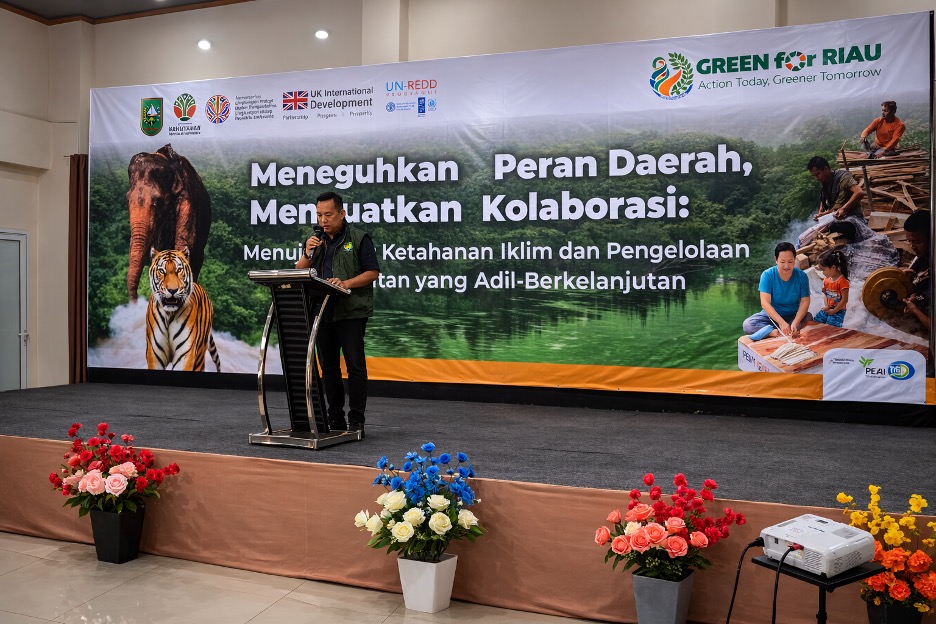
Indragiri Hulu, February 27, 2026 – The GREEN for Riau Initiative (GREEN for Riau) further strengthens its commitment to encouraging support from local governments and stakeholders for the implementation of the Free, Prior, and Informed Consent (FPIC) principle. Through a series of socialization activities in Indragiri Hulu, Indragiri Hilir, and Kuantan Singingi Regencies, this initiative emphasizes the importance of cross-sector collaboration to achieve inclusive, transparent, and equitable forest and land governance as a foundation for strengthening regional climate resilience.
This activity provided a strategic dialogue space between local governments, indigenous communities, social forestry, civil society organizations, the Forest Utilization Business Permit (PBPH), academics, and development partners to align steps towards sustainable forest and land management while strengthening low-emission development in Riau Province.
During the meeting, Bambang Arifatmi, Country Coordinator of UNEP UN-REDD Programme Indonesia, stated that "We now have the momentum through the GREEN for Riau program to transform challenges into opportunities—with integrity as the foundation, collaboration as the culture, innovation as the driving force, and good governance as the guardrail."
Meanwhile, the Regional Secretary of Indragiri Hulu Regency, Zulfahmi Adrian, A.P., M.Si., emphasized that "GREEN for Riau is not just an environmental program; it is a collective commitment to building more equitable, transparent, and sustainable forest and peatland governance."
 Strengthening Governance and Funding Transparency
In Parallel Session 1, attended by representatives from Regional Apparatus Organizations (OPD), Technical Implementation Units (UPT), and Forest Utilization Business Licensing (PBPH), Grievance Redress Mechanism Expert Anwar Rosyadi and Budget Tagging Expert Rizky Rachmawati emphasized the importance of strengthening governance through stakeholder mapping, institutional strengthening, budget tagging, and identifying the need for a Feedback and Grievance Redress Mechanism (FGRM).
Strengthening governance and funding transparency are strategic steps in supporting the effectiveness of climate change mitigation and adaptation actions. Through a structured reporting system and budget tagging, each activity can be traced for its contribution to emission reductions and climate risk reduction. This transparency also strengthens accountability, increases stakeholder trust, and ensures that every source of funding—whether from the regional budget or partners—has a tangible impact on climate resilience and sustainable development.
Inclusive Community Participation
Parallel Session 2, which involved indigenous peoples, local communities, women's groups, and social forestry groups, emphasized the importance of active community participation in all stages of the program. Indigenous Peoples/Local Communities Expert, Himyul Wahyudi, S.E., and Gender Expert, Dzul Afifah Arifin, M.Sc., emphasized that the success of GREEN-RIAU depends heavily on inclusive community involvement.
The GREEN for Riau Initiative addresses more than just carbon, but also ensures that women, indigenous peoples, and vulnerable groups have equal access to the process and its benefits.
By strengthening the role of communities and actively involving women's groups and indigenous communities, this program is expected to encourage green development that focuses not only on reducing emissions but also on social justice and community well-being.
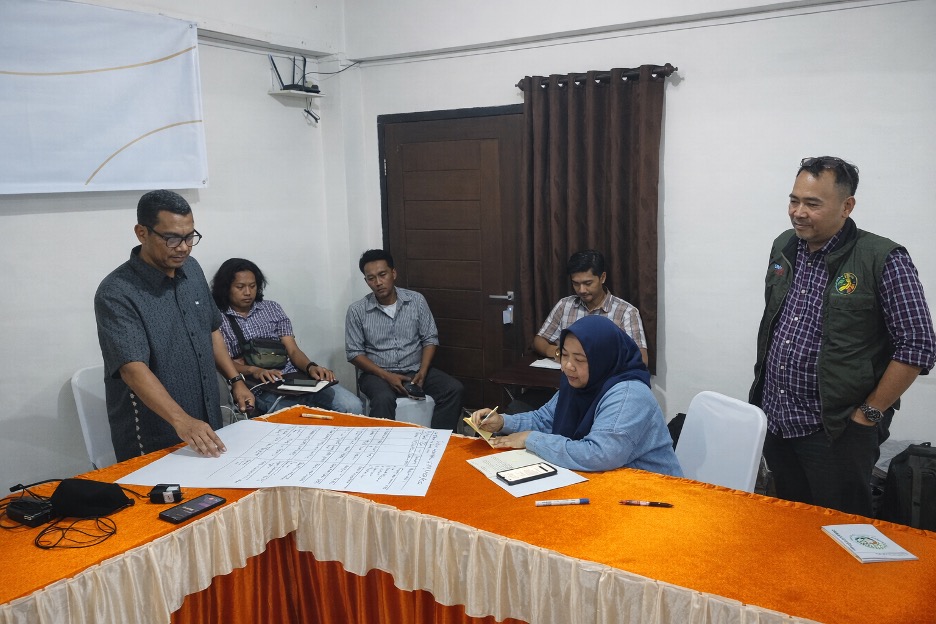 Social Risk and Conflict Mapping
In the social risk mapping session, Stakeholder Engagement and Community Development Expert, Harry Oktavian, and Conflict Resolution Expert, Dr. Ir. Wiratno, M.Sc., emphasized the importance of early identification of land tenure conflicts and land conversion as key challenges in Riau.
The discussion focused on the potential for conflict resulting from overlapping permits, spatial planning changes, and unclear forest and village boundaries, which are often the root of problems at the grassroots level.
An open discussion involving Regional Government Organizations (OPD), Technical Implementation Units (UPT), and PBPH also raised various issues on the ground, including land claims and the existence of certificates within forest areas.
"Many conflicts are rooted in boundary issues, maps, and lack of transparency in information," emphasized Dr. Wiratno. Similarly, Harry Oktavian added, "The GREEN for Riau Initiative must be a solution, not a source of new conflict. Through social risk mapping, we ensure that every step is sensitive to field conditions and strengthen trust between stakeholders."
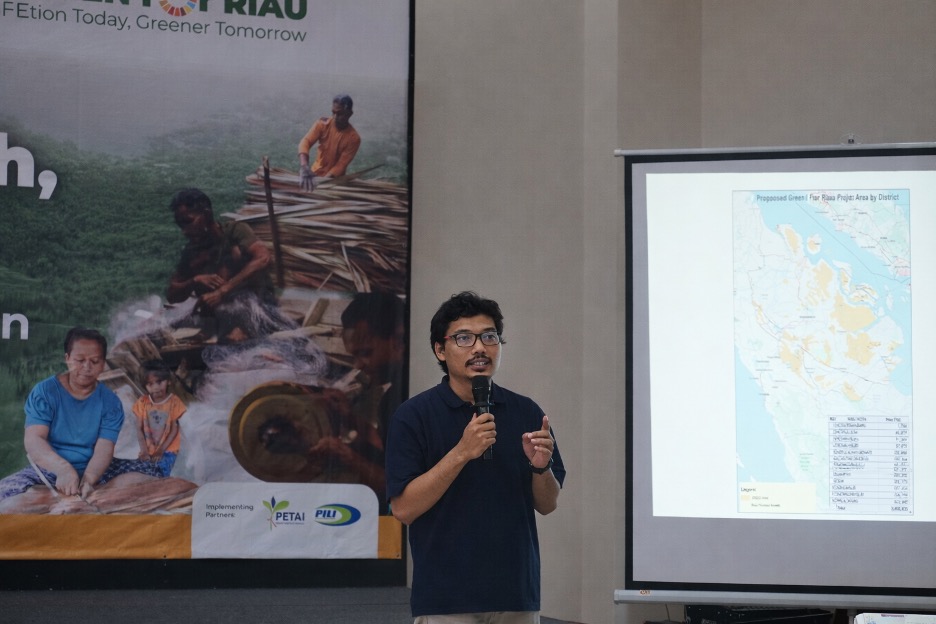
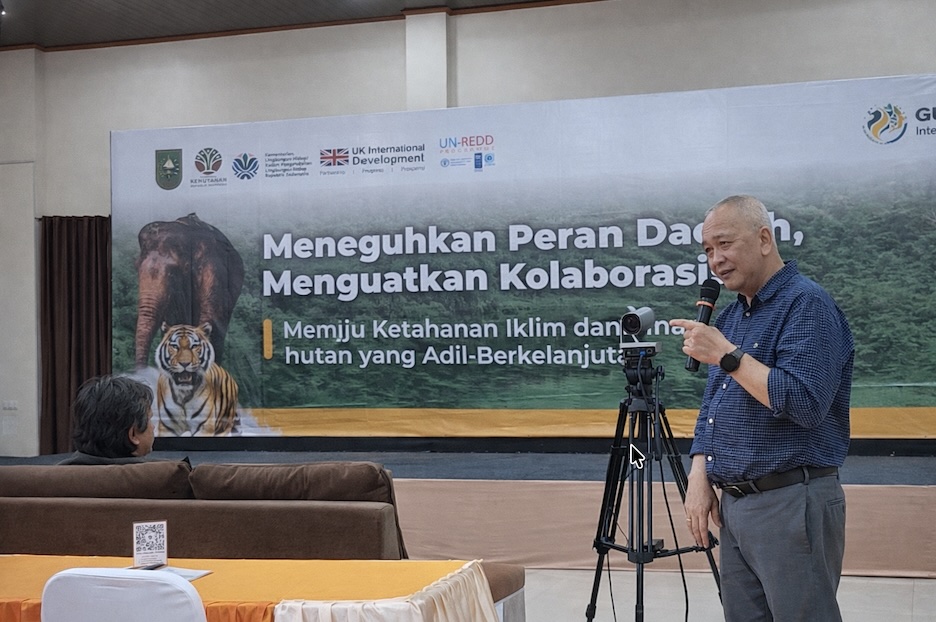 Indicative Carbon Accounting Area of 2.6 Million Hectares
In his presentation, Nesting Development and REDD+ Governance Expert Muis Fajar stated that GREEN for Riau has formulated an indicative carbon accounting area of 2.6 million hectares spread across 12 regencies/cities as the basis for calculating emission reductions based on the ART-TREES standard, with a 2016 baseline. Only areas meeting technical criteria are included in the calculation, while approximately 49,000 hectares of conflict areas are prioritized for governance improvements and resolution through schemes such as TORA (Land Objects of Agrarian Reform) before being included in the carbon scheme.
"Our approach is not simply to calculate carbon, but to ensure better governance so that benefits truly return to the community," he emphasized.
In addition to tenure conflicts, risk mapping also includes wildlife-human conflict in elephant and tiger ranges. Through the principle of beyond carbon, GREEN-Riau emphasizes integrity, biodiversity protection, and strengthening documentation and transparency as keys to increasing the credibility and value of Riau's carbon in the international market.
 Commitment Towards Equitable Green Development
In the closing session, the Head of the Forest Planning and Utilization Division of the Riau Province Environment and Forestry Agency, Dr. Matnuril, S.IP., M.Sc., M.H., emphasized that the GREEN for Riau Initiative is a shared ideal that must be implemented collaboratively and equitably. He expressed his appreciation for the active participation of all participants, while also encouraging them to strengthen the commitment and understanding developed across all regencies/cities in Riau.
"The GREEN for Riau Initiative is a shared ideal that we must safeguard and implement with strong collaboration. If we work together, the benefits will not only benefit the forests, but also the communities throughout Riau," he emphasized.
He also expressed his gratitude to the partners, hoping that Riau Province would soon move from the readiness stage to implementation, so that the benefits of green development can be felt throughout its 2.6 million-hectare jurisdiction.
About the UN-REDD Programme: The UN-REDD Programme is a UN collaboration (UNEP, FAO, UNDP) to assist developing countries in reducing emissions from deforestation and forest degradation and managing forests sustainably.