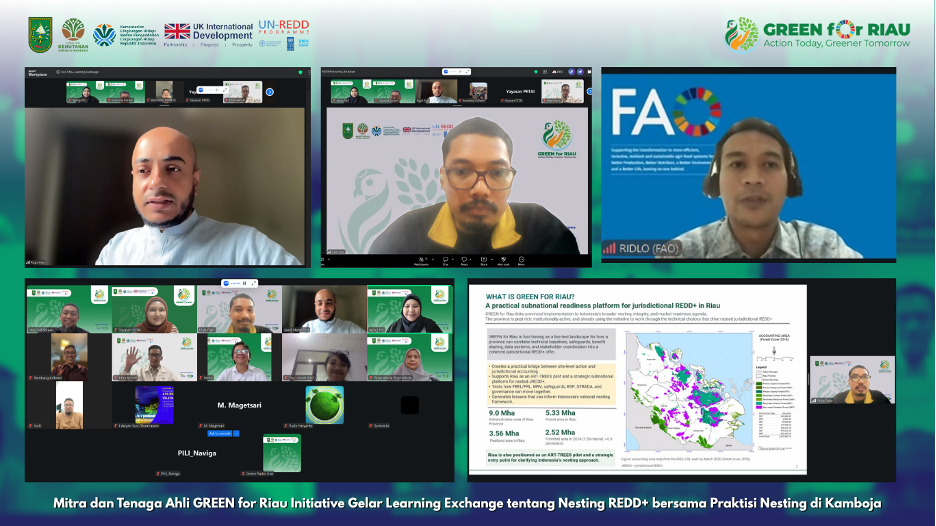
Pekanbaru, May 19, 2026 — The GREEN for Riau Initiative held an online NESTING Learning Exchange via Zoom on Tuesday, May 19, 2026. This meeting served as a platform for sharing knowledge and reflection on the nesting approach within the REDD+ framework, specifically to support Riau Province's readiness for Jurisdictional REDD+ (JREDD+) implementation.
The event featured Dr. Jamil Mahmood, Climate and Forest Specialist from UNDP. He shared lessons learned from the REDD+ nesting framework development process in Cambodia, including challenges in aligning REDD+ projects with the jurisdictional approach, the Measurement, Reporting, and Verification (MRV) system, safeguards, the registry, and benefit-sharing mechanisms.
The meeting was opened by Bambang Arifatmi, PhD, Country Coordinator of the UNEP UN-REDD Programme in Indonesia, who expressed his appreciation for Dr. Jamil's willingness to share his experiences. He emphasized that cross-border learning is crucial for Riau, especially as the province is building technical and institutional readiness for jurisdiction-based REDD+.
In the discussion, the GREEN for Riau team outlined the context of Riau Province as a priority area for reducing emissions from the forestry and land sector. Riau has complex landscapes, including forest areas, concessions, social forestry, and extensive peat ecosystems. This complexity makes a nesting approach crucial to ensure that various emission reduction initiatives, both at the project and jurisdictional levels, are interconnected and do not create the risk of overlapping emissions claims.
Muis Fajar, a consultant for Nesting Development and REDD+ Governance, explained that Riau is developing a nesting concept to bridge existing REDD+ initiatives at the project level with a broader jurisdictional framework. One key concern is how to align differences in methodology, baseline periods, carbon standards, and emissions calculations between registered projects and the jurisdictional framework being developed.
In response, Dr. Jamil emphasized that developing nesting requires a comprehensive framework and not a single standard. The nesting framework needs to be designed to accommodate various mechanisms, including voluntary carbon standards, results-based payments, and other relevant schemes.
He also emphasized the importance of data alignment between the national, subnational, and project levels to avoid the risk of double counting and emissions leakage.
“Alignment of emissions calculations, MRV systems, safeguards, registries, and benefit sharing is a crucial element in ensuring the integrity of the nesting framework,” was one of the key points emphasized in the discussion.
The safeguards aspect was also a key topic of discussion. Irfan Kemal, Safeguards Coordinator, addressed the challenges of ensuring that safeguards and Free, Prior, and Informed Consent (FPIC) processes can be adequately implemented across a broad jurisdiction and involving multiple stakeholders. Dr. Jamil also shared his experience on the importance of a well-documented, easily accessible safeguards reporting system capable of storing evidence of implementation for monitoring and audit purposes.
The discussion also highlighted the importance of a Benefit Sharing Mechanism (BSM), which must be developed in a transparent, participatory manner, involving stakeholders who play a direct and indirect role in emissions reduction efforts. A benefit sharing mechanism is seen as a crucial requirement for REDD+ implementation to provide equitable impacts for the government, communities, local communities, and all parties contributing to ecosystem protection and restoration.
Through this learning exchange, the GREEN for Riau Initiative gained valuable input to strengthen the development of a nesting framework in Riau. Key lessons learned include the need to strengthen a consistent MRV system, integrate safeguards, develop a registry linked to the national system, and develop a clear and accountable benefit sharing framework.
This activity is part of a series of learning and capacity-building processes conducted by the GREEN for Riau Initiative to build Riau Province's readiness for a credible, inclusive, and environmentally sound JREDD+ implementation. Going forward, the lessons learned from this forum are expected to strengthen the technical and institutional processes for REDD+ in Riau, while also supporting the province's contribution to Indonesia's climate change mitigation agenda.