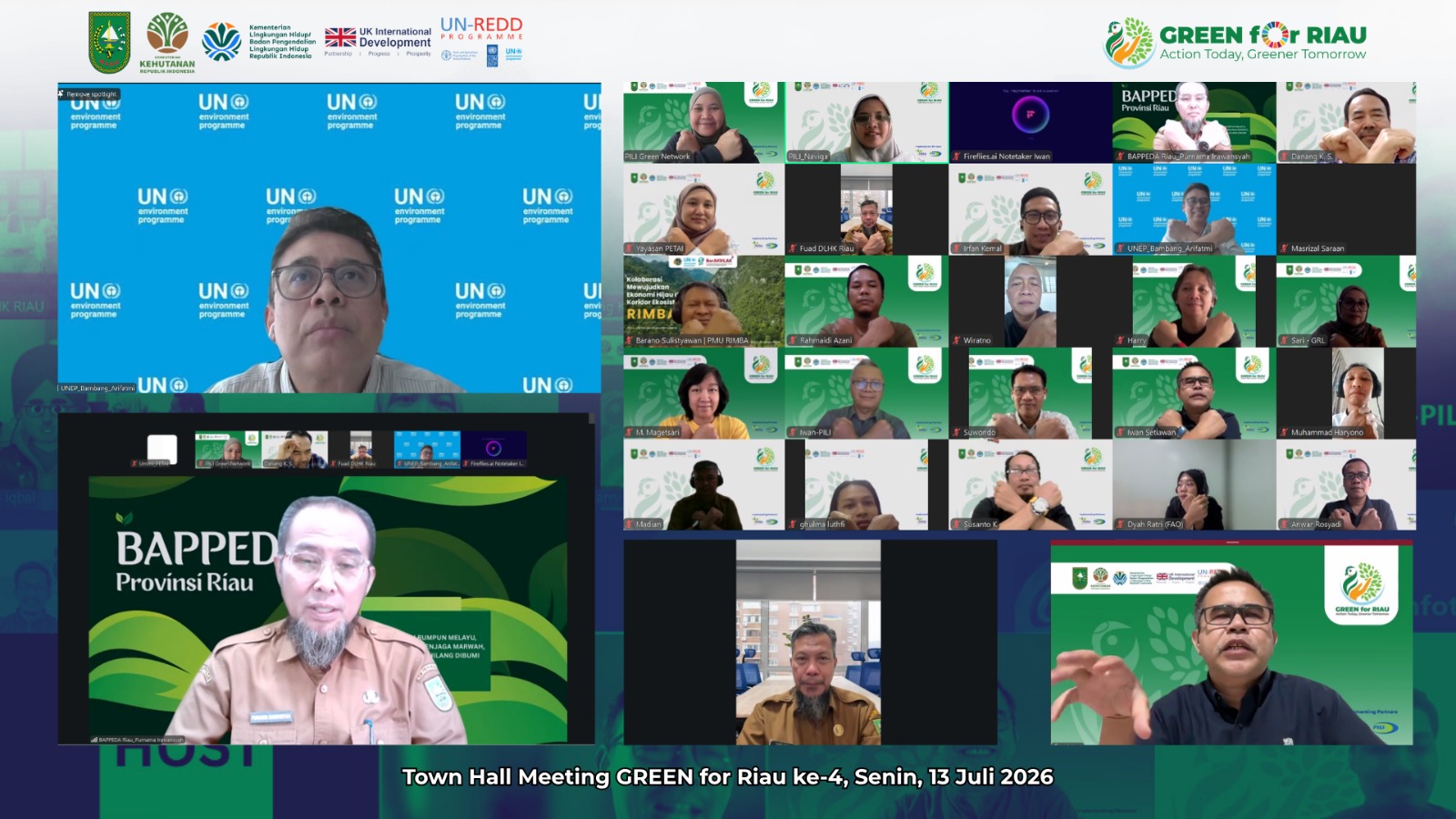
Pekanbaru, 13 July 2026 — The GREEN for Riau Initiative held its 4th Town Hall Meeting on Monday, 13 July 2026, in an online format. The meeting served as a forum for communication, evaluation, integration, and coordination to align progress across various program components, while strengthening stakeholder synergy in support of a credible, transparent, and sustainable jurisdictional carbon scheme in Riau Province.
The meeting was attended by representatives of the Regional Development Planning Agency (Bappeda) of Riau Province, the Environment and Forestry Agency (DLHK) of Riau Province, UNEP, FAO, implementing organizations, GREEN for Riau experts, implementing partners Yayasan PILI and PETAI, as well as several development and program partners, including the RIMBA Corridor Project, M4CR, Proforest, Penabulu, Yakopi, and other partners.
Bambang Arifatmi, Ph.D., Country Coordinator of the UNEP UN-REDD Programme Indonesia, in his opening remarks expressed appreciation for the commitment of all partners and the GREEN for Riau team, who continue to work together in addressing various issues and challenges in program implementation. He emphasized that collaboration, integrity, and the spirit of continuous innovation are key to achieving program targets while supporting low-emission development in Riau Province.
“The challenges faced by GREEN for Riau are not easy. However, I believe that with a spirit of togetherness, collective action, and strong commitment, we can continue to deliver the best achievements for GREEN for Riau and the people of Riau Province,” he said.
Representing DLHK Riau Province, Muhammad Fuad expressed appreciation for the continued collaboration between the Provincial Government of Riau, technical experts, and all partners in supporting the implementation of GREEN for Riau. He emphasized that program success is not only measured by final outcomes, but also by consistency in implementation and the quality of documents that serve as the foundation for policy implementation and decision-making.
“The success of GREEN for Riau is not only determined by the final results, but also by consistency in implementation and the quality of documents that form the basis of policy. Good documents must reflect real conditions on the ground so that implementation can be well targeted,” he said.
The Head of Bappeda Riau Province, Purnama Irawansyah, S.Hut., M.M., stated that cross-sector collaboration is an important factor in accelerating the implementation of the GREEN for Riau Initiative. According to him, synergy among local government, development partners, experts, and stakeholders is needed to ensure that each stage of the program proceeds according to plan, while strengthening low-emission development and sustainable environmental management in Riau Province.
“Collaboration and commitment from all parties are key to ensuring that GREEN for Riau targets can be achieved according to the agreed timeline. Introducing program progress to various stakeholders is also important to build shared understanding and strengthen support for GREEN for Riau implementation,” he said.
Synergy with the RIMBA Corridor Project
During the sharing session with the RIMBA Corridor Project, Barano Siswa Sulistyawan, Team Leader of the RIMBA Corridor Program, presented the achievements and implementation direction of the RIMBA Program. He also highlighted potential synergies with the GREEN for Riau Initiative in strengthening area governance, biodiversity protection, and sustainable green economic development.
The synergy between GREEN for Riau and the RIMBA Corridor Project is considered important because both initiatives share common objectives in strengthening landscape management, maintaining ecosystem connectivity, protecting biodiversity, and promoting more sustainable regional development.
Riau’s REDD+ STRADA Enters Final Consolidation Stage
Prof. Dr. Suwondo, Mitigation Action Plan (MAP) Expert, presented the progress of the Riau Province REDD+ Regional Strategy and Action Plan (STRADA REDD+).
“The preparation of the Riau Province REDD+ STRADA has entered the final consolidation stage. Following the document refinement process, the next steps will include national consultation and technical assistance, as well as public consultation as part of the endorsement process for the Riau Province REDD+ STRADA through a Governor’s Decree,” he stated.
STRADA REDD+ is one of the key instruments in Riau’s REDD+ architecture, as it serves as a roadmap for implementing mitigation actions at the regional level. The document is expected to serve as a reference for various stakeholders in aligning programs, policies, financing, and activities at the field level.
Strengthening Safeguards and PADIATAPA
Meanwhile, Irfan Kemal Putra, Safeguards Expert, reported that the Stakeholder Engagement Plan and PADIATAPA Guidelines have entered the final refinement stage after undergoing several review processes.
Both documents will proceed to public consultation before finalization and capacity strengthening for PADIATAPA implementers in Riau Province. This process is an important step to ensure that REDD+ implementation is inclusive, transparent, and respectful of the rights of Indigenous Peoples and local communities.
Progress on REDD+ Technical and Institutional Components
During the meeting, GREEN for Riau Initiative experts also presented progress on various program components, including the preparation of the Forest Reference Emission Level (FREL), Measurement, Reporting, and Verification (MRV), institutional strengthening, data governance and management, nesting, Benefit Sharing Mechanism (BSM), budget tagging, grievance redress mechanism, respect for human rights, and recognition of Indigenous Peoples.
These achievements reflect significant progress in building the technical, institutional, and social foundations needed to support credible, transparent, and high-integrity Jurisdictional REDD+ (JREDD+) implementation in Riau Province.
Strengthening these technical and institutional components is a key prerequisite for Riau Province to establish a REDD+ architecture that is aligned with national and international standards, while remaining relevant to regional needs and communities at the field level.
Strategic Follow-Up Agenda
The 4th Town Hall Meeting produced several important and strategic follow-up agendas that will become the focus of program implementation in the near term. These include accelerating national consultations with the Ministry of Forestry, refining various technical documents related to the REDD+ architecture, conducting public consultations, strengthening coordination among experts, and preparing for the visit of UK-FCDO development partners scheduled for late July 2026.
The meeting also emphasized the importance of maintaining consistency in program implementation, strengthening coordination across components, and ensuring that each instrument being developed is connected within a comprehensive jurisdictional REDD+ implementation framework.
The success of the GREEN for Riau Initiative depends not only on technical achievements, but also on shared commitment to building strong collaboration and trust, maintaining openness, strengthening the leadership of the Riau Provincial Government, and fostering a sense of ownership among all stakeholders.
Through sustained synergy, the full range of GREEN for Riau activities is expected to support sustainable forest and land governance, high-integrity greenhouse gas emission reductions, improved community welfare, biodiversity protection, and the acceleration of green economic development in Riau Province.