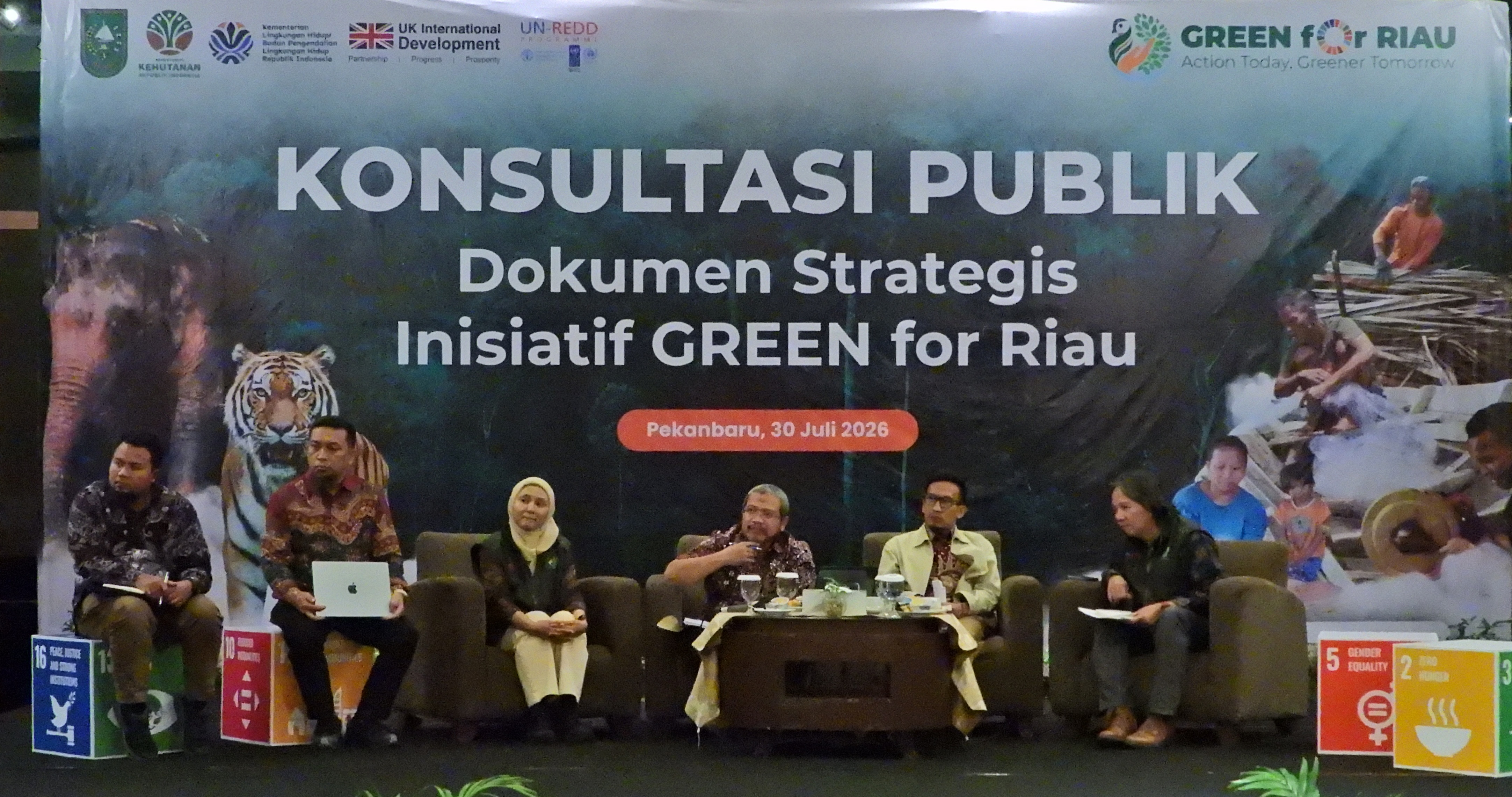
Pekanbaru, 30 July 2026 — The Riau Provincial Government, through the GREEN for Riau Initiative, held a Public Consultation on GREEN for Riau Strategic Documents in a hybrid format at Hotel Pangeran, Pekanbaru, on Thursday, 30 July 2026.
This public consultation forum marked an important part of Riau Province’s readiness to implement jurisdictional REDD+ by strengthening governance that is inclusive, participatory, transparent, and equitable.
The consultation brought together national and regional government representatives, vertical agencies, district and municipal governments, universities, Malay customary institutions and Indigenous Peoples, civil society organizations, religious organizations, women’s groups and vulnerable groups, social forestry groups, the private sector, development partners, and the media.
Participants shared opinions, corrections, and recommendations to refine the strategic documents that will serve as the foundation for REDD+ implementation in Riau.
The public consultation was attended by more than 270 participants, both in person and online, consisting of 206 men and 68 women. The livestream on YouTube also received 127 views.
Women’s representation, which reached around one quarter of participants, served as an important note for further strengthening meaningful participation of women, vulnerable groups, persons with disabilities, Indigenous Peoples, and local communities in the next stages.
Women and Indigenous Peoples were not merely present; they actively raised questions, shared opinions, and provided inputs. Participation is not only measured by attendance numbers, but also by the space given to express views, influence decisions, and receive program benefits fairly.

Policy Direction and Stakeholder Support
Prof. Dr. Haruni Krisnawati, S.Hut., M.Si., Senior Advisor to the Minister of Forestry for Climate Change, emphasized that Riau holds a strategic position in the sustainable development agenda because it has tropical forests, peatlands, mangroves, and high conservation value ecosystems with significant carbon stocks.
Riau is also one of Indonesia’s national economic growth centers, making its success in balancing economic development and environmental conservation a major contribution to Indonesia’s climate targets.
“What is being developed and prepared is not merely a set of documents, but an architecture that will serve as the foundation for REDD+ governance in Riau Province,” said Prof. Haruni.
She emphasized that all strategies, institutions, safeguards, participation mechanisms, benefit sharing, and grievance redress mechanisms need to be integrated with the national system.
This alignment is important to strengthen REDD+ implementation while opening opportunities for Riau to access results-based payments, climate finance, carbon trading, and other green innovations.
Erfa Canisthya, Climate Change Policy Officer at the British Embassy in Indonesia, conveyed the UK Government’s support for Indonesia’s FOLU Net Sink 2030 agenda through GREEN for Riau.
According to her, the progress of this green initiative reflects the strengthening commitment of the region and the increasingly broad involvement of stakeholders in preparing for jurisdictional REDD+ implementation.
“The more diverse perspectives we listen to, the stronger these documents will become as a foundation for future implementation,” said Erfa.
She added that the success of GREEN for Riau should not only be measured by emission reductions, but also by how far marginalized communities are involved, benefits are distributed fairly, and trust among stakeholders is built.
Bambang Arifatmi, Country Coordinator of the UNEP UN-REDD Programme in Indonesia, stated that GREEN for Riau is expected to contribute to regional, national, and global climate targets while helping address Riau Province’s climate financing gap.
During the forum, the financing needs to achieve Riau Province’s FOLU Net Sink 2030 target were estimated at IDR 11.3 trillion.
“This public consultation is not merely a forum for discussion, but a starting point to move forward together,” said Bambang.
He emphasized that deforestation and forest degradation affect not only the environment, but also the economy, food security, water availability, public health, biodiversity, and the future of the next generation.
Therefore, government, the private sector, civil society, academia, and communities need to move together through collective action and develop a development approach that creates synergy between the economy and the environment as a positive-sum game.
The Regional Secretary of Riau Province, represented on this occasion by Purnama Irawansyah, S.Hut., M.M., Head of Bappeda Riau Province, reaffirmed the regional government’s commitment to ensuring that forest protection and emission reductions go hand in hand with real and sustainable benefits for communities.
The Riau Provincial Government is also exploring opportunities for carbon financing through a jurisdictional approach, including the idea of managing part of the proceeds as an environmental endowment fund to support forest protection, ecosystem restoration, community empowerment, and green development.

Seven Strategic Documents for REDD+ Governance
The public consultation discussed seven complementary documents: the Regional Strategy (STRADA) REDD+ Riau Province, Stakeholder Engagement Plan (SEP), Free, Prior and Informed Consent Guidelines (FPIC/PADIATAPA), Feedback and Grievance Redress Mechanism (FGRM) tools, Gender Action Plan, benefit-sharing mechanism guidelines, and a document on the engagement of Indigenous Peoples and local communities.
These documents were developed through studies, internal reviews, discussions at subnational, national, and global levels, as well as consultations with various stakeholder groups. Their preparation was supported by around 22 experts at the Riau, national, and international levels.
Danang Kabul Sukresno, Provincial Lead of the GREEN for Riau Initiative, explained that the initiative is built on three main pillars: emission reductions, community empowerment, and ecosystem restoration.
Substantively, STRADA REDD+ will serve as the policy direction and action plan for emission reductions in the land-based sector. The stakeholder engagement and PADIATAPA documents ensure information disclosure and participation free from coercion.
The Gender Action Plan strengthens gender equality, disability, and social inclusion, while the FGRM provides a traceable and accountable grievance-handling system.
The benefit-sharing mechanism is directed toward ensuring that economic and non-economic benefits are distributed transparently, fairly, and proportionally. Meanwhile, the Indigenous Peoples and local communities document positions them as rights holders and key actors in forest management.

Public Inputs Strengthen the Substance
During the plenary session, participants provided inputs on accelerating the recognition of Indigenous Peoples and customary territories, clarifying community identification, protecting biodiversity and wildlife corridors, improving the quality of PADIATAPA implementation, ensuring fairness in benefit sharing, and strengthening the independence of the grievance mechanism.
Participants also requested that materials on REDD+, carbon, safeguards, and GREEN for Riau be communicated in simpler language and reach communities at the village and site levels.
Other inputs emphasized that women’s representation should not stop at numerical targets. Participation indicators need to measure the ability of women, persons with disabilities, and vulnerable groups to express their views safely, influence decisions, exercise leadership, and receive benefits.
The program was also encouraged to provide affirmative and exponential approaches, while considering the risks of gender-based violence and accessibility needs.
The drafting team stated that all inputs will be documented and reviewed as materials for cross-document refinement.
Indicative data on Indigenous Peoples, benefit-sharing mechanisms, wildlife protection, alternative livelihoods, FGRM independence, site-level communication strengthening, and inter-agency coordination will be further developed in the next stages.
Participants may continue to submit written questions and inputs through a Google Form and GREEN for Riau’s official channels for 14 days after the public consultation.
The consultation results are expected to produce high-quality and implementable documents, gain legitimacy from stakeholders, and serve as a reference for jurisdictional REDD+ implementation in Riau Province, as well as a good practice example for other provinces in Indonesia.

The Public Consultation Document can be accessed at KMC GREEN for Riau(https://green4riau.id/kmc/konsultasi-publik-dokumen-strategis-green-for-riau).
Document status: The documents in this collection are not final documents. All documents are still in draft status and were prepared as material for the GREEN for Riau Strategic Document Public Consultation. The document's substance will be further refined based on input, corrections, and recommendations obtained from the public consultation process and further review by the drafting team.
Feedback and Questions Form (https://docs.google.com/forms/d/e/1FAIpQLSe4CQoldIIfb0wt8HazrrICYaDiK2GS_BOy4h1ir7rXN9HyGA/viewform)
This form is used to collect responses, questions, corrections, and recommendations on the seven strategic documents of the GREEN for Riau Initiative. Input is expected to support the improvement of these documents so that they align with safeguard policies and principles, have a clear implementation process, are applicable, and meet the principles of inclusivity, meaningful participation, transparency, and fairness. Respondents can provide input on one or more documents. Please complete the relevant sections and skip the remaining sections.